Budget Agent
Where your next dollar should go: right now, and next quarter.
A weekly reallocation list. A real quarterly plan. Confidence intervals on both.
So you know how big a bet to make, and what outcomes you can bet on.
01
A weekly reallocation list ranked by lift you'd actually capture.
Most budget tools rank channels by ROAS or last‑click. The Budget Agent ranks them by incremental lift, the conversions that won't happen without your spend.
"Move $X from Meta retention to TikTok prospecting" with a confidence interval, an expected lift, and the reason behind the call.
The Monday list isn't a dashboard; it's a decision queue, sorted from biggest delta to smallest.
02
A next‑quarter plan built on response curves, not last year's spreadsheet.
The same model that recommends this week's reallocations powers the planning view. You set a budget envelope and a business target; the agent simulates allocations across your live response curves and historical context patterns.
"What if I cut LinkedIn 30%?" answered against your data, not last year's flat‑percentage logic.
It surfaces the saturation points per channel and produces a quarterly plan with scenario branches.
03
A weekly reallocation list ranked by lift you'd actually capture.
The agent tells you when it's certain enough to bet big and when it's only certain enough to test. Most teams have never been told what their model doesn't know; this is the first thing the BlueAlpha Budget Agent tells them, empowering confident action.
"Move $X from Meta retention to TikTok prospecting" with a confidence interval, an expected lift, and the reason behind the call.
Every recommendation comes with the range.
What it looks like Monday morning.
Reallocation queue · this week
01
Move $50K from Meta retention to TikTok prospecting
Causal MMM contribution +37% last cycle · saturation reached on Meta retention
+$165K
$120K – $210K · 82%
02
Cut LinkedIn brand by 30%, reallocate to YouTube bumpers
Past saturation on LinkedIn · YouTube response curve still steep
+$92K
$70K – $118K · 78%
03
Hold Google Search Brand at current pacing
Within optimal range · no incremental gain from raise or cut
±$0
no action · 91%
04
Test Reddit at $25K, 2 weeks
Wide CI · agent recommends test before scale-up
Test
CI too wide to scale · 41%
5 recommendations · 80% confidence threshold
The reason it works
Last‑click attribution
Gives Meta retention the credit because it touched the buyer last.
Ignores every channel that built the demand.
Result: you over‑fund the bottom of the funnel and starve the channels building it.
Multi‑touch attribution
Splits credit across touchpoints with a model, usually one the platforms also influenced.
Sounds balanced. Inherits the platforms' bias.
Result: a story that sounds balanced but inherits the platforms' bias.
Causal MMM + incrementality
Estimates what would have happened without each channel and tests the model against geo holdouts.
Confidence intervals on every claim.
Result: a recommendation grounded in what actually moved the needle, with confidence intervals on every claim.
MCP‑native
Just ask.
What's the highest‑confidence reallocation I could approve before EOD?
If I had to cut $200K out of next quarter, where would the lift loss be smallest?
Show me every channel that's past the saturation point this month.
Why did the model move money out of Meta retention last week?
What does next quarter look like if Q3 seasonality matches last year?
From day one to first decision
What your first week looks like.
The agent goes live on Monday. By Friday, you've got a weekly reallocation rhythm and a draft next‑quarter plan on the table.
Monday
First calibration
The agent ingests 18 months of spend, conversions, and platform data; pulls in any existing incrementality reads; and fits the response curves channel by channel. By end of day, the team sees the first recommendation queue, sorted by expected lift.
Tuesday
First structural finding
The agent surfaces the saturation points across your channels. On most accounts, at least one channel is past saturation (every dollar is buying a fraction of the lift the previous one bought) and at least one is starved (the next dollar would buy disproportionately more). That's a one‑time policy correction worth a meaningful share of the weekly budget.
Wed - Fri
The loop runs
Approved reallocations go through the Execution Agent. Rejected recommendations come back with a reason and update the priors. By end of the first week, you have a weekly reallocation rhythm, a calibrated model, and a draft plan for next quarter that runs against your live response curves rather than last year's flat percentages.
For the technical reviewer
One agent in a system of six
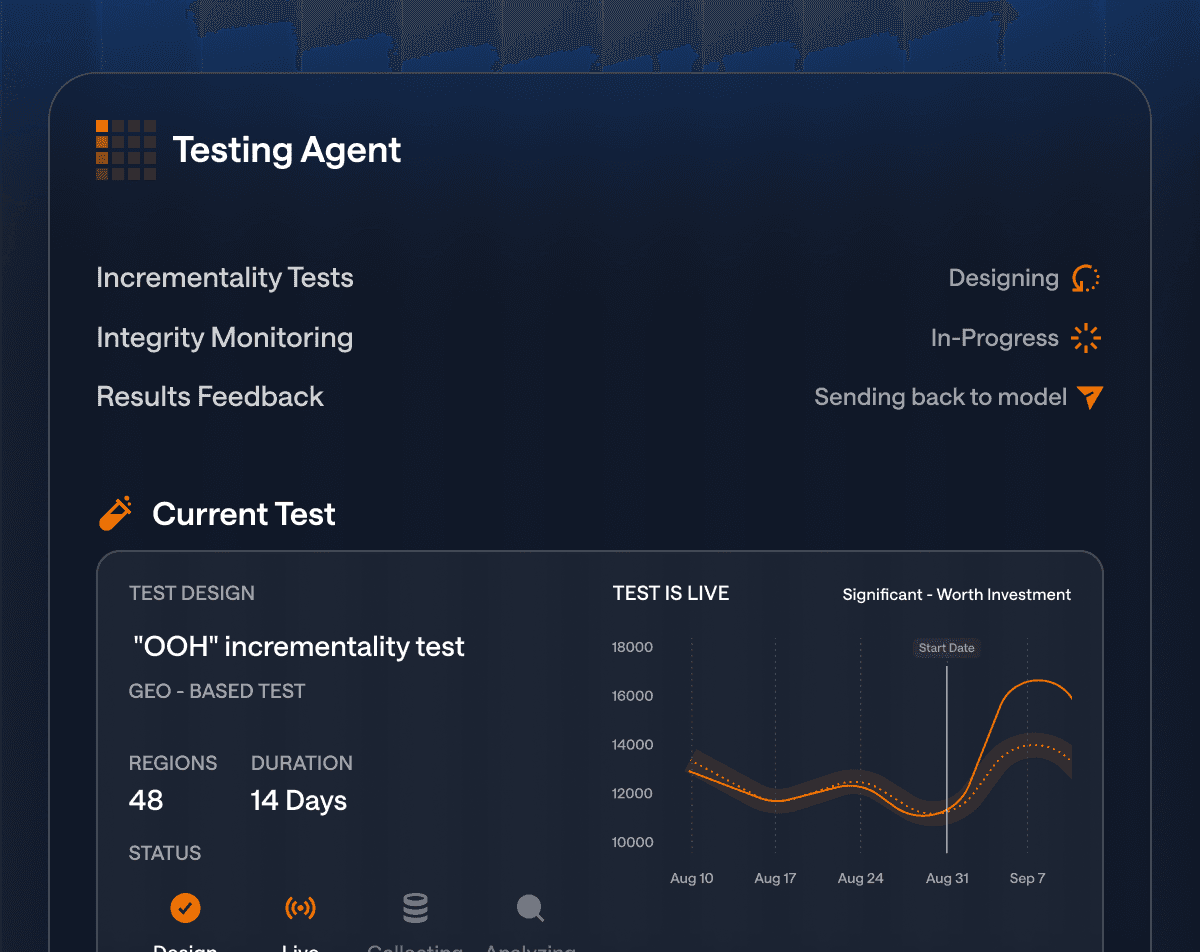
Testing Agent
Incrementality posteriors update the Budget Agent's priors. The test that would shrink the biggest uncertainty next gets queued.
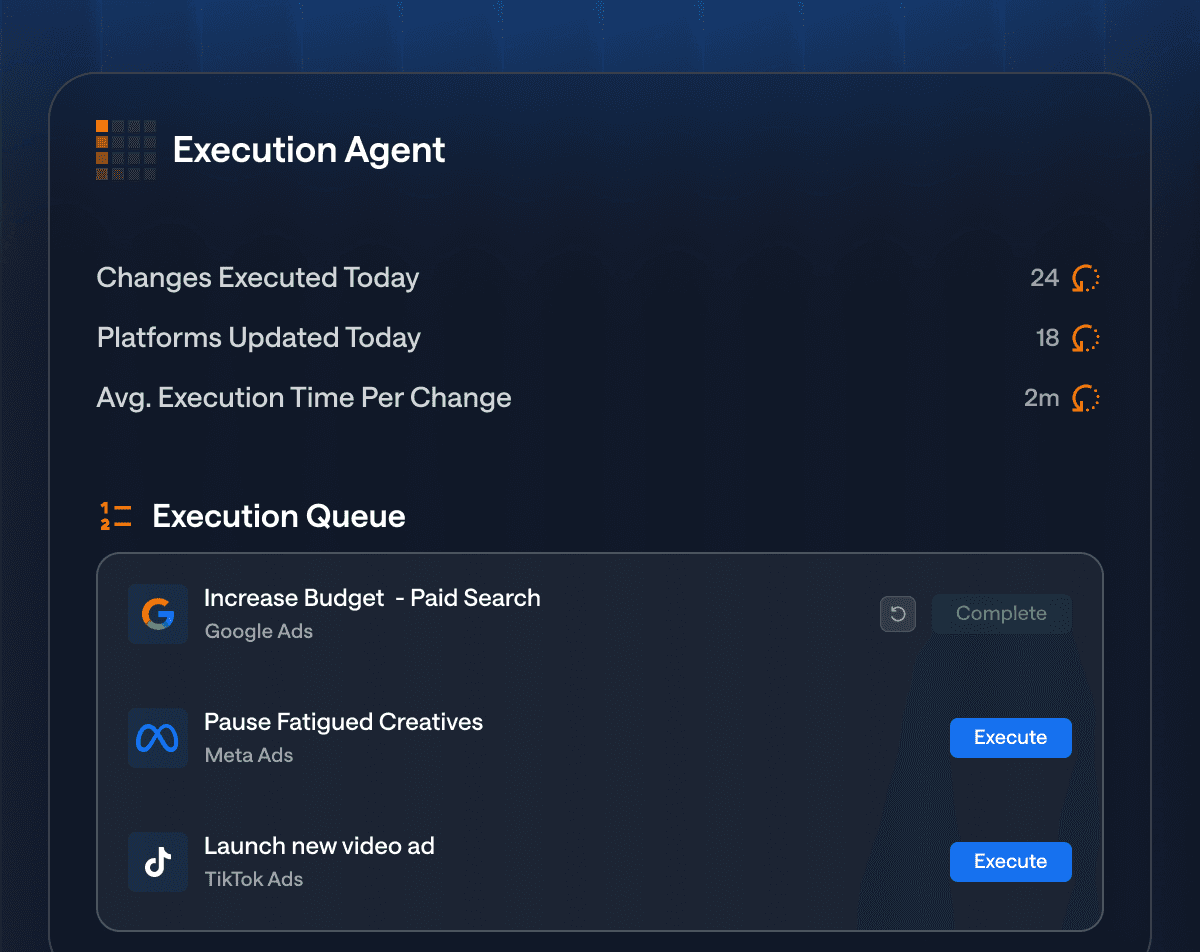
Execution Agent
Approved reallocations get pushed on‑platform with a full audit trail. Reversible, traceable, logged.
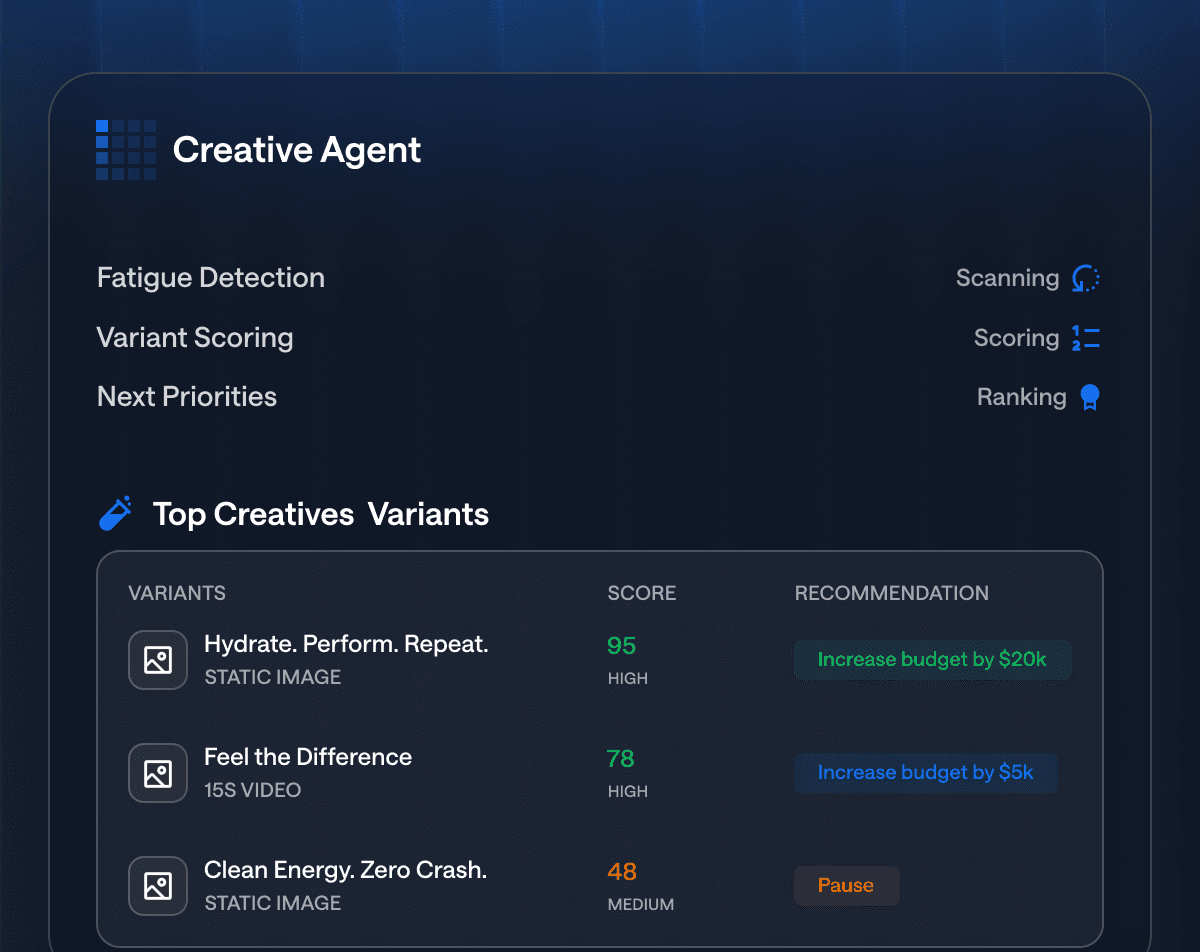
Creative Agent
When creative fatigue is flagged, the Budget Agent re‑scores the affected campaigns immediately.
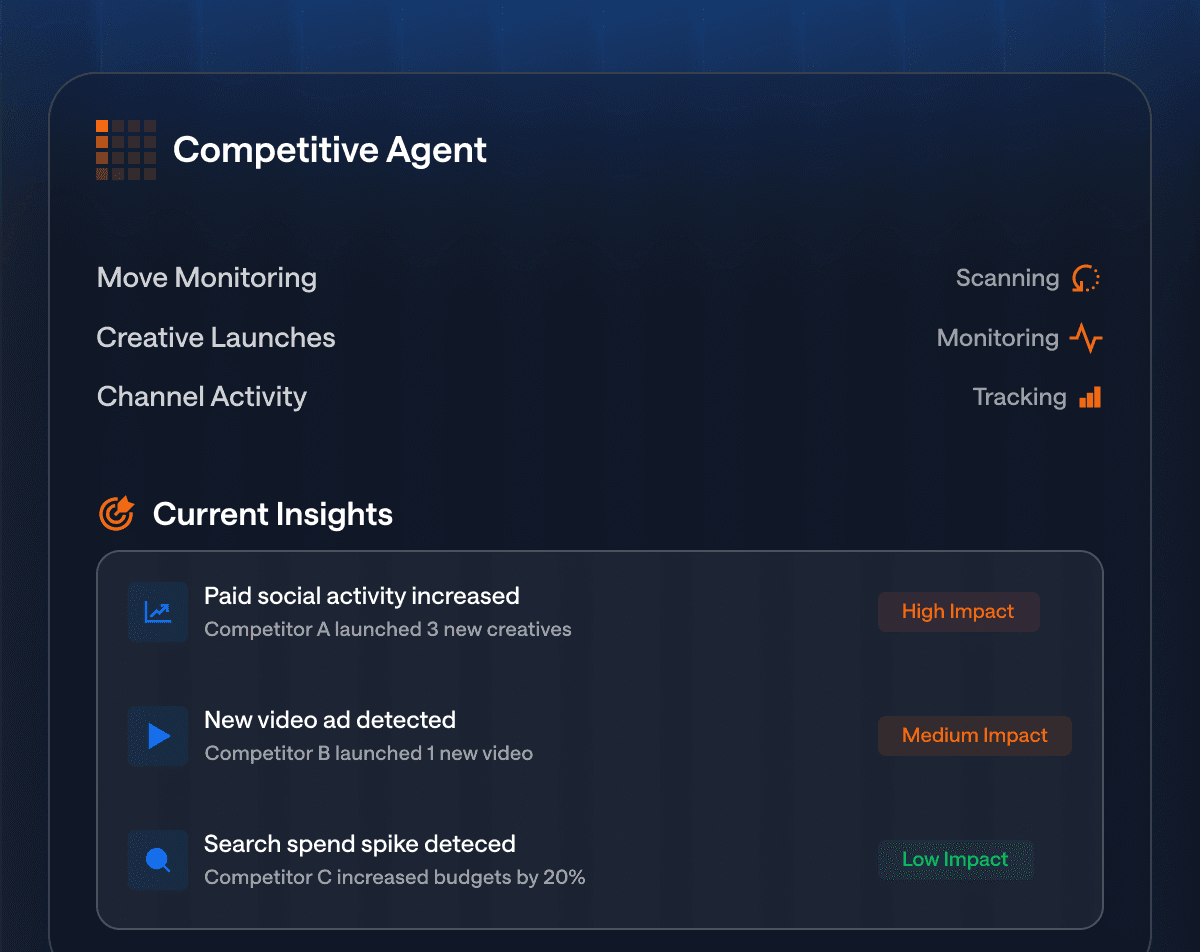
Competitive Agent
New channel test recommendations get priced against your response curves before the test ships.
What teams ask us first.
Don't I already get this from my MMM vendor?
How is this different from a media-mix optimizer inside an ads platform?
What if my model is wrong?
How do you handle seasonality and macro shifts?
Can the agent move money automatically?
Where does the planning view fit?