Matthias Stepancich
The Best Customer Segmentation Software for Retail Brands
Discover top customer segmentation tools for retail brands to optimize targeting, increase marketing precision, and drive sustainable growth.
Channels
Measurement
Marketing Mix Modeling


For small and mid-sized retail businesses, precision matters. Every customer interaction should be strategic, ensuring that marketing efforts drive maximum impact without wasted spend. The right customer segmentation software makes this possible, by offering data-driven insights, streamlined targeting, and actionable strategies in one intuitive platform.
Why Customer Segmentation Matters for Retail Brands
Targeted Marketing with Maximum ROI
With limited budgets, retail SMBs can’t afford broad, unfocused campaigns. Effective segmentation divides your audience based especially on purchasing behavior and engagement trends. This allows you to focus on high-value segments (repeat buyers, high spenders, and at-risk customers), driving better conversion rates and revenue, resulting in a higher iROI (incremental ROI).
Personalization That Drives Loyalty
Generic messaging no longer works. Today’s customers expect relevant, tailored experiences. Segmentation empowers you to craft messaging that resonates with each audience, improving customer satisfaction, retention, and advocacy.
Scalability Without Complexity
As your business scales, so does your data. But growth companies don’t need bloated, overly complex solutions. The right software pinpoints the most impactful segments without overwhelming you, delivers a streamlined approach, and ensures you focus on what truly moves the needle.
Customer Segmentation Tools Can Be Complex
At its core, segmentation is about grouping customers into meaningful categories based on data. Key segmentation models include:
Behavioral Segmentation – Analyzes customer interactions, such as purchase frequency, browsing habits, and engagement with marketing content.
Demographic Segmentation – Groups customers by age, gender, income, and education level.
Geographic Segmentation – Targets audiences based on city, region, or country.
Psychographic Segmentation – Focuses on values, interests, and lifestyle preferences.
Needs- or Value-Based Segmentation – Identifies customers by lifetime value or key pain points.
For retail SMBs, the goal isn’t to collect endless segments, it’s to identify and act on those that drive profit. The best segmentation tools cut through the noise, offering clarity and precision.
Key Features to Look For
User-Friendly Interface
Why It Matters: retail SMB teams juggle multiple roles. A clean, intuitive dashboard saves time and simplifies segmentation.
Robust Data Integrations
Why It Matters: You need seamless access to data from eCommerce platforms, CRMs, email marketing tools, and social media ads.
Advanced Segmentation Options
Why It Matters: Going beyond basic demographics allows for smarter targeting. Segmentation based on RFM (Recency, Frequency, Monetary), and LTV (LifeTime Value, e.g. multi-purchasers vs. single-purchasers) can improve precision.
Automation & Personalization
Why It Matters: Automated workflows deliver the right recommendation at the right time, without manual effort.
Scalability & Flexible Pricing
Why It Matters: As your company grows, your segmentation needs will evolve. Select a solution that fits your budget today but can handle larger datasets and expanded segmentation in the future.
The ideal segmentation platform for growth-stage companies should:
Offer clear, actionable insights, with no data overload.
Be user-friendly, enabling quick implementation.
Automate segmentation using AI to improve accuracy.
Provide built-in analytics to measure impact.
Comparison Table: Top Customer Segmentation Software Solutions for SMBs
The table below compares several popular customer segmentation solutions, highlighting their key strengths and limitations, and assigning a final grade from 1 to 5 based on their suitability for retail SMBs.
Brand | Key Strengths | Limitations | Final Grade |
|---|---|---|---|
BlueAlpha | Tailored for SMBs with only the essential, high-impact segmentation features | May lack some advanced enterprise features commonly found in software platforms for very large organizations | 5 |
Contentsquare | Comprehensive digital experience insights with rich visualization and multi-channel integrations | Overly complex for SMBs who don't need all advanced features | 4.5 |
HubSpot | Integrated CRM with robust list segmentation and marketing automation | Segmentation features are less specialized compared to dedicated tools | 4 |
Hotjar | Combines qualitative and quantitative insights (surveys, heatmaps, session recordings) | Lacks some advanced segmentation options and scalability for larger data sets | 4 |
Heap | Automatic event tracking with a low-code platform | Data overload can occur; may require additional technical expertise to manage effectively | 4 |
Mixpanel | Provides detailed product analytics with customizable behavioral segmentation | Steeper learning curve and pricing may be less SMB-friendly | 3.5 |
Qualtrics XM | Advanced experience management with robust, AI-powered feedback segmentation | Higher cost and complexity that might exceed SMB requirements | 3.5 |
Monetate | Strong in personalization and A/B testing with real-time segmentation for conversion optimization | Focused mainly on eCommerce; less depth in broader segmentation approaches | 3 |
GA4 (Google Analytics) | Widely used with a free version available | Sampling limitations and basic dashboards make it less precise for in-depth segmentation | 3 |
Comparison Table: Top Customer Segmentation Software Solutions for SMBs
Smarter Segmentation, Greater Impact
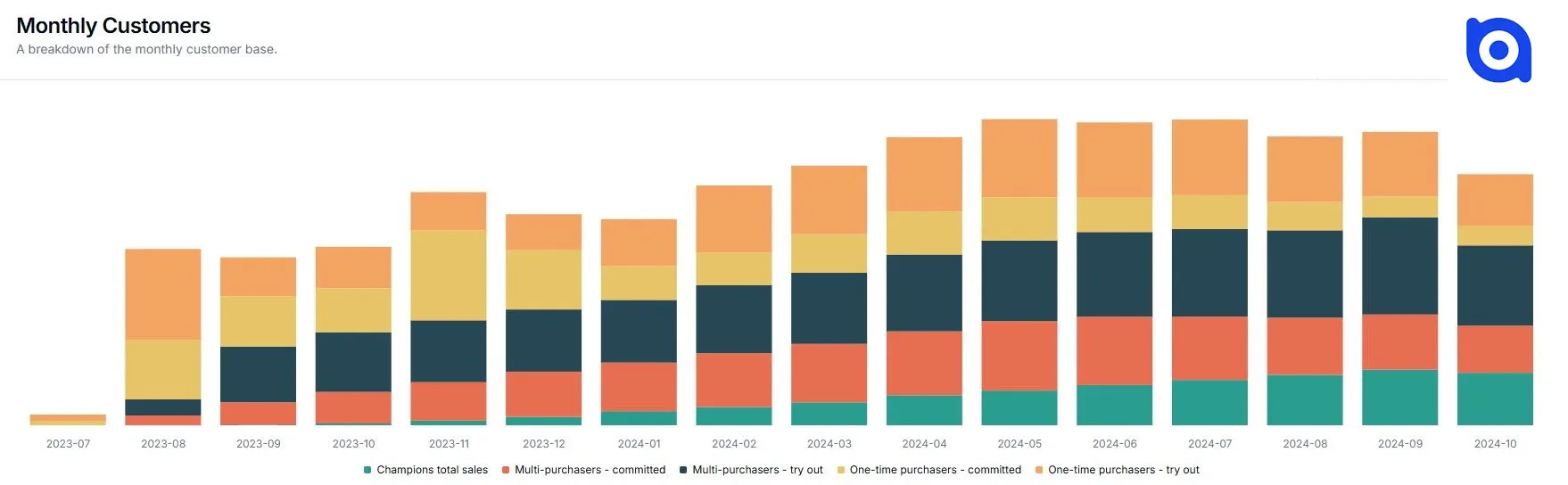
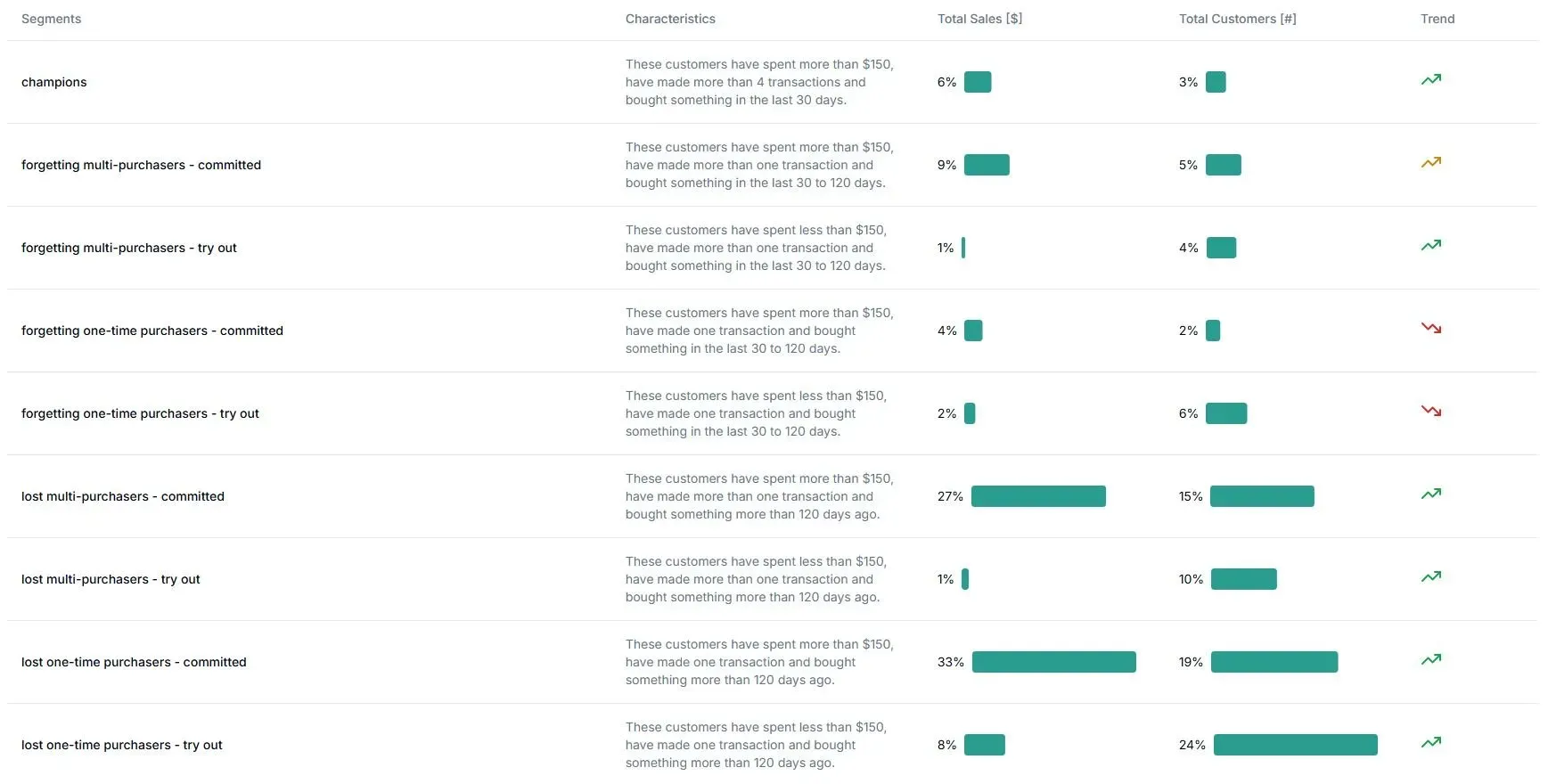
For retail SMBs, customer segmentation should be insightful, not overwhelming. BlueAlpha’s Customer Optimizer is designed for simplicity, delivering clear, actionable customer categories that drive real business growth. By analyzing historical purchase behavior and engagement trends, BlueAlpha automatically segments customers into high-impact groups:
Champions – High-value customers who have spent over a certain amount, made more than a certain number of transactions, and purchased in the last 30 days. These loyal advocates are primed for exclusive offers and VIP engagement.
Forgetting Multi-Purchasers: Committed vs. Try Out – Customers with repeat purchases in the last 30-120 days, differentiated by spending behavior.
Forgetting One-Time Purchasers: Committed vs. Try Out – Customers who have made a single purchase, segmented by spending power and recency.
Lost Multi- and One-Time Purchasers – Customers inactive for over 120 days, prioritized based on past spending to inform re-engagement efforts.
Recent Multi- and One-Time Purchasers – Buyers who made a purchase in the last 30 days, ready for personalized follow-up campaigns.
By focusing on key behavioral patterns, BlueAlpha eliminates unnecessary complexity, providing SMBs with insights that directly impact revenue.
Integrated, Automated, and Actionable
Seamless Data Integration
BlueAlpha connects effortlessly with eCommerce platforms, CRMs, and the other marketing tools used by retail businesses, to create a unified customer view. Real-time dashboards and intuitive reports give you instant visibility into segment performance and marketing ROI.
Automated Workflows for Precision Marketing
Once segmented, customers can be automatically enrolled in targeted campaigns. Whether through personalized emails, dynamic on-site messaging, or strategic social media ads, BlueAlpha ensures every interaction is timely and relevant, without manual effort.
Incrementality Testing and Media Mix Modeling
Beyond segmentation, BlueAlpha distinguishes itself by offering built-in incrementality testing and media mix modeling. These features empower you to understand the true lift each campaign provides and optimize your media spend across channels. Rather than guessing which channel or tactic is most effective, you can now measure and validate your decisions with precision. Combined with high-value segment identification, they increase the incrementality of your marketing efforts even further.
Best Practices for Implementing Customer Segmentation Software
1. Define Clear Objectives
Before diving into segmentation, establish your goals. Whether you aim to reduce churn, increase repeat purchases, or improve email engagement, clear objectives will guide your strategy. Your segmentation software should help track progress and refine your approach.
2. Ensure Data Accuracy and Consistency
Clean, consolidated data is the foundation of effective segmentation. Eliminate duplicates, standardize data sources, and integrate information from various platforms. A well-structured database enhances segmentation accuracy and marketing effectiveness.
3. Start Broad, Then Refine
Begin with high-impact customer segments such as high-value customers, at-risk buyers, or lapsed customers. As you collect insights, refine these categories further to enhance targeting precision and campaign effectiveness.
4. Continuously Test and Optimize
Customer behaviors evolve, and your segmentation strategy should adapt. Leverage real-time dashboards and testing tools to measure campaign success, identify trends, and iterate based on performance data.
5. Align Teams with Data-Driven Insights
Effective segmentation isn’t just for marketing. It benefits sales, customer support, and product teams as well. Share insights across departments to create a unified, personalized customer experience.
The ideal customer segmentation tool for growth companies should be:
User-Friendly – Simplifies complex segmentation without overwhelming users.
Data-Driven – Offers analytics to track segment performance and optimize campaigns.
Scalable – Grows with your business, adapting to increased data and segmentation needs.
Integrated – Seamlessly connects with your CRM, email marketing, and advertising tools.
A well-implemented segmentation strategy can transform marketing efficiency, customer retention, and revenue growth.
Frequently Asked Questions (FAQ)
Can growth-stage businesses benefit from segmentation software?
Absolutely. Even with a moderate customer database, segmentation reveals critical trends that improve targeting and engagement.
How soon can I see measurable results?
Most businesses notice improvements in conversion rates and engagement within the first few campaign cycles – often in 1-2 months.
Is customer segmentation software expensive?
Pricing varies, but many vendors offer flexible plans that scale with your business needs. Look for transparent pricing and customizable options.
How do I measure segmentation success?
Track metrics like open rates, click-through rates, customer retention, and revenue lift. A/B testing different segment strategies can further optimize results. BlueAlpha’s integrated Media Mix Modeling and incrementality testing features ensure you isolate and measure the true impact of your segmentation efforts, eliminating guesswork and making every marketing dollar count.
Ready to Scale You Retail Brand with Smarter Customer Segmentation?
Don’t let valuable opportunities slip through the cracks. Contact us today or request a demo to see how BlueAlpha can transform your customer data into actionable, revenue-driving insights.