Klover: Millions Saved in 30 Days, 35% Incremental CAC Improvement
Klover cut Meta iOS spend 50% with zero conversion loss, scaled Apple Search Ads 10x, and improved incremental CAC by 35%. Path to 7-figure savings in 30 days.
Incrementality Proven
Wasted Spend Eliminated
Spend Scaled Profitably

“BlueAlpha's platform gave us the confidence to make bold budget cuts we'd been hesitating on. Seeing Meta's diminishing returns validated with data, we reduced spend by 50% without losing conversions. That freed up budget to scale Apple Search Ads where we're seeing real incremental growth.”
“BlueAlpha's platform gave us the confidence to make bold budget cuts we'd been hesitating on. Seeing Meta's diminishing returns validated with data, we reduced spend by 50% without losing conversions. That freed up budget to scale Apple Search Ads where we're seeing real incremental growth.”

Scott Whittemore Growth Analytics Manager @ Attain/Klover
BlueAlpha deployed an always-on Bayesian MMM calibrated with geo-based incrementality tests across Klover's paid media portfolio. Within 30 days, the measurement revealed that Meta iOS had hit diminishing returns at prior spend levels while Apple Search Ads had significant scaling headroom. Klover cut Meta iOS spend by approximately 50% with no measurable loss in conversions, scaled Apple Search Ads by roughly 10x while maintaining incrementality, and improved incremental CAC by 35% across the portfolio.
Klover: Fintech App Spending Millions Post-ATT
Klover is a fintech cash-advance mobile app with a multi-million-dollar monthly paid media budget spread across a dozen-plus channels. The growth team measures acquisition at the point of first cash-advance disbursement, a downstream conversion event that sits well below an install or signup. This lower-volume but higher-signal KPI requires careful statistical treatment.
After iOS privacy changes disrupted platform-reported metrics, the team lost confidence in the numbers their ad platforms were showing. As Scott Whittemore, Growth Analytics Manager at Attain/Klover, put it: "It's all just a black box for app ads. It's different than the e-commerce side." Channel dashboards still looked healthy, but the team could no longer distinguish between users acquired by paid media and users who would have converted organically.
Was Meta iOS Still Incremental at Prior Spend Levels?
Two specific questions framed the engagement with BlueAlpha:
Was Meta iOS still driving incremental conversions at the prior spend level, or had it hit diminishing returns that platform metrics were hiding? And could Apple Search Ads be scaled well beyond prior levels while maintaining incrementality?
The team's urgency came from two directions. Operationally, they were scaling aggressively and needed measurement confidence to match the pace: "We've been putting a lot of stock in the media mix model," John Stavropoulos, Marketing Lead at Attain/Klover, noted at the outset of the scaling phase. Strategically, the finance team had mandated a shift toward acquiring higher-LTV user segments, which meant every dollar of spend needed to justify its contribution more precisely than before.
BlueAlpha's Approach
BlueAlpha executed a four-phase methodology over six weeks.
Phase 1: Rapid integration and baseline MMM (Week 1)
BlueAlpha ingested two years of historical spend and conversion data across all channels and built calibrated response curves using a Bayesian hierarchical MMM with channel-specific adstock and saturation parameters. The model accounted for Klover's weekly pay-period cycle seasonality, which creates natural fluctuation in conversion volume that can mask or amplify channel effects if not modeled explicitly. The initial read indicated diminishing returns on Meta iOS at higher spend levels and untapped headroom on Apple Search Ads.
Phase 2: Incrementality test calibration (Weeks 2-3)
To validate the MMM's directional reads, BlueAlpha designed geo-based holdout tests on Meta iOS and Apple Search Ads. The Meta iOS test held out spend in selected states to measure whether conversions dropped proportionally (indicating incremental contribution) or held steady (indicating the spend was largely non-incremental at that level). The Apple Search Ads test measured whether scaling spend into new volume maintained incremental lift or flattened. Scott articulated the team's own view of this calibration layer: "MMMs work best when there's constant geo-testing in the background to validate the model, and you get the geo lift results, and then you incorporate them in the MMM, and the MMM keeps getting smarter."
Phase 3: Channel-specific optimization (Weeks 3-4)
With test results confirming the MMM's reads, BlueAlpha produced a reallocation plan: reduce Meta iOS spend by approximately 50% and shift the freed budget into Apple Search Ads, which the tests had validated as incremental at higher volume. Apple Search Ads was split into Brand vs. Non-Brand campaigns to preserve efficiency as spend scaled.
Phase 4: Continuous monitoring (Weeks 5-6)
As the reallocation rolled out, BlueAlpha provided weekly readouts comparing realized outcomes to model predictions. The data confirmed stable conversion volume through the Meta reductions and incremental growth from the Apple scale-up.
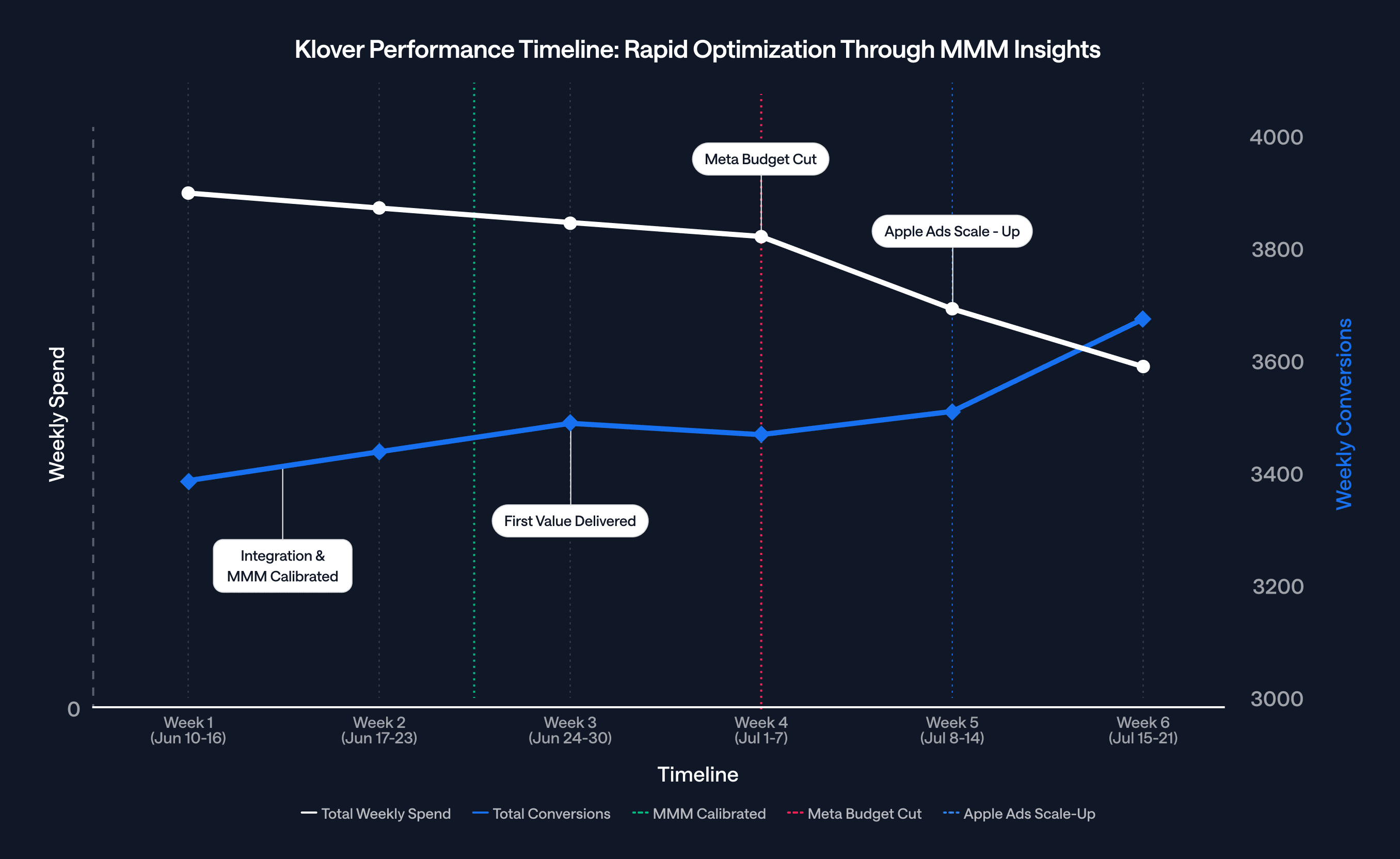
Meta iOS: Diminishing Returns. Apple Search Ads: 10x
Channel | Platform View | Incremental Reality (Measured) | Action Taken |
|---|---|---|---|
Meta iOS | Healthy performance at prior spend level | Diminishing returns confirmed. Significant portion of reported conversions were non-incremental at that spend level | Spend reduced ~50% |
Apple Search Ads | Efficient but running at low volume | Incrementality validated at ~10x scale. Lift maintained as spend increased | Scaled ~10x |
Millions Saved in 30 Days, 35% Better Incremental CAC
Meta iOS:
Spend reduced by approximately 50% with no material decline in weekly conversions. Cost per incremental conversion improved by double digits. On a run-rate basis, the Meta reductions alone point to 7-figure annualized savings.
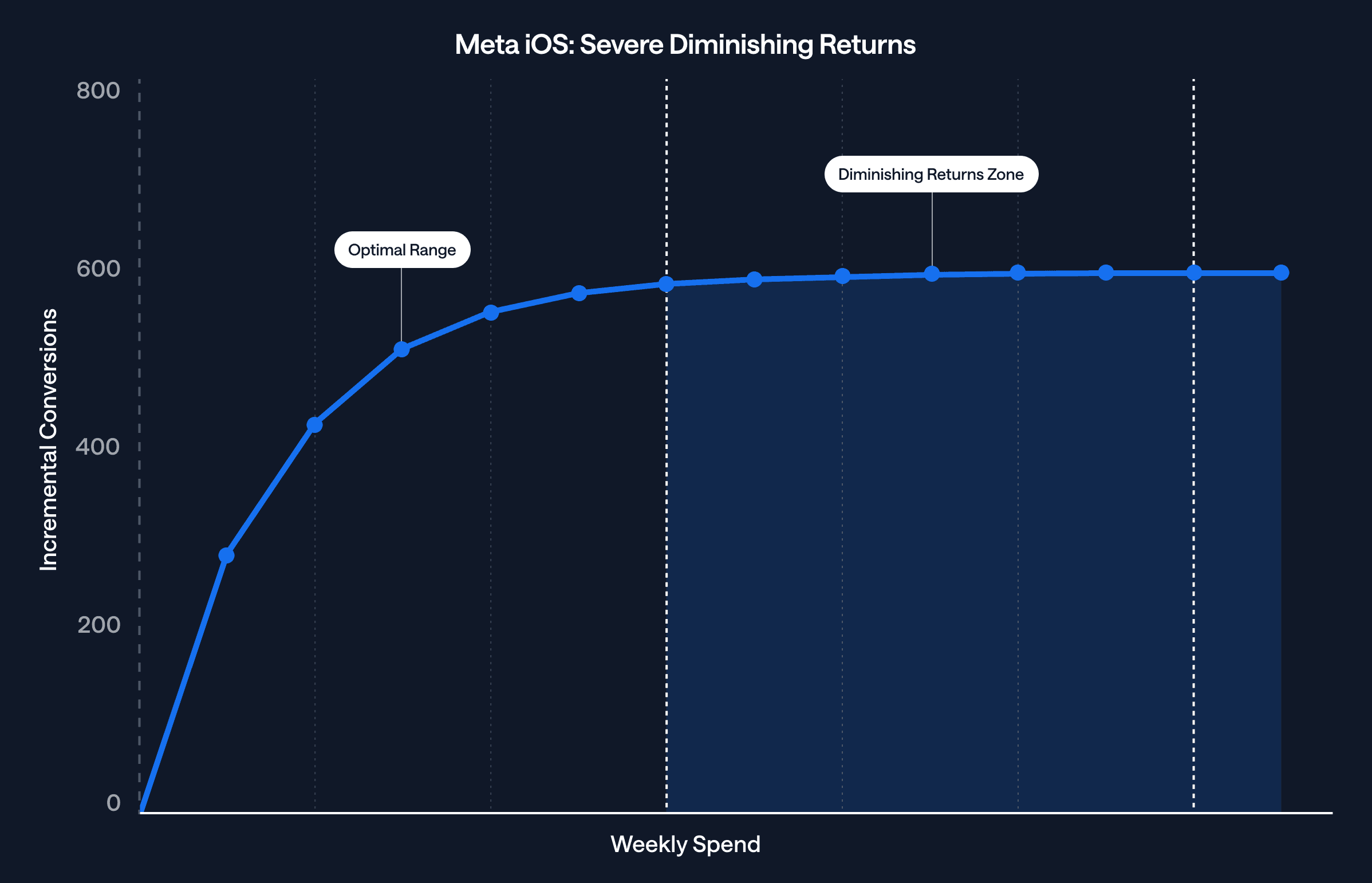
Apple Search Ads:
Scaled by roughly 10x while maintaining positive incremental lift throughout. The Brand vs. Non-Brand split preserved efficiency at higher volumes and gave the team finer-grained control over scaling.
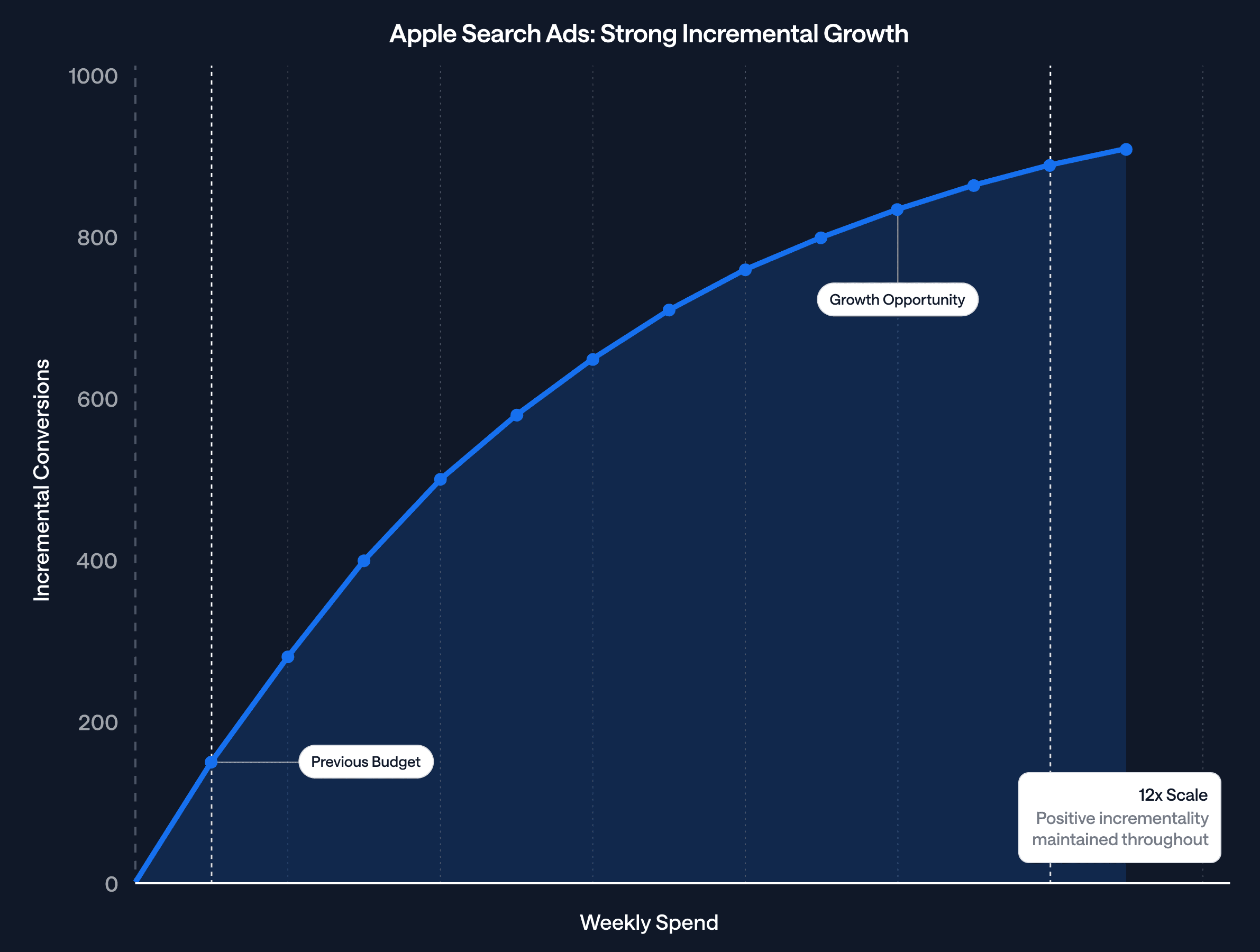
Overall portfolio (pilot window):
Conversions increased by 8% compared with the pre-optimization baseline. Incremental CAC improved by 35% as non-incremental spend was removed and redirected to channels with proven lift. BlueAlpha's investment achieved ROI within the first 14 days.
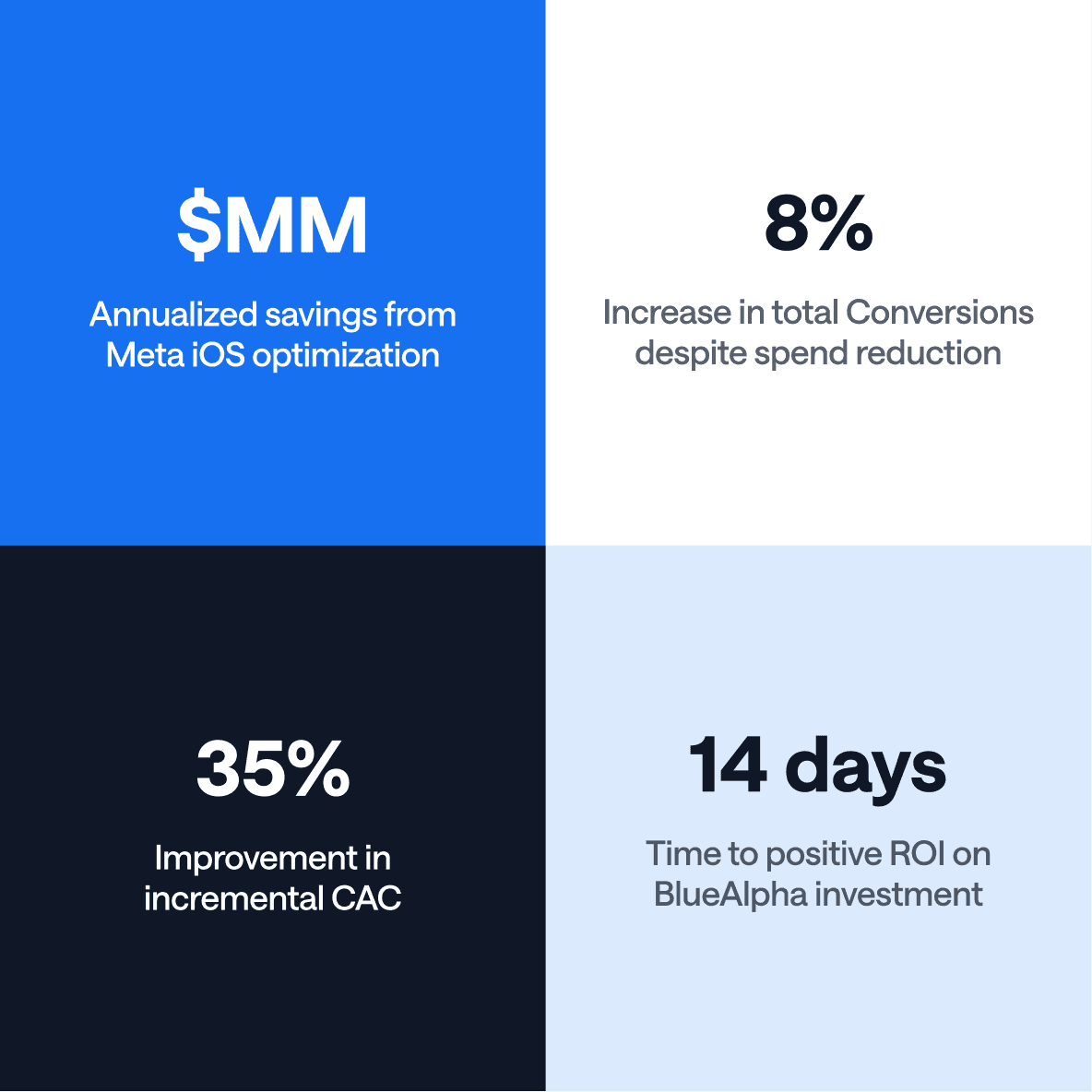
Measurement Extended to Android and Influencer Marketing
Klover expanded the always-on measurement system beyond the pilot. A Google Android UAC holdout test was launched to quantify incremental lift and set efficient spend bounds on a channel the team had flagged as another "black box." Brand vs. Non-Brand optimization on Apple Search Ads continued with ongoing monitoring of lift at each spend tier. The always-on testing framework was expanded to additional channels while the MMM tracked marginal efficiency across the full portfolio in real time.
The team also extended BlueAlpha's measurement approach to a new channel category: influencer marketing via YouTube sponsorships through Agentio, where BlueAlpha proved that creator partnerships drove approximately 10% of iOS conversions.
Running paid media on a fintech app and questioning what your platforms are telling you post-ATT? Book a 30-minute strategy call to see how incrementality-calibrated MMM separates real lift from platform noise.
“BlueAlpha's platform gave us the confidence to make bold budget cuts we'd been hesitating on. Seeing Meta's diminishing returns validated with data, we reduced spend by 50% without losing conversions. That freed up budget to scale Apple Search Ads where we're seeing real incremental growth.”
Scott Whittemore Growth Analytics Manager @ Attain/Klover
BlueAlpha deployed an always-on Bayesian MMM calibrated with geo-based incrementality tests across Klover's paid media portfolio. Within 30 days, the measurement revealed that Meta iOS had hit diminishing returns at prior spend levels while Apple Search Ads had significant scaling headroom. Klover cut Meta iOS spend by approximately 50% with no measurable loss in conversions, scaled Apple Search Ads by roughly 10x while maintaining incrementality, and improved incremental CAC by 35% across the portfolio.
Klover: Fintech App Spending Millions Post-ATT
Klover is a fintech cash-advance mobile app with a multi-million-dollar monthly paid media budget spread across a dozen-plus channels. The growth team measures acquisition at the point of first cash-advance disbursement, a downstream conversion event that sits well below an install or signup. This lower-volume but higher-signal KPI requires careful statistical treatment.
After iOS privacy changes disrupted platform-reported metrics, the team lost confidence in the numbers their ad platforms were showing. As Scott Whittemore, Growth Analytics Manager at Attain/Klover, put it: "It's all just a black box for app ads. It's different than the e-commerce side." Channel dashboards still looked healthy, but the team could no longer distinguish between users acquired by paid media and users who would have converted organically.
Was Meta iOS Still Incremental at Prior Spend Levels?
Two specific questions framed the engagement with BlueAlpha:
Was Meta iOS still driving incremental conversions at the prior spend level, or had it hit diminishing returns that platform metrics were hiding? And could Apple Search Ads be scaled well beyond prior levels while maintaining incrementality?
The team's urgency came from two directions. Operationally, they were scaling aggressively and needed measurement confidence to match the pace: "We've been putting a lot of stock in the media mix model," John Stavropoulos, Marketing Lead at Attain/Klover, noted at the outset of the scaling phase. Strategically, the finance team had mandated a shift toward acquiring higher-LTV user segments, which meant every dollar of spend needed to justify its contribution more precisely than before.
BlueAlpha's Approach
BlueAlpha executed a four-phase methodology over six weeks.
Phase 1: Rapid integration and baseline MMM (Week 1)
BlueAlpha ingested two years of historical spend and conversion data across all channels and built calibrated response curves using a Bayesian hierarchical MMM with channel-specific adstock and saturation parameters. The model accounted for Klover's weekly pay-period cycle seasonality, which creates natural fluctuation in conversion volume that can mask or amplify channel effects if not modeled explicitly. The initial read indicated diminishing returns on Meta iOS at higher spend levels and untapped headroom on Apple Search Ads.
Phase 2: Incrementality test calibration (Weeks 2-3)
To validate the MMM's directional reads, BlueAlpha designed geo-based holdout tests on Meta iOS and Apple Search Ads. The Meta iOS test held out spend in selected states to measure whether conversions dropped proportionally (indicating incremental contribution) or held steady (indicating the spend was largely non-incremental at that level). The Apple Search Ads test measured whether scaling spend into new volume maintained incremental lift or flattened. Scott articulated the team's own view of this calibration layer: "MMMs work best when there's constant geo-testing in the background to validate the model, and you get the geo lift results, and then you incorporate them in the MMM, and the MMM keeps getting smarter."
Phase 3: Channel-specific optimization (Weeks 3-4)
With test results confirming the MMM's reads, BlueAlpha produced a reallocation plan: reduce Meta iOS spend by approximately 50% and shift the freed budget into Apple Search Ads, which the tests had validated as incremental at higher volume. Apple Search Ads was split into Brand vs. Non-Brand campaigns to preserve efficiency as spend scaled.
Phase 4: Continuous monitoring (Weeks 5-6)
As the reallocation rolled out, BlueAlpha provided weekly readouts comparing realized outcomes to model predictions. The data confirmed stable conversion volume through the Meta reductions and incremental growth from the Apple scale-up.
Meta iOS: Diminishing Returns. Apple Search Ads: 10x
Channel | Platform View | Incremental Reality (Measured) | Action Taken |
|---|---|---|---|
Meta iOS | Healthy performance at prior spend level | Diminishing returns confirmed. Significant portion of reported conversions were non-incremental at that spend level | Spend reduced ~50% |
Apple Search Ads | Efficient but running at low volume | Incrementality validated at ~10x scale. Lift maintained as spend increased | Scaled ~10x |
Millions Saved in 30 Days, 35% Better Incremental CAC
Meta iOS:
Spend reduced by approximately 50% with no material decline in weekly conversions. Cost per incremental conversion improved by double digits. On a run-rate basis, the Meta reductions alone point to 7-figure annualized savings.
Apple Search Ads:
Scaled by roughly 10x while maintaining positive incremental lift throughout. The Brand vs. Non-Brand split preserved efficiency at higher volumes and gave the team finer-grained control over scaling.
Overall portfolio (pilot window):
Conversions increased by 8% compared with the pre-optimization baseline. Incremental CAC improved by 35% as non-incremental spend was removed and redirected to channels with proven lift. BlueAlpha's investment achieved ROI within the first 14 days.
Measurement Extended to Android and Influencer Marketing
Klover expanded the always-on measurement system beyond the pilot. A Google Android UAC holdout test was launched to quantify incremental lift and set efficient spend bounds on a channel the team had flagged as another "black box." Brand vs. Non-Brand optimization on Apple Search Ads continued with ongoing monitoring of lift at each spend tier. The always-on testing framework was expanded to additional channels while the MMM tracked marginal efficiency across the full portfolio in real time.
The team also extended BlueAlpha's measurement approach to a new channel category: influencer marketing via YouTube sponsorships through Agentio, where BlueAlpha proved that creator partnerships drove approximately 10% of iOS conversions.
Running paid media on a fintech app and questioning what your platforms are telling you post-ATT? Book a 30-minute strategy call to see how incrementality-calibrated MMM separates real lift from platform noise.