How to Measure Influencer Marketing Incrementality
Klover proved YouTube sponsorships drive incremental conversions with a geo holdout test. This playbook shows how to build the same measurability system.
Why Influencer Marketing Breaks Traditional Measurement
Influencer marketing is one of the fastest-growing channels in paid media, but it remains one of the hardest to measure. Traditional attribution models fail because spend is lumpy (not continuous), impact is delayed (videos accumulate views over weeks), and platform-reported metrics are unreliable.
This playbook shows how to integrate influencer spend into your Marketing Mix Model, establish causal contribution, and build a measurability framework that lets you evaluate any creator deal before committing budget. You can replicate this framework whether you're running campaigns through platforms (e.g. Agentio), working with agencies, or managing direct creator relationships.
BlueAlpha built this framework for Klover, a consumer fintech app scaling creator partnerships through Agentio. The Klover influencer marketing case study proved that YouTube sponsorships drive incremental conversions using a geo holdout + BSTS methodology, giving the team a measurability calculator to evaluate every deal before signing.
Watch: Proving the Incrementality of YouTube Creator Marketing
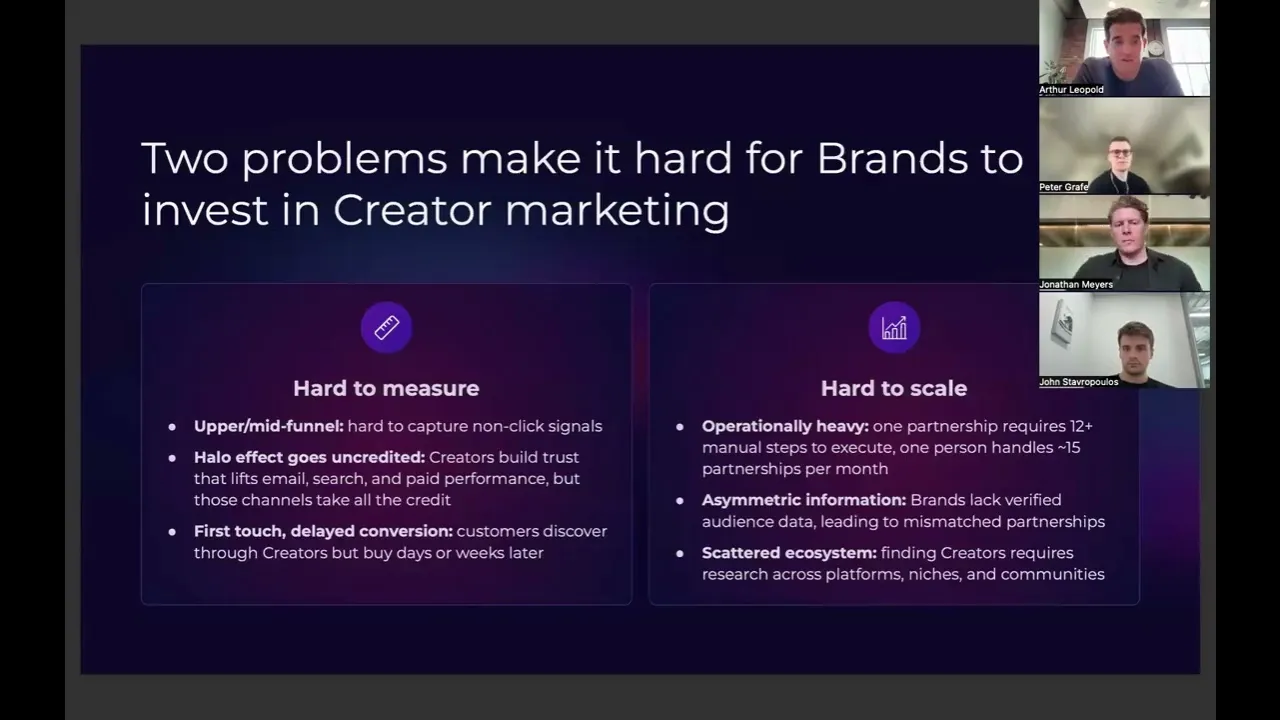
Creator marketing is the hardest line in a media plan to defend. Last-touch attribution undervalues it by roughly 2-3x, so most brands underfund a channel that is already working. Agentio, BlueAlpha and Klover recorded this session to answer one question: how do you prove creator marketing drives incremental revenue, and what happens to the budget once you can?
Klover started with a creator test of roughly $150K per month through Agentio. Within three weeks they had a real incrementality read. ROAS on the Agentio channel came in well above Facebook, they more than doubled quarterly creator spend, and one person now runs 100+ creators a month with no new headcount.
What the session covers
Why last-touch attribution, multi-touch attribution, discount codes and post-purchase surveys all break on creator marketing
How marketing mix modeling captures the halo effect and the delayed conversion window that creator content actually produces
How to size a creator test before spending: the minimum impressions needed to detect a lift
The decay curve reality: full impact lands about three weeks after launch and takes three to four weeks to fade once you turn spend off
How Klover selects creators, licenses the winners as paid social and CTV ads, and reinvests weekly
The number one mistake Agentio sees brands make in a first creator program
By the numbers
Around 50% of consumer attention now sits on creator content
Roughly $800B in digital ad spend, against about $12B going directly to creators
Consumers trust creators about 70% more than brands
Last-touch undervalues creator ROI by about 2-3x on average across BlueAlpha's client base
Agentio sees incrementality between 2x and 5x across its brand portfolio
Klover: three weeks to a first incrementality read, 2x quarterly spend, 100+ creators a month, zero added headcount
Brand safety review for 1,000 creators with a 10-year content lookback: 113 years of billable human hours, or minutes on Agentio
Speakers: Arthur Leopold (Co-founder and CEO, Agentio), Jonathan Meyers (Co-founder and CTO, Agentio), Peter Grafe (Co-founder and CEO, BlueAlpha), John Stavropoulos (Growth Lead, Klover). Q&A moderated by Mavi Santarelli (Agentio).
When to Use This Influencer Measurement Framework
Use Case | Signals It Fits |
|---|---|
Scaling influencer spend | Budget increasing but no way to prove incrementality |
Creator platform evaluation | Using Agentio, Grin, CreatorIQ, etc. and need to validate ROI |
One-off sponsorship decisions | Evaluating individual creator deals ($5K-$50K+) |
Channel mix justification | Board/CFO asking "does influencer actually work?" |
Agency accountability | Need to verify agency-reported influencer metrics |
Prerequisites for Influencer MMM Integration
Ability to track conversions (installs, sign-ups, purchases) at daily or weekly level
Access to influencer spend data (when money went out)
Access to view/impression data over time (not just totals)
MMM capability (internal or vendor) that supports non-standard data inputs
Minimum 4-6 weeks of influencer activity for initial calibration
Why Influencer Channels Are Different from Programmatic
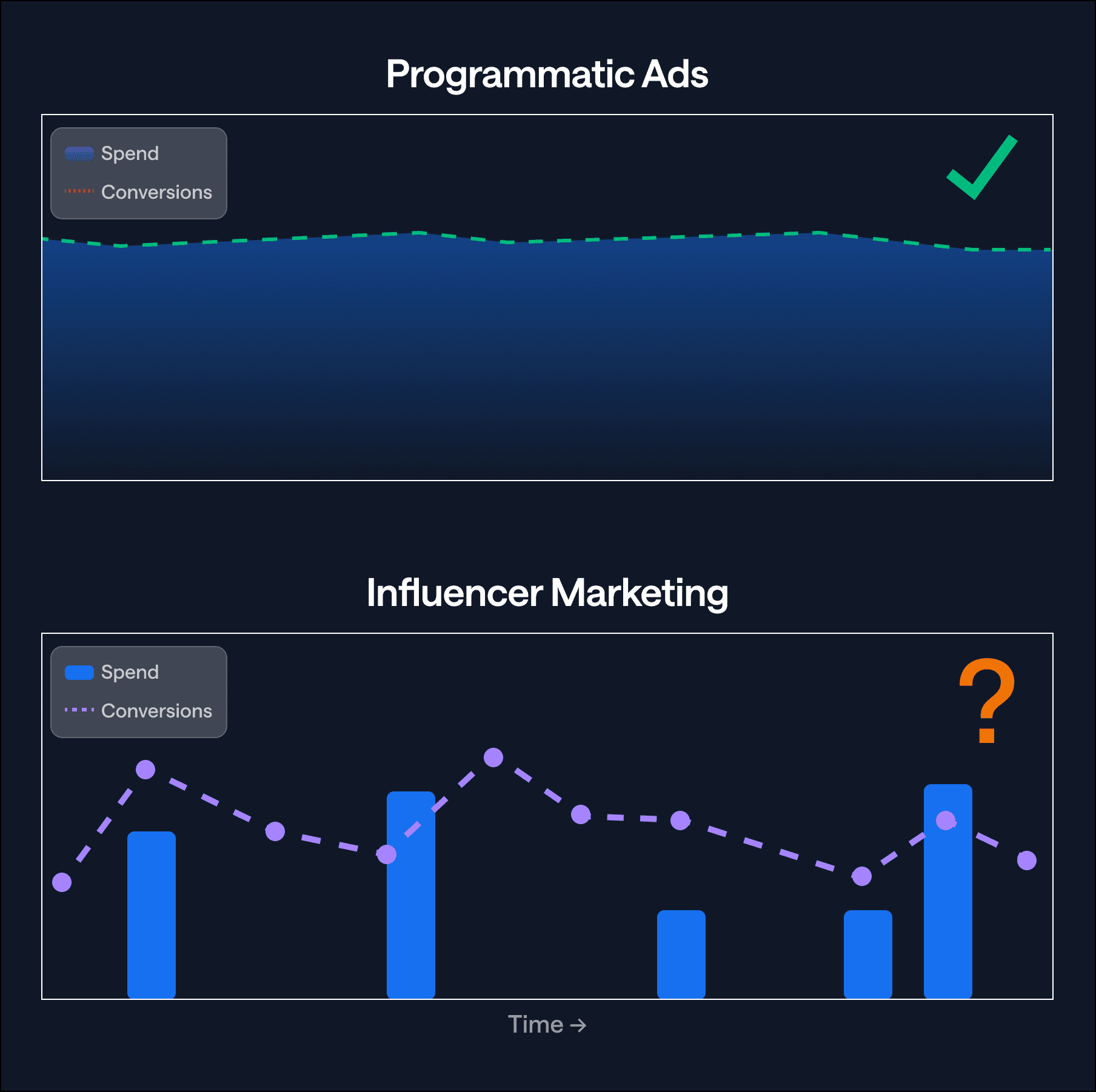
Programmatic channels generate continuous signals. Spend flows daily, impressions accumulate steadily, and models have plenty of data points to learn from.
Influencer channels work differently:
Spend happens in lumps (a creator posts, you pay)
Views accumulate over days/weeks as content gains traction
Impact on conversions is delayed and distributed
Platform "conversions" are often view-through fantasies
Treating influencer like programmatic (attribution at point of click) will never work. You need a different approach.
Phase 1: Build the Influencer Data Architecture (Week 1-2)
Goal: Build the data foundation that captures how influencer actually works.
Actions:
Map your influencer data sources
Platform dashboards (Agentio, Grin, CreatorIQ, etc.)
Agency reports
Direct creator invoices
Analytics platforms (AppsFlyer, GA4, etc.)
Define the data schema
Field | Description | Granularity |
|---|---|---|
Spend | Contracted cost per video/post | Per creative |
Views | Cumulative views over time | Daily or weekly |
Channel | Creator/channel identifier | Per creator |
Platform | YouTube, Instagram, TikTok, etc. | Per platform |
Live Date | When content went live | Per creative |
Set up data pipeline
Pull spend at the campaign/creator level
Pull views over time (not just final totals)
Aggregate to weekly granularity for MMM integration
Critical insight: The combination of spend AND views over time is what makes influencer measurable. Spend alone tells you when money went out. Views tell you when impact actually happened.
Phase 2: Integrate Influencer Spend into Your MMM (Week 2-4)
Goal: Integrate influencer into your Marketing Mix Model to establish causal contribution.
Actions:
Choose your modeling approach
Scenario | Approach |
|---|---|
Single platform (iOS or Android) | Add influencer as standalone channel |
Cross-platform (iOS + Android) | Initially count 100% in both models to observe true contribution, then split based on observed ratio |
Multiple creator platforms | Aggregate or segment based on data volume |
Configure the MMM specification
Input: Weekly spend + weekly views by channel
Output: Contribution to conversions (with confidence intervals)
Include adstock/carryover effects (influencer impact persists as videos accumulate views)
Run initial model and validate
Check that influencer contribution is non-zero and statistically significant
Compare modeled contribution to platform-reported metrics
Validate that contribution moves directionally with spend changes
Establish baseline metrics
From your initial model runs, extract:
Contribution %: What share of conversions does influencer drive?
Conversions per 1,000 views: Your baseline efficiency metric
Cost per incremental conversion: True ROI, not platform-reported
Phase 3: Build the Measurability Framework (Week 4-6)
Goal: Create a reusable system to evaluate any influencer deal before signing.
This is where measurement becomes an action system. Instead of just reporting what happened, you build a tool that informs future decisions.
The Measurability Calculator
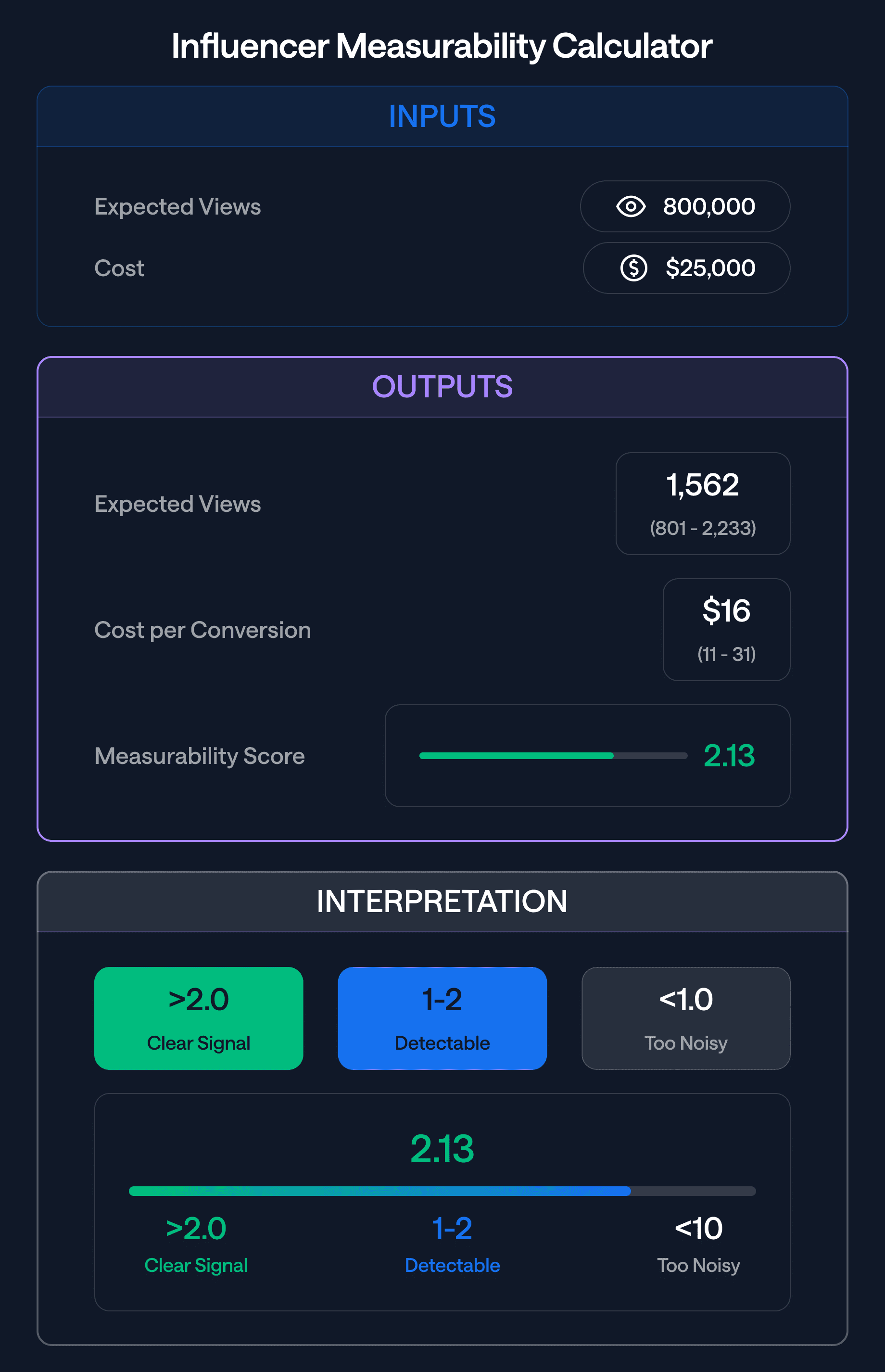
How it works:
Inputs (from creator's media kit):
Expected views (based on channel average)
Cost (proposed deal size)
Calculations (using your baseline data):
Expected conversions = Expected views × (your conversions per 1,000 views)
Cost per conversion = Cost ÷ Expected conversions
Measurability score = Expected lift ÷ Normal KPI fluctuation
Outputs:
Expected conversion range (min/mean/max)
Cost per conversion range
Measurability score with interpretation
Measurability Score Interpretation:
Score | Meaning | Recommendation |
|---|---|---|
> 2.0 | Signal clearly above noise | High confidence - proceed if economics work |
1.0 - 2.0 | Detectable over few weeks | Moderate confidence - consider deal size |
0.5 - 1.0 | Borderline detectable | Low confidence - may need larger commitment |
< 0.5 | Below noise floor | Not measurable - avoid or bundle with others |
Building the calculator:
Measurability Score = Expected Lift / KPI Standard Deviation
Where:
Expected Lift = Expected Views × (Mean Conversions per 1,000 Views)KPI Standard Deviation = Historical weekly fluctuation in total conversions
Phase 4: Operationalize and Scale (Week 6+)
Goal: Turn measurement into a continuous decision-making system.
Actions:
Weekly MMM refresh
Update model with latest spend and conversion data
Track contribution trends over time
Flag anomalies (sudden drops or spikes in efficiency)
Creator-level analysis
With sufficient data, identify which creators/channels perform above or below average
Use relative performance (not absolute incrementality) to guide renewal decisions
Build a "creator efficiency index" for your top partners
Pre-deal evaluation workflow
Before signing any creator deal, run it through the measurability calculator
Set minimum thresholds (e.g., measurability score > 1.5)
Document expected vs. actual performance for continuous calibration
Quarterly portfolio review
Compare influencer contribution to other channels
Assess whether to scale, hold, or reduce influencer allocation
Update baseline metrics as more data accumulates
Results Template for Influencer Channel Contribution
Use this framework to document your influencer measurement results:
Metric | Value | Confidence | Notes |
|---|---|---|---|
Modeled contribution (iOS) | __% | 95% CI | From MMM |
Modeled contribution (Android) | __% | 95% CI | From MMM |
Conversions per 1,000 views | . | ±. | Baseline for calculator |
Incremental cost per conversion | $__ | $__ - $__ | Range at 90% CI |
Creators tracked | __ | - | Channel-level granularity |
Measurability threshold | . | - | Minimum score for new deals |
Decision Framework for Creator Deals and Renewals
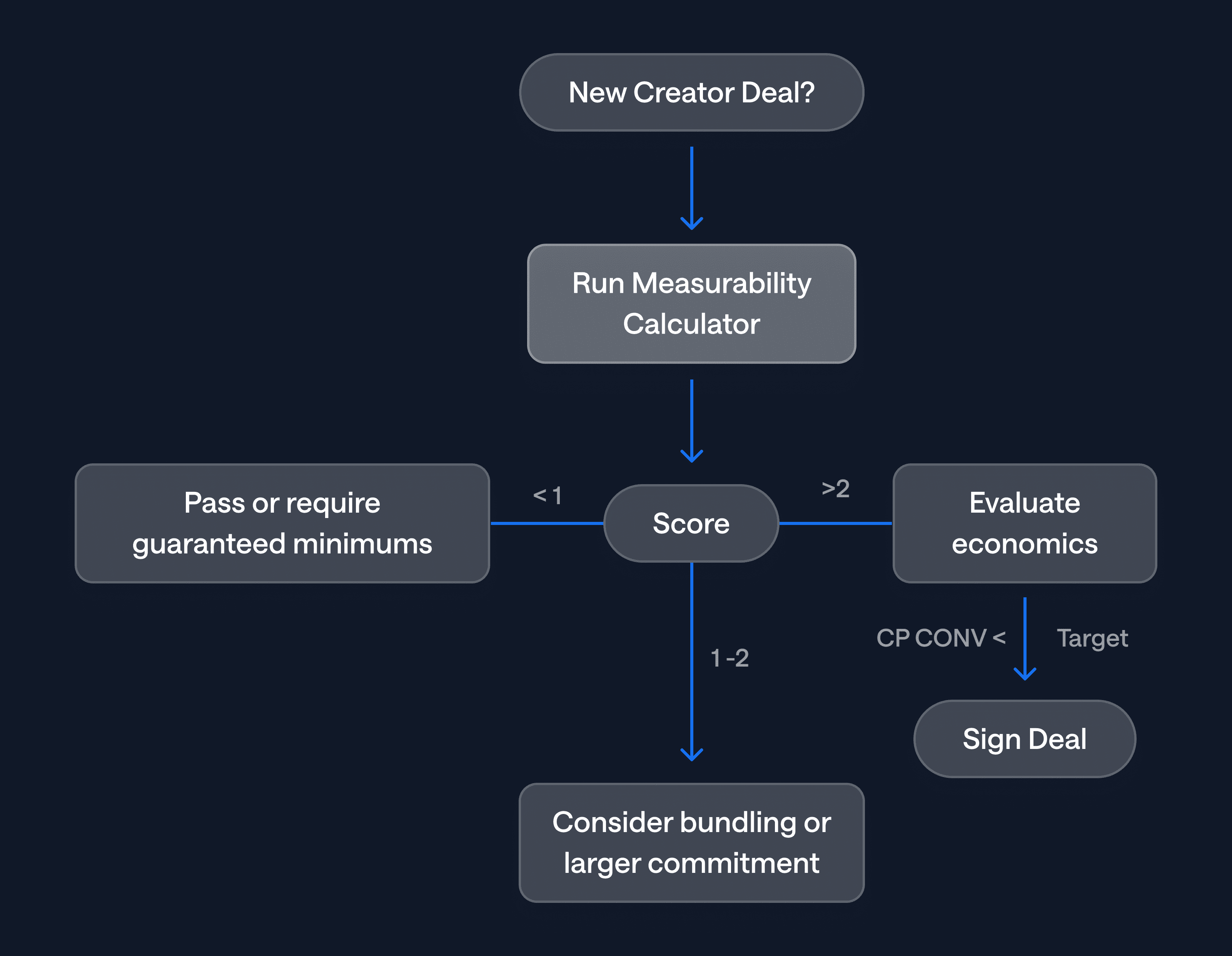
For new deals:
Score > 2.0 AND cost per conversion < 1.5× target → Sign
Score 1.0-2.0 AND economics borderline → Negotiate larger commitment or pass
Score < 1.0 → Pass (or bundle multiple small creators into one measurable package)
For renewals:
Actual performance > expected → Renew and consider scaling
Actual performance within range → Renew at same level
Actual performance < expected → Renegotiate or don't renew
Five Measurement Mistakes That Waste Influencer Budgets
❌ Treating influencer spend like programmatic spend
Applying last-click attribution to influencer will always undercount
Solution: Use MMM with views-over-time, not just spend
❌ Evaluating creators on platform metrics alone
Platform-reported conversions include view-through attribution fantasies
Solution: Compare platform metrics to MMM-attributed contribution
❌ Killing tests too early
Influencer impact accumulates as videos gain views over weeks
Solution: Commit to 4-6 week observation windows minimum
❌ Signing deals below measurability threshold
Small deals (< 100K expected views) often fall below noise floor
Solution: Bundle small creators or set minimum deal sizes
❌ Ignoring the views dimension
Spend-only models miss when impact actually happens
Solution: Always integrate both spend and views into your model
Replication Checklist: Six-Week Influencer MMM Setup
Week 1
Audit current influencer data sources (platforms, agencies, direct)
Define data schema (spend, views, channel, platform, dates)
Set up data extraction pipeline
Week 2
Aggregate data to weekly granularity
Integrate into MMM specification
Run initial model with influencer as standalone channel
Week 3-4
Validate model outputs against known patterns
Extract baseline metrics (contribution %, conversions per 1K views)
Build measurability calculator spreadsheet/tool
Week 5-6
Test calculator against recent deals (backtest)
Calibrate thresholds based on your business context
Document workflow for pre-deal evaluation
Week 6+
Implement weekly MMM refresh cadence
Train team on calculator usage
Schedule quarterly portfolio reviews
Key Takeaways for Measuring Influencer Incrementality
Influencer is measurable, but only if you build for its unique characteristics: lumpy spend, delayed impact, views over time.
MMM is the foundation. Integrate spend and views into your model to establish causal contribution.
A measurability system beats one-off tests. Build a reusable framework that evaluates every deal before you sign.
Platform metrics lie. What creators and platforms report as conversions rarely reflects true incrementality.
Signal-to-noise matters. Small deals may be literally unmeasurable. Set minimum thresholds.
BlueAlpha built this measurability framework for Klover, proving that YouTube sponsorships via Agentio drive incremental conversions using geo holdout + BSTS methodology. The decision layer runs the same weekly MMM refresh and creator-level analysis described in this playbook.
See the full results in the Klover influencer marketing case study.
Book a 30-Minute Strategy Call
FAQ
Can I measure influencer marketing without an MMM?
Not causally. Last-click attribution will always undercount influencer because impact is delayed as videos accumulate views over weeks. An MMM with views-over-time as an input variable is the minimum requirement for establishing causal contribution. Without it, you are relying on platform-reported metrics that consistently overstate conversions.
What is a measurability score and how do I calculate it?
The measurability score is the expected lift from a creator deal divided by the standard deviation of your weekly KPI fluctuation. A score above 2.0 means the signal will clearly stand out from noise. Below 0.5 means the deal is too small to detect. The formula: Expected Lift (expected views times your baseline conversions per 1,000 views) divided by your KPI standard deviation.
What is the minimum deal size for influencer to be measurable?
Deals generating fewer than 100,000 expected views typically fall below the noise floor, meaning the lift they produce is smaller than normal weekly fluctuation in your KPI. If a creator's expected views are below this threshold, either negotiate a larger commitment or bundle multiple creators into a single measurable package.
How do I handle influencer spend in my MMM when impact is delayed?
Integrate both spend and views over time into your model, not just spend. Spend tells you when money went out. Views tell you when impact actually happened. Configure adstock and carryover effects to capture the fact that influencer videos continue generating conversions for weeks after the initial post.
How long should I run an influencer measurement test?
At minimum four to six weeks. Influencer impact accumulates as videos gain traction and views compound. Cutting a test at two weeks will undercount the channel's true contribution. BlueAlpha's Klover engagement used a geo holdout methodology across a six-week window to prove YouTube sponsorships drive incremental conversions.
How do I compare influencer ROI to my other paid channels?
Use your MMM to extract the incremental cost per conversion for influencer alongside every other channel in your mix. Compare on the same metric (incremental CPA or incremental ROAS) with confidence intervals. Do not compare platform-reported metrics across channels because each platform overstates differently.

