beehiiv: Meta's True CPA Was 345% Higher Than Reported

BlueAlpha's geo-based incrementality tests revealed beehiiv's Meta signup CPA was 345% higher than platform-reported. TikTok validated as most efficient channel.

Incrementality Proven

Wasted Spend Eliminated

"BlueAlpha's rigorous testing revealed the true value of channels that ad platform metrics were both over- and underestimating. We finally understood where our dollars were best spent. Their insights allowed us to reallocate our budget with confidence to fuel our scalable growth."

"BlueAlpha's rigorous testing revealed the true value of channels that ad platform metrics were both over- and underestimating. We finally understood where our dollars were best spent. Their insights allowed us to reallocate our budget with confidence to fuel our scalable growth."

EJ White, former Head of Growth at beehiiv

EJ White Former Head of Growth at beehiiv

BlueAlpha ran structured incrementality tests across four of beehiiv's paid channels and found that platform-reported CPAs diverged from incremental CPAs by as much as 345%. The tests separated channels that were genuinely acquiring new newsletter signups and paid-plan subscribers from channels that were claiming credit for users who would have converted organically. beehiiv used the results to reallocate budget toward channels with proven incremental value.


beehiiv: Mobile-to-Desktop Attribution Gap Across 5 Platforms

beehiiv is a newsletter platform serving creators and media companies. At the time of the engagement, beehiiv was running 30+ campaigns across 5+ platforms: Meta, TikTok, YouTube, LinkedIn, and Google. The growth team tracked two conversion events separately: free account signups and paid-plan purchases (what beehiiv calls "net new purchases," meaning a first-time paid subscription).

A key structural challenge: most of beehiiv's ad traffic arrives on mobile, but starting a newsletter requires a desktop workflow. The gap between mobile ad click and desktop signup means deterministic attribution consistently underreports or misattributes the channels that generate those users. As Brian Kudler, beehiiv's Performance Marketing lead, described it: "For Meta, there's a lot of site traffic on mobile, and people who start a newsletter aren't gonna do that on mobile. So it looks bad when you look at the deterministic data."


Platform-Reported CPAs vs. Real Incremental Cost per Signup

beehiiv's leadership had raised a concern about paid-acquired user quality. Organic users generated revenue per user (RPU) above $150, while Meta and TikTok-acquired users averaged $50-75 RPU. The question was whether push media channels were acquiring low-quality, low-intent users starting small plans, or whether the attribution gap was distorting the picture.

Conflicting metrics from platform reports, GA4, internal attribution, and post-purchase surveys made it impossible to answer that question with the available data. As Brian put it: "Ultimately, there still isn't a clear overview on everything and the impact each channel is having."

Without knowing which channels were genuinely incremental, beehiiv risked overspending on channels where platform-reported CPA looked artificially low (because the platform was claiming organic conversions) and underspending on channels where CPA looked high but the users were actually incremental.


BlueAlpha's Approach

BlueAlpha used a two-phase methodology: a Bayesian Marketing Mix Model (MMM) to identify which channels warranted testing, followed by geo-based incrementality tests to measure the true incremental cost per signup and cost per paid-plan conversion.

Phase 1: Bayesian MMM

BlueAlpha built a hierarchical MMM with channel-specific adstock and saturation curves to separate high-value from low-value channels. The model accounted for beehiiv's 30-day average time to purchase (from signup to paid plan), a lag that most platform attribution misses entirely. The MMM identified Meta as the channel with the widest gap between platform-reported and modeled contribution, making it the highest-priority test candidate.

Phase 2: Geo-based incrementality tests

BlueAlpha ran structured tests on four channels: YouTube, Meta, LinkedIn, and TikTok. Each channel was isolated in a specific state to create clean treatment-vs-control comparisons. The test ran for approximately six weeks with a post-treatment observation window. For each channel, the test compared platform-reported CPA against incrementally measured CPA.


Meta's True Signup CPA Was 345% Higher Than Reported

Channel

Platform-Reported vs. Incremental CPA

Direction

Confidence

TikTok

Incremental CPA was ~10% lower than platform-reported

Platform overestimated cost (TikTok was better than it looked)

99%

YouTube

Incremental CPA was ~50% higher than platform-reported

Platform underestimated cost

100%

Meta

Incremental CPA was ~345% higher than platform-reported

Platform dramatically underestimated cost

93%

LinkedIn

Inconclusive

Insufficient conversion volume during test window

60%

The Meta result was the most significant finding. Platform-reported signup CPA understated the true cost of acquiring an incremental beehiiv user by ~345%. The gap was driven by Meta claiming credit for signups that would have occurred organically, a pattern amplified by the mobile-to-desktop conversion path that Meta's pixel cannot track deterministically.

TikTok's result was the opposite of what most teams expect. Its incremental CPA was actually ~10% lower than what the platform reported, meaning TikTok was undervaluing its own contribution. With 99% confidence, TikTok was validated as the most accurately measured and most efficient signup channel in beehiiv's portfolio.

LinkedIn's test did not reach statistical significance (60% confidence) due to insufficient conversion volume during the test window. Further testing with a larger budget and longer duration was recommended.
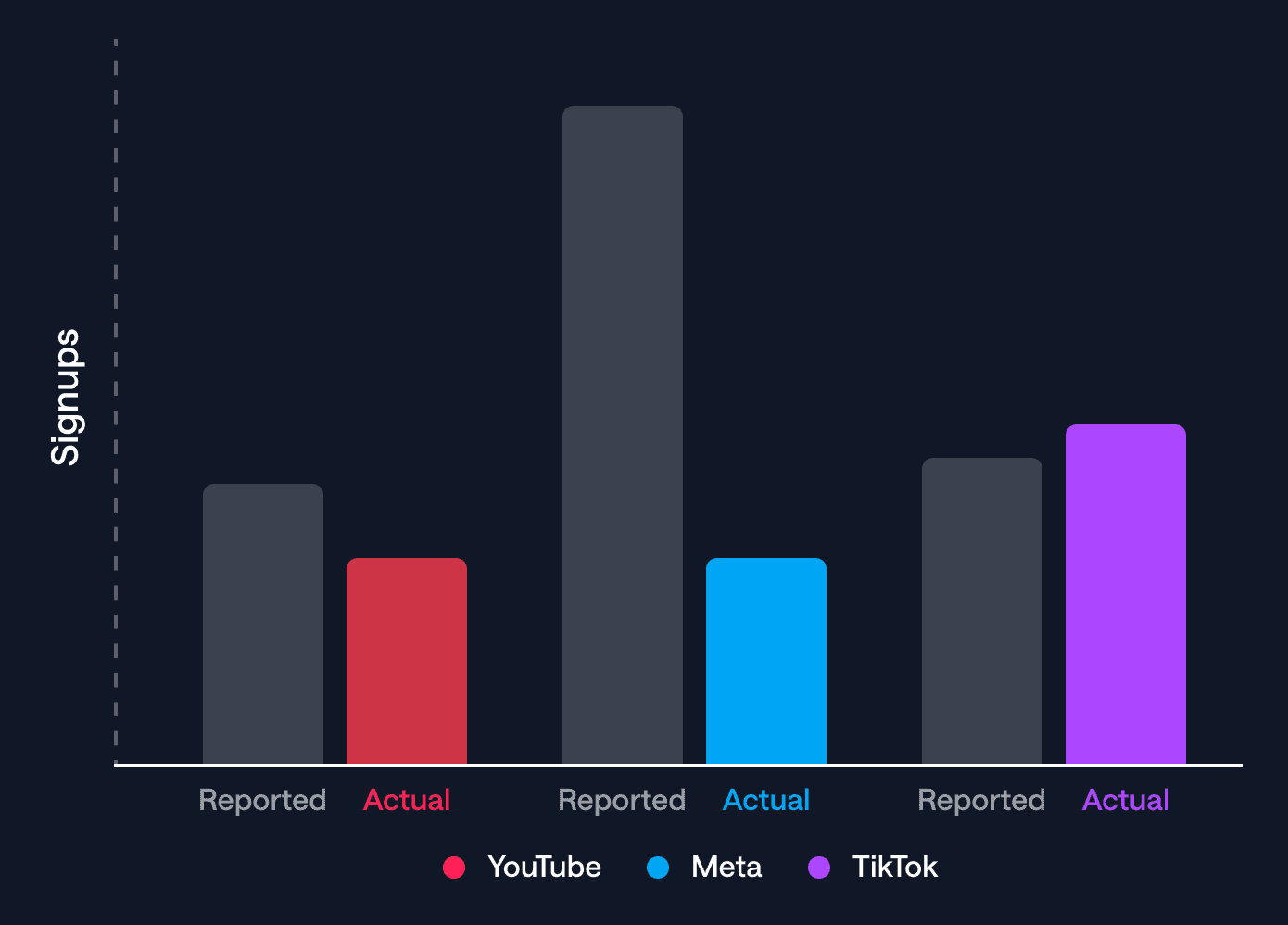
Before‑and‑after chart comparing signups reported by ad platforms with incremental signups identified through testing.

Figure 1. Before‑and‑after chart comparing signups reported by ad platforms with incremental signups identified through testing.


Why Platform-Reported Conversions Don't Add Up

The purchase-level analysis exposed an even more dramatic gap than the signup analysis, but in the opposite direction: ad platforms were massively underreporting the number of paid-plan conversions their channels actually drove.

Channel

What the Platform Reported

What the Incrementality Test Found

Confidence

YouTube

Single-digit purchases

Multiples more incremental purchases than platform reported

99%

Meta

Zero purchases attributed

Double-digit incremental purchases with no platform visibility

94%

TikTok

Near-zero purchases attributed

Roughly 20x more incremental purchases than platform reported

76%

LinkedIn

Zero purchases attributed

Inconclusive

50%

Meta's platform reported effectively zero purchases during the test window. The incrementality test detected double-digit conversions at 94% confidence. YouTube and TikTok showed similar patterns: platforms attributed single-digit or near-zero purchases, while the incrementality analysis found multiples more. The platforms were not just inaccurate on CPA; they were failing to attribute the majority of actual conversions.

The incremental cost per paid-plan conversion came in well below beehiiv's internal acquisition cost threshold for YouTube and Meta. TikTok delivered the lowest incremental cost per net new purchase of any channel tested, consistent with its strong signup-level performance.

This finding was critical for beehiiv's leadership, whose primary concern was paid-acquired user quality. The data showed that channels driving expensive signups could still deliver users who convert to paid plans at rates that justify the acquisition cost. The quality problem was not with the channels; it was with the measurement.


Budget Rebalanced: TikTok and YouTube Scaled

beehiiv used the test results to rebalance spend across its channel portfolio. TikTok and YouTube received increased budgets based on their proven incremental economics. Meta spend was right-sized to reflect its true incremental contribution rather than its platform-reported CPA.

EJ White, beehiiv's former Head of Growth, summarized the outcome: "BlueAlpha's rigorous testing revealed the true value of channels that ad platform metrics were both over- and underestimating. We finally understood where our dollars were best spent."

LinkedIn was flagged for a larger, longer-term test to generate sufficient conversion volume for a conclusive read.


See how BlueAlpha measures what your ad platforms can't. Book a 30-minute strategy call to discuss how geo-based incrementality tests can reveal your true channel-level CPAs.


"BlueAlpha's rigorous testing revealed the true value of channels that ad platform metrics were both over- and underestimating. We finally understood where our dollars were best spent. Their insights allowed us to reallocate our budget with confidence to fuel our scalable growth."

EJ White, former Head of Growth at beehiiv

EJ White Former Head of Growth at beehiiv

BlueAlpha ran structured incrementality tests across four of beehiiv's paid channels and found that platform-reported CPAs diverged from incremental CPAs by as much as 345%. The tests separated channels that were genuinely acquiring new newsletter signups and paid-plan subscribers from channels that were claiming credit for users who would have converted organically. beehiiv used the results to reallocate budget toward channels with proven incremental value.


beehiiv: Mobile-to-Desktop Attribution Gap Across 5 Platforms

beehiiv is a newsletter platform serving creators and media companies. At the time of the engagement, beehiiv was running 30+ campaigns across 5+ platforms: Meta, TikTok, YouTube, LinkedIn, and Google. The growth team tracked two conversion events separately: free account signups and paid-plan purchases (what beehiiv calls "net new purchases," meaning a first-time paid subscription).

A key structural challenge: most of beehiiv's ad traffic arrives on mobile, but starting a newsletter requires a desktop workflow. The gap between mobile ad click and desktop signup means deterministic attribution consistently underreports or misattributes the channels that generate those users. As Brian Kudler, beehiiv's Performance Marketing lead, described it: "For Meta, there's a lot of site traffic on mobile, and people who start a newsletter aren't gonna do that on mobile. So it looks bad when you look at the deterministic data."


Platform-Reported CPAs vs. Real Incremental Cost per Signup

beehiiv's leadership had raised a concern about paid-acquired user quality. Organic users generated revenue per user (RPU) above $150, while Meta and TikTok-acquired users averaged $50-75 RPU. The question was whether push media channels were acquiring low-quality, low-intent users starting small plans, or whether the attribution gap was distorting the picture.

Conflicting metrics from platform reports, GA4, internal attribution, and post-purchase surveys made it impossible to answer that question with the available data. As Brian put it: "Ultimately, there still isn't a clear overview on everything and the impact each channel is having."

Without knowing which channels were genuinely incremental, beehiiv risked overspending on channels where platform-reported CPA looked artificially low (because the platform was claiming organic conversions) and underspending on channels where CPA looked high but the users were actually incremental.


BlueAlpha's Approach

BlueAlpha used a two-phase methodology: a Bayesian Marketing Mix Model (MMM) to identify which channels warranted testing, followed by geo-based incrementality tests to measure the true incremental cost per signup and cost per paid-plan conversion.

Phase 1: Bayesian MMM

BlueAlpha built a hierarchical MMM with channel-specific adstock and saturation curves to separate high-value from low-value channels. The model accounted for beehiiv's 30-day average time to purchase (from signup to paid plan), a lag that most platform attribution misses entirely. The MMM identified Meta as the channel with the widest gap between platform-reported and modeled contribution, making it the highest-priority test candidate.

Phase 2: Geo-based incrementality tests

BlueAlpha ran structured tests on four channels: YouTube, Meta, LinkedIn, and TikTok. Each channel was isolated in a specific state to create clean treatment-vs-control comparisons. The test ran for approximately six weeks with a post-treatment observation window. For each channel, the test compared platform-reported CPA against incrementally measured CPA.


Meta's True Signup CPA Was 345% Higher Than Reported

Channel

Platform-Reported vs. Incremental CPA

Direction

Confidence

TikTok

Incremental CPA was ~10% lower than platform-reported

Platform overestimated cost (TikTok was better than it looked)

99%

YouTube

Incremental CPA was ~50% higher than platform-reported

Platform underestimated cost

100%

Meta

Incremental CPA was ~345% higher than platform-reported

Platform dramatically underestimated cost

93%

LinkedIn

Inconclusive

Insufficient conversion volume during test window

60%

The Meta result was the most significant finding. Platform-reported signup CPA understated the true cost of acquiring an incremental beehiiv user by ~345%. The gap was driven by Meta claiming credit for signups that would have occurred organically, a pattern amplified by the mobile-to-desktop conversion path that Meta's pixel cannot track deterministically.

TikTok's result was the opposite of what most teams expect. Its incremental CPA was actually ~10% lower than what the platform reported, meaning TikTok was undervaluing its own contribution. With 99% confidence, TikTok was validated as the most accurately measured and most efficient signup channel in beehiiv's portfolio.

LinkedIn's test did not reach statistical significance (60% confidence) due to insufficient conversion volume during the test window. Further testing with a larger budget and longer duration was recommended.

Before‑and‑after chart comparing signups reported by ad platforms with incremental signups identified through testing.

Figure 1. Before‑and‑after chart comparing signups reported by ad platforms with incremental signups identified through testing.


Why Platform-Reported Conversions Don't Add Up

The purchase-level analysis exposed an even more dramatic gap than the signup analysis, but in the opposite direction: ad platforms were massively underreporting the number of paid-plan conversions their channels actually drove.

Channel

What the Platform Reported

What the Incrementality Test Found

Confidence

YouTube

Single-digit purchases

Multiples more incremental purchases than platform reported

99%

Meta

Zero purchases attributed

Double-digit incremental purchases with no platform visibility

94%

TikTok

Near-zero purchases attributed

Roughly 20x more incremental purchases than platform reported

76%

LinkedIn

Zero purchases attributed

Inconclusive

50%

Meta's platform reported effectively zero purchases during the test window. The incrementality test detected double-digit conversions at 94% confidence. YouTube and TikTok showed similar patterns: platforms attributed single-digit or near-zero purchases, while the incrementality analysis found multiples more. The platforms were not just inaccurate on CPA; they were failing to attribute the majority of actual conversions.

The incremental cost per paid-plan conversion came in well below beehiiv's internal acquisition cost threshold for YouTube and Meta. TikTok delivered the lowest incremental cost per net new purchase of any channel tested, consistent with its strong signup-level performance.

This finding was critical for beehiiv's leadership, whose primary concern was paid-acquired user quality. The data showed that channels driving expensive signups could still deliver users who convert to paid plans at rates that justify the acquisition cost. The quality problem was not with the channels; it was with the measurement.


Budget Rebalanced: TikTok and YouTube Scaled

beehiiv used the test results to rebalance spend across its channel portfolio. TikTok and YouTube received increased budgets based on their proven incremental economics. Meta spend was right-sized to reflect its true incremental contribution rather than its platform-reported CPA.

EJ White, beehiiv's former Head of Growth, summarized the outcome: "BlueAlpha's rigorous testing revealed the true value of channels that ad platform metrics were both over- and underestimating. We finally understood where our dollars were best spent."

LinkedIn was flagged for a larger, longer-term test to generate sufficient conversion volume for a conclusive read.


See how BlueAlpha measures what your ad platforms can't. Book a 30-minute strategy call to discuss how geo-based incrementality tests can reveal your true channel-level CPAs.


See which of your marketing dollars are actually working.

See which of your marketing dollars are actually working.

See which of your marketing dollars are actually working.