How Proper Cloth Proved YouTube Ads Drive E-commerce Revenue
BlueAlpha's upper funnel measurement test proved YouTube drove ~$180K incremental revenue for Proper Cloth at 2.43x ROAS. 0.36% probability of loss.
Incrementality Proven
Spend Scaled Profitably

“We were convinced upper-funnel channels were a black hole - money in, nothing measurable out. YouTube especially felt like brand theater we couldn't justify. BlueAlpha didn't just prove YouTube worked; they showed us it drives immediate, measurable revenue. That fundamentally changed how we think about video advertising.”
“We were convinced upper-funnel channels were a black hole - money in, nothing measurable out. YouTube especially felt like brand theater we couldn't justify. BlueAlpha didn't just prove YouTube worked; they showed us it drives immediate, measurable revenue. That fundamentally changed how we think about video advertising.”

Jeffrey Lai Head of Analytics & Advertising at Proper Cloth
BlueAlpha ran a geo-based incrementality test on Proper Cloth's YouTube Demand Gen campaigns and proved that upper-funnel video advertising drove approximately $180K in incremental sales revenue at a 2.43x ROAS, with only 0.36% probability of loss. The test resolved a months-long internal debate between the team's performance marketers (who wanted to kill YouTube and reinvest in Meta) and those who believed the channel was contributing. The 12.7% cumulative lift in total sales, measured against a Bayesian synthetic control, gave the team the data to scale YouTube with board-level confidence.
Proper Cloth: D2C Menswear, YouTube Under Scrutiny
Proper Cloth is a premium custom menswear D2C brand. The growth team, led by Jeffrey (Head of Analytics and Advertising) and Nick (Paid Media), tracked performance through new customer revenue as their primary goal, with a formal marginal break-even ROAS (MBROAS) threshold that every channel had to clear. The team ran an in-house session-based tracking system (Snowplow) alongside a post-purchase survey, which gave them their own attribution view independent of platform reporting.
As Nick described their general stance toward ad platforms: "We don't trust the platform very much. We just tend to rely on our own model."
Upper Funnel Measurement: Was YouTube Incremental?
Proper Cloth had been running YouTube ads in test mode for months. Jeff described the starting point: "We've had some fire success with the video company, but a very small scale. And when we tried to expand it, the CPAs always looked expensive. But when we include YouTube conversions, it would look good." The question was whether YouTube's reported conversions reflected real incremental revenue or view-through credit for sales that would have happened through Meta or organic.
The team was split:
The performance-first camp (Nick and others) saw YouTube as unattributable spend that competed with proven Meta campaigns for budget. Meta delivered clear, trackable conversions against their MBROAS target. YouTube felt like brand theater they could not justify. As Nick put it: "Whatever Google is saying, you kind of don't know how much to believe it."
The scaling camp (Seph, CEO) saw YouTube as a potential growth lever for reaching the company's 42% new customer revenue growth target for 2026. That target required unlocking channels beyond Meta and Google Search. But without causal proof, investing in YouTube meant diverting budget from channels that were already working.
The core tension: Jeff knew they lacked the internal capability to resolve the question. "When we've tried this in the past, we were able to design an experiment, but we weren't that great at interpreting the results and figuring out the best next step."
BlueAlpha's Approach
BlueAlpha designed a geo-based incrementality test to produce a definitive answer.
Experiment design
Three states (Massachusetts, California, Pennsylvania) served as treatment markets where YouTube Demand Gen campaigns ran, with 40+ control states providing a synthetic baseline. The campaign used YouTube in-stream only, 15-second video creative, no product feed, optimized for purchases (not awareness). Targeting included In-Market audiences, Custom Intent, Lookalike, and Remarketing segments. The primary KPI was total sales revenue, measured through Proper Cloth's own transaction data, not platform-reported conversions.
Week-by-week progression
Week 1 showed no lift (algorithm learning period)
Week 2 produced early signals
Week 3 delivered statistically significant lift in total sales
Weeks 4-5 sustained a 12.7% cumulative lift
The two-week lag before results is typical for upper-funnel campaigns and is a reason many brands kill YouTube tests prematurely.
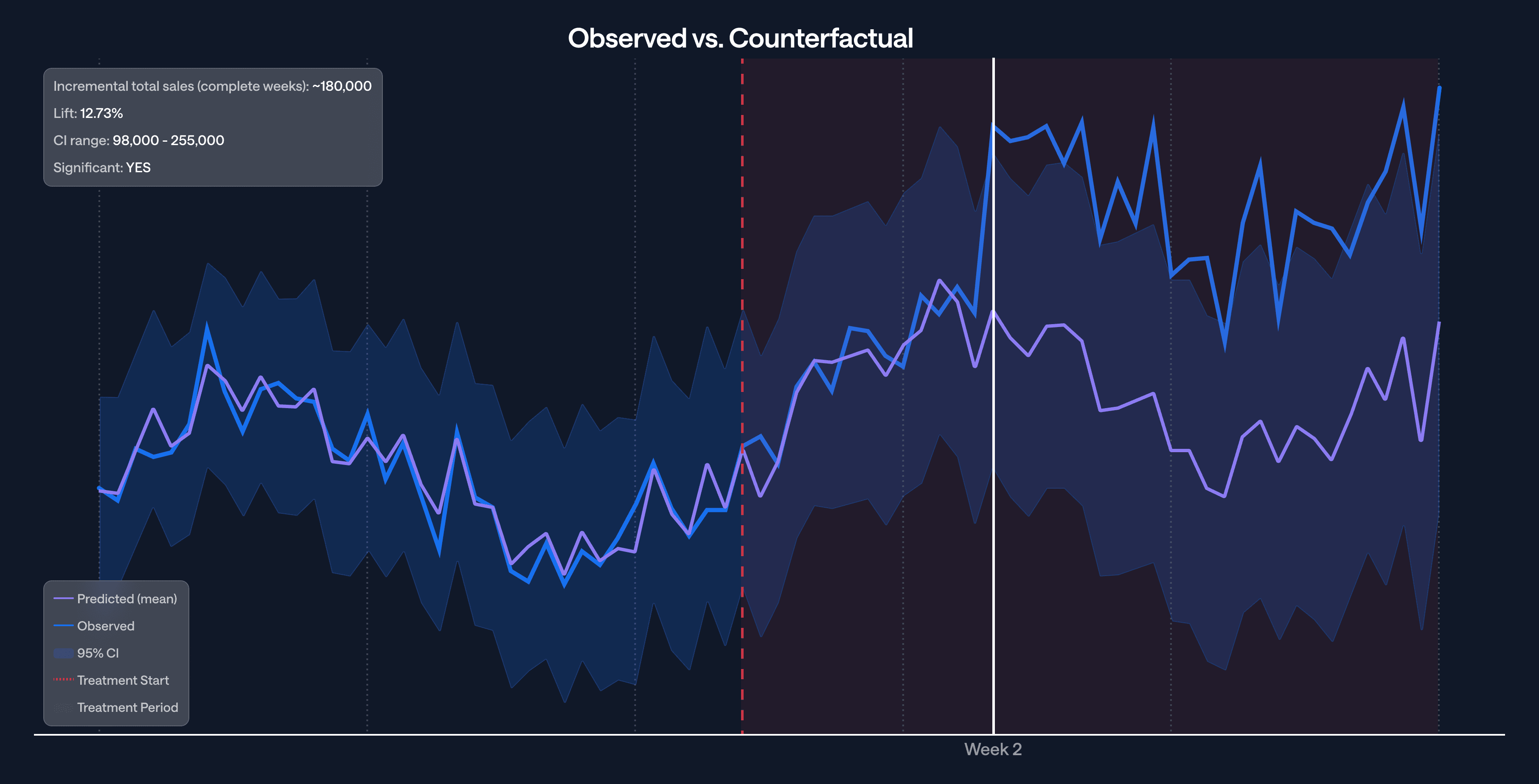
Key Insight: Starting Week 2, clear week-over-week increase in total sales relative to the control group for 3 consecutive weeks. The lag time of 2 weeks before seeing results is typical for upper-funnel campaigns. Patience pays off.
Session-Based Attribution vs. MMM vs. Geo Holdout
Metric | YouTube Platform View | In-House Session Tracking (Snowplow) | Geo Holdout (Measured) |
|---|---|---|---|
Conversions | Reported conversions (view-through + click) | Lower count (session-based, no view-through) | ~$180K incremental revenue, 95% CI: ~$98K to ~$255K |
ROI assessment | "Looks good when we include YouTube conversions" (Jeff) | "CPAs always looked expensive" (Jeff) | 2.43x ROAS (range: 1.3x to 3.47x) |
Confidence in result | Low (team did not trust platform) | Low (in-house model could not isolate YouTube) | 95% statistical confidence, 0.36% probability of loss |
~$180K Incremental Revenue, 2.43x ROAS, 0.36% Loss Risk
~$180K in proven incremental sales. The 95% confidence interval ranged from approximately $98K to $255K. Even at the lower bound, the ROI was 1.3x, meaning YouTube remained profitable in the worst-case scenario.
12.7% cumulative lift in total sales. YouTube was not just generating brand awareness; it was driving bottom-line revenue that would not have existed without the spend.
0.36% probability of loss. This number transformed the internal debate. Jeff and Nick no longer needed to trust platform reporting or argue from priors. The risk of losing money on YouTube was quantifiably near zero.
Seph's read on the result: "This test so far suggests that whatever YouTube reports, the real ROI could be 10 times that."
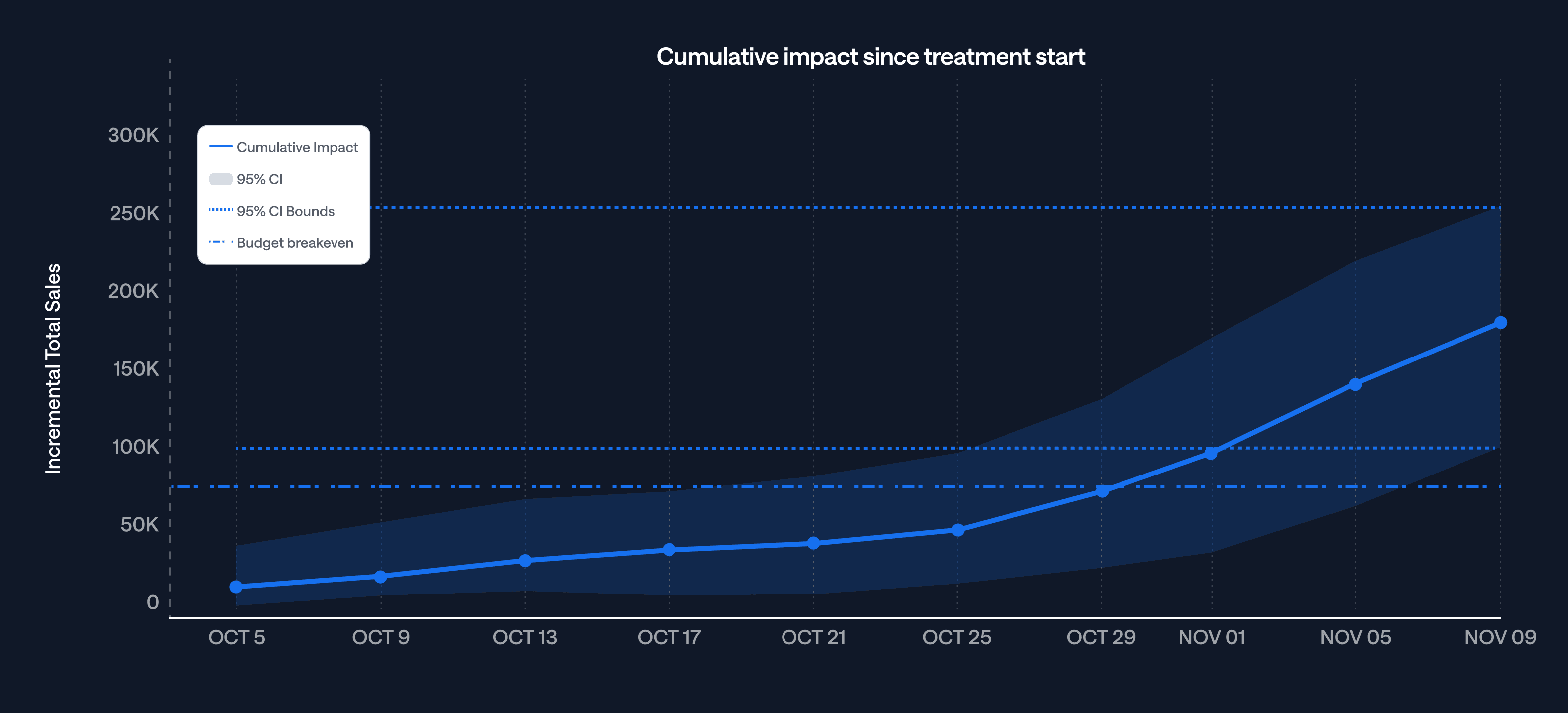
Key Finding: Only 0.36% probability that the campaign would lose money. Even at the lower 95% confidence interval (~$98K), the ROI is still 1.3x - meaning even in the worst-case scenario, YouTube remains profitable.
YouTube Scaled to Top-Revenue Markets, PMax Holdout Next
With upper-funnel impact proven, Proper Cloth moved to scale:
YouTube expanded from 3 treatment states to top-revenue markets with a 2-3x budget increase, using the same winning setup (in-stream, 15-second video, conversion-optimized). A Demand Gen test with product feeds was launched to validate whether existing cheap Demand Gen conversions were truly incremental. A Performance Max holdout test was designed to determine whether PMax was driving real growth or cannibalizing other channels. The testing roadmap extended to CTV advertising as the next upper-funnel opportunity.
Key Takeaways for D2C E-Commerce Brands
Upper-funnel skepticism is justified, but testable. Don't accept 'brand building' claims without proof. Only geo-based incrementality testing reveals whether upper-funnel spend drives net-new revenue.
Platform metrics mislead about upper-funnel. YouTube's reported conversions included view-through credit that could not be validated without a holdout. Only the geo experiment proved incrementality.
Patience required. 2-3 week learning periods are normal for video campaigns. Killing tests too early means missing breakthrough results.
Risk can be quantified. A 0.36% probability of loss transformed executive hesitation into confident scaling decisions. Statistical proof turns internal debate into action.
Upper-funnel can drive immediate revenue. YouTube delivered measurable bottom-line sales, not just future 'brand equity.' The Demand Gen campaign was configured for purchases, not awareness, and it worked.
Debating internally whether YouTube or another upper-funnel channel is worth the investment? Book a strategy call to design a geo holdout test that gives you a definitive answer in weeks, not quarters.
“We were convinced upper-funnel channels were a black hole - money in, nothing measurable out. YouTube especially felt like brand theater we couldn't justify. BlueAlpha didn't just prove YouTube worked; they showed us it drives immediate, measurable revenue. That fundamentally changed how we think about video advertising.”
Jeffrey Lai Head of Analytics & Advertising at Proper Cloth
BlueAlpha ran a geo-based incrementality test on Proper Cloth's YouTube Demand Gen campaigns and proved that upper-funnel video advertising drove approximately $180K in incremental sales revenue at a 2.43x ROAS, with only 0.36% probability of loss. The test resolved a months-long internal debate between the team's performance marketers (who wanted to kill YouTube and reinvest in Meta) and those who believed the channel was contributing. The 12.7% cumulative lift in total sales, measured against a Bayesian synthetic control, gave the team the data to scale YouTube with board-level confidence.
Proper Cloth: D2C Menswear, YouTube Under Scrutiny
Proper Cloth is a premium custom menswear D2C brand. The growth team, led by Jeffrey (Head of Analytics and Advertising) and Nick (Paid Media), tracked performance through new customer revenue as their primary goal, with a formal marginal break-even ROAS (MBROAS) threshold that every channel had to clear. The team ran an in-house session-based tracking system (Snowplow) alongside a post-purchase survey, which gave them their own attribution view independent of platform reporting.
As Nick described their general stance toward ad platforms: "We don't trust the platform very much. We just tend to rely on our own model."
Upper Funnel Measurement: Was YouTube Incremental?
Proper Cloth had been running YouTube ads in test mode for months. Jeff described the starting point: "We've had some fire success with the video company, but a very small scale. And when we tried to expand it, the CPAs always looked expensive. But when we include YouTube conversions, it would look good." The question was whether YouTube's reported conversions reflected real incremental revenue or view-through credit for sales that would have happened through Meta or organic.
The team was split:
The performance-first camp (Nick and others) saw YouTube as unattributable spend that competed with proven Meta campaigns for budget. Meta delivered clear, trackable conversions against their MBROAS target. YouTube felt like brand theater they could not justify. As Nick put it: "Whatever Google is saying, you kind of don't know how much to believe it."
The scaling camp (Seph, CEO) saw YouTube as a potential growth lever for reaching the company's 42% new customer revenue growth target for 2026. That target required unlocking channels beyond Meta and Google Search. But without causal proof, investing in YouTube meant diverting budget from channels that were already working.
The core tension: Jeff knew they lacked the internal capability to resolve the question. "When we've tried this in the past, we were able to design an experiment, but we weren't that great at interpreting the results and figuring out the best next step."
BlueAlpha's Approach
BlueAlpha designed a geo-based incrementality test to produce a definitive answer.
Experiment design
Three states (Massachusetts, California, Pennsylvania) served as treatment markets where YouTube Demand Gen campaigns ran, with 40+ control states providing a synthetic baseline. The campaign used YouTube in-stream only, 15-second video creative, no product feed, optimized for purchases (not awareness). Targeting included In-Market audiences, Custom Intent, Lookalike, and Remarketing segments. The primary KPI was total sales revenue, measured through Proper Cloth's own transaction data, not platform-reported conversions.
Week-by-week progression
Week 1 showed no lift (algorithm learning period)
Week 2 produced early signals
Week 3 delivered statistically significant lift in total sales
Weeks 4-5 sustained a 12.7% cumulative lift
The two-week lag before results is typical for upper-funnel campaigns and is a reason many brands kill YouTube tests prematurely.
Key Insight: Starting Week 2, clear week-over-week increase in total sales relative to the control group for 3 consecutive weeks. The lag time of 2 weeks before seeing results is typical for upper-funnel campaigns. Patience pays off.
Session-Based Attribution vs. MMM vs. Geo Holdout
Metric | YouTube Platform View | In-House Session Tracking (Snowplow) | Geo Holdout (Measured) |
|---|---|---|---|
Conversions | Reported conversions (view-through + click) | Lower count (session-based, no view-through) | ~$180K incremental revenue, 95% CI: ~$98K to ~$255K |
ROI assessment | "Looks good when we include YouTube conversions" (Jeff) | "CPAs always looked expensive" (Jeff) | 2.43x ROAS (range: 1.3x to 3.47x) |
Confidence in result | Low (team did not trust platform) | Low (in-house model could not isolate YouTube) | 95% statistical confidence, 0.36% probability of loss |
~$180K Incremental Revenue, 2.43x ROAS, 0.36% Loss Risk
~$180K in proven incremental sales. The 95% confidence interval ranged from approximately $98K to $255K. Even at the lower bound, the ROI was 1.3x, meaning YouTube remained profitable in the worst-case scenario.
12.7% cumulative lift in total sales. YouTube was not just generating brand awareness; it was driving bottom-line revenue that would not have existed without the spend.
0.36% probability of loss. This number transformed the internal debate. Jeff and Nick no longer needed to trust platform reporting or argue from priors. The risk of losing money on YouTube was quantifiably near zero.
Seph's read on the result: "This test so far suggests that whatever YouTube reports, the real ROI could be 10 times that."
Key Finding: Only 0.36% probability that the campaign would lose money. Even at the lower 95% confidence interval (~$98K), the ROI is still 1.3x - meaning even in the worst-case scenario, YouTube remains profitable.
YouTube Scaled to Top-Revenue Markets, PMax Holdout Next
With upper-funnel impact proven, Proper Cloth moved to scale:
YouTube expanded from 3 treatment states to top-revenue markets with a 2-3x budget increase, using the same winning setup (in-stream, 15-second video, conversion-optimized). A Demand Gen test with product feeds was launched to validate whether existing cheap Demand Gen conversions were truly incremental. A Performance Max holdout test was designed to determine whether PMax was driving real growth or cannibalizing other channels. The testing roadmap extended to CTV advertising as the next upper-funnel opportunity.
Key Takeaways for D2C E-Commerce Brands
Upper-funnel skepticism is justified, but testable. Don't accept 'brand building' claims without proof. Only geo-based incrementality testing reveals whether upper-funnel spend drives net-new revenue.
Platform metrics mislead about upper-funnel. YouTube's reported conversions included view-through credit that could not be validated without a holdout. Only the geo experiment proved incrementality.
Patience required. 2-3 week learning periods are normal for video campaigns. Killing tests too early means missing breakthrough results.
Risk can be quantified. A 0.36% probability of loss transformed executive hesitation into confident scaling decisions. Statistical proof turns internal debate into action.
Upper-funnel can drive immediate revenue. YouTube delivered measurable bottom-line sales, not just future 'brand equity.' The Demand Gen campaign was configured for purchases, not awareness, and it worked.
Debating internally whether YouTube or another upper-funnel channel is worth the investment? Book a strategy call to design a geo holdout test that gives you a definitive answer in weeks, not quarters.