
Winning Market Share in Consumer AI SaaS (2026-2027)
A five-phase growth framework for consumer AI SaaS: incrementality-first MMM, GeoLift testing, and CFO-ready measurement. Built on BlueAlpha benchmarks.
Why Consumer AI Growth Teams Need This Playbook
This guide is for Directors and VPs of Marketing / Growth building consumer-facing AI SaaS.
Funding is tightening, model launches arrive monthly, and a single bad attribution call can vaporize half this quarter’s budget. Boards still ask for market-share stories, yet the numbers that justify spend live in five ad dashboards, three product tools, and a spreadsheet no one trusts.
This playbook equips you to turn that mess into a repeatable growth engine. You will learn how to:
Translate marketing signals into finance-ready language so the investors and the CFO can green-light bigger bets.
Diagnose and fix attribution and channel cannibalization with MMMs and incrementality tests, ending the guesswork about which half of the ad budget is wasted.
Run 10+ experiments each week without drowning in data sprawl, then scale only the touches that are provably incremental.
It draws on real benchmarks, live examples, and BlueAlpha's first-principles measurement framework, letting you spend with confidence today and compound gains through 2027.
BlueAlpha's Bayesian MMM and GeoLift infrastructure powers the measurement framework in this playbook. The same system that proved beehiiv's Meta CPA was 345% higher than platform-reported and helped Klover cut Meta iOS spend by 50% with zero lost conversions provides the incrementality reads that drive every budget decision described here.
Why the Consumer AI Window Is Closing in 2026
Funding is melting into a few giants. Q1 2025 broke records with $66.6 billion flowing into AI. 79% of that capital sat in mega-rounds at infra vendors, leaving consumer apps to scrap for the rest.
New entrants flood the shelves. Seventeen fresh web products cracked a16z’s Top 100 Gen-AI list in just six months.
User expectations leap each model cycle. ChatGPT doubled from 200M to 400M weekly actives in under six months after GPT-4o voice rolled out .
Marketing waste is compounding. Median CAC pay-back stretched past two years for average SaaS brands in 2024 (source: Bantrr).
Fail to operationalize incrementality-based growth loops now and you risk a price-warred, churn-heavy future.
Consumer AI Market, Competitors, and Customer Pulse
Market overview
Revenue pool: Global consumer AI software will top $32 billion ARR by EoY 2026 (Menlo Ventures forecast, June 2025).
Growth: 48% CAGR 2023-2025 for consumer AI apps tracked by Similarweb in a16z Top 100.
Funding: Early-stage deal count down 30% YoY, but ticket sizes steady (median $3.8M early-stage; source: CB Insights).
Competitor heatmap (snapshot 2026)
Segment | Usage leader | Revenue leader | Moat indicator |
|---|---|---|---|
General chat | ChatGPT (400M WAU) | ChatGPT Plus | Model depth + distribution |
Multilingual chat | DeepSeek (#2 mobile MAU) | Gemini | Local language support |
Video gen / edit | VivaCut (MAU) vs. Splice (revenue) | Splice | Prosumer tooling |
Coding IDE | Cursor (hundreds of k devs) | Cursor | Enterprise data integration |
SWOT (your org)
Strengths → proprietary engagement graph; in-house model fine-tuning.
Weaknesses → single-point attribution, lacking self-serve upgrade motions.
Opportunities → niche AI agents for hobbyist creators (CB Insights sees vertical agents maturing) .
Threats → big-tech bundles eroding willingness to pay; GPU cost volatility.
Customer insights (2026 pulse check)
Who pays? Millennials (29-44) now out-consume Gen Z in daily AI usage (source: Menlo Ventures survey).
Jobs-to-be-done: accelerate learning (33%), simplify creation (30%), save time on life admin (21%); source: Attest.
Willingness to pay: 41% of frequent users say they would pay ≥$15 per month for an AI tool that saves 3 hours per week (Attest panel, Mar 2025).
Pain spikes: onboarding cognitive load, privacy fears, inconsistent voice outputs.
Prerequisites for Running This Growth Program
Consumer-facing AI SaaS product in market. This playbook assumes you have a live product with paying users. Pre-product teams should focus on product-market fit before investing in measurement infrastructure.
Daily or weekly conversion and revenue data by channel. You need channel-level spend, signups, and purchases flowing into a data warehouse or analytics platform at daily or weekly granularity.
User-level event data for churn and LTV analysis. Phases 1-2 require product analytics (event streams, session data, refund tags) segmented by user cohort.
Ability to run geo-based experiments. Phases 3-4 require withholding media in specific geographies. If your product is live in fewer than 5 markets, GeoLift test design options will be limited.
Executive sponsor willing to commit to a 12+ week program. This is not a one-off audit. The five phases build on each other, and the measurement system compounds value over quarters.
MMM capability (internal or vendor) for Phases 3-5. If you do not have MMM infrastructure, BlueAlpha provides it as part of the engagement.
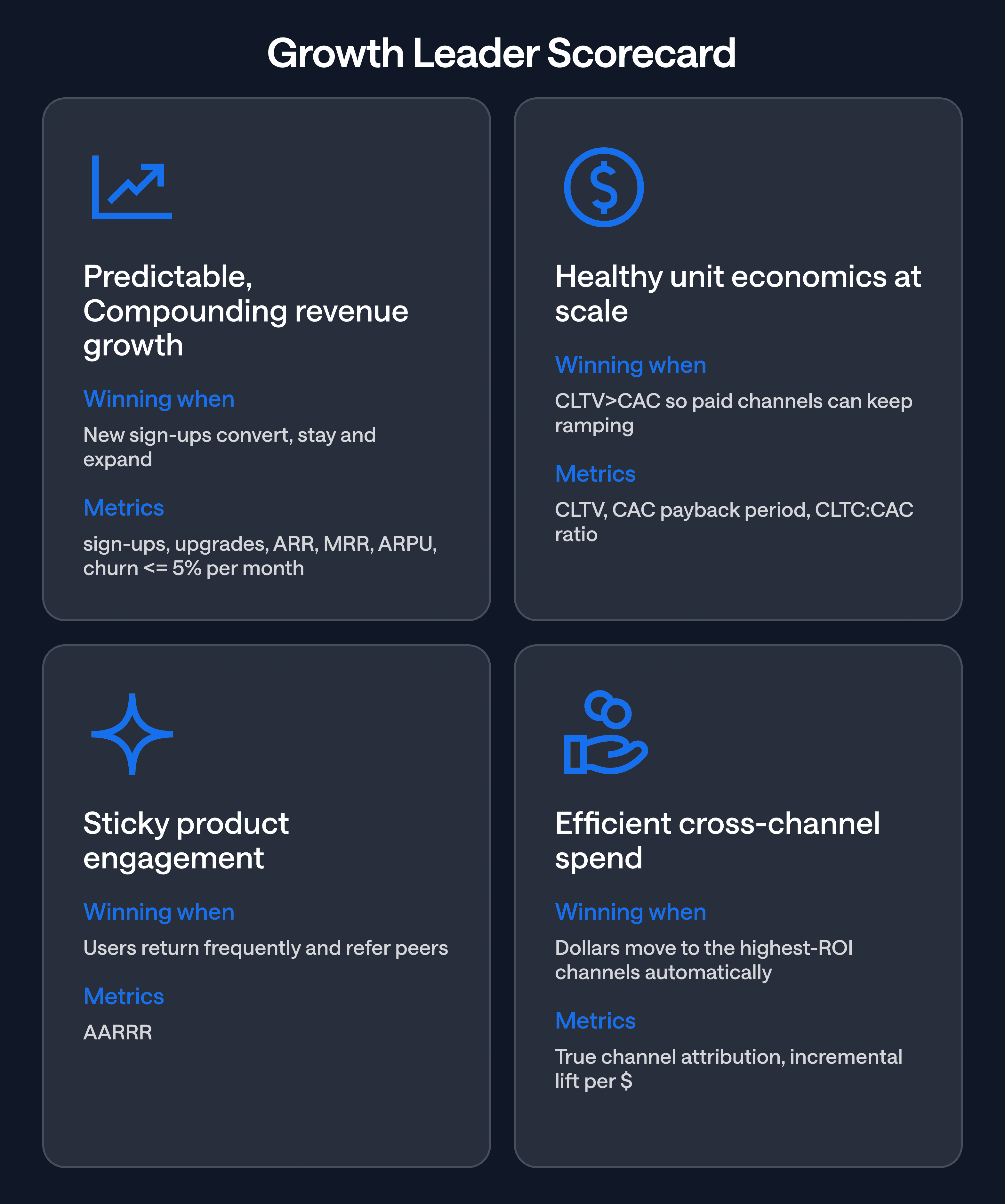
Growth Leader Scorecard: Objectives and Victory Conditions
Objectives, Victory Conditions & Metrics
Phase Entry and Exit Gates for Consumer AI Growth
You need clear finish lines so the CFO signs the cheques and the team sees progress.
Below are entry and exit criteria for each phase. A phase is only ‘done’ when it removes a pain point and advances a strategic objective. Entry and exit gates are hard numbers, not vibes. The numbers reflect 2025 consumer AI SaaS benchmarks.
Phase | Pain point resolved | Entry gate; Exit gate | Leading metrics |
|---|---|---|---|
Discovery | Churn hidden in growth | Churn trend unknown; Top 3 churn drivers isolated | Churn driver R2 > 0.7 |
Segmentation | Personalization debt | No personas with LTV data; JTBD + LTV personas live | LTV spread >= 4x |
Experimentation | Data sprawl & slow tests | < 3 valid tests/wk, 0 incr. tests/month; >= 10 tests/wk, 1-2 incr. tests/month | Test velocity, GeoLift cadence |
Scale orchestration | Attribution & cannibalization | CAC pay-back >10 months; <8 months | Incremental ROAS, CAC pay-back |
Review & control | Resource squeeze | No audit cycle; Quarterly Growth Audit sent | Audit on time, board NPS |
North-star metric → Net Revenue Retention (NRR); when NRR rises, you are compounding.
Supporting metrics → CAC pay-back, 90-day retention, burn multiple.
Key experimentation metrics → All-test velocity, incrementality cadence, cumulative ARR from “needle-mover” tests.
Consumer AI SaaS Metric Benchmarks
Metric | Median | Top quartile |
|---|---|---|
CAC pay-back (consumer SaaS) | 6 months (First Page Sage) | 3 months |
90-day retention | 30% (Pendo) | 45%+ |
CLTV : CAC | 3.0 (Benchmarkit) | 5.0+ |
NRR | 104% (SaaS Capital) | 118% |
Finance Lens
Pricing moves to outcome units, not seats. ElevenLabs tweaked ladders seven times in 40 days; Salesforce adopted outcome-based pricing with Agentforce’s $2 per conversation and Flex Credits models.
‘ARR + annualized usage’ replaces single ARR rows.
GPU cost per active user exposes margin leaks in real time.
Databricks feeds live telemetry into an AI forecast model, not Excel sheets.
Phases at a glance
Phase | Goal | Time box | Key output |
|---|---|---|---|
Discovery | Map demand & friction | 1-2 weeks | Insight memo |
Segmentation | Rank personas by LTV | 2 weeks | Persona deck |
Experimentation | 10+ rapid tests/wk; 1-2 incrementality tests/mo | Continuous | Unified test log |
Spend orchestration | Reallocate $ to real lift | Continuous | Weekly spend script |
Review & control | Institutionalize learnings | 2 days/quarter | Board deck |
Phase 1: Map Demand, Friction, and Churn Drivers
Pain point addressed → Churn hidden in growth
Why it matters → You cannot optimize what you cannot name. A clear demand map focuses limited tokens and GPU cycles.
Inputs → Analytics event stream, customer interviews (10 × 15 min), refund tags.
RACI → R Data analyst; A Growth Manager; C Support lead; I VP Eng.
Steps
Export last 60 days events; run Pareto on time-to-value.
Conduct five in-app polls to capture intent; tag JTBD.
Cluster qualitative answers using thematic AI (e.g., GPT-5) to surface JTBD; isolate top 5 churn drivers.
Present findings in 15-slide memo.
Quality checklist
At least 200 survey responses
Clusters explain 80% of churn reasons
Outputs → Insight memo, updated taxonomy.
KPIs → Survey completion, activation time delta.
Phase 2: Rank Personas by LTV and Monetizability
Pain point addressed → Personalization debt
Goal → Turn raw insights into monetizable personas.
Inputs → Event taxonomy, JTBD clusters, spend cohorts.
RACI → R Data science; A VP Growth; C Product design; I Support.
Broad steps
Use BlueAlpha to build a RFM (recency-frequency-monetary) table.
Layer JTBD tags.
Compute LTV distribution; flag top decile.
Draft persona pages; align each persona with messaging & value prop.
Checklist
Segments mutually exclusive & collectively exhaustive
LTV spread >4× between top and bottom quartile.
Typical duration → 2 weeks.
Outputs → Persona one-pagers.
KPIs → LTV spread, segment coverage.
Phase 3: Run 10+ Tests per Week with GeoLift Cadence
Pain point addressed → Data sprawl & slow tests
RACI → R Experiment owner; A Head of Growth; C Data science; I Legal (for privacy).
3A. Rapid-cycle tests
Goal → Find small wins fast: pricing copy, UX tweaks, creative angles.
Cadence → ≥ 10 per week.
Tooling → In-app A/B platform, feature flags.
Steps
Pull backlog ideas into a Kanban board every Monday.
Pre-register goal + MDE; design runs 1–3 days.
Deploy to 100 % when lift > 2 % and p < 0.05.
Log result in BlueAlpha test ledger.
3B. Incrementality tests (GeoLift / MMM refresh)
Goal → Answer strategic spend questions (e.g. “What is YouTube really worth after cannibalization?”)
Cadence → 1-2 tests per month (2-3 weeks runtime for each test).
Tooling → BlueAlpha GeoLift wizard + BlueAlpha Bayesian MMM.
Steps
Frame a question tied to budget action (e.g. shift 20% from Meta to TikTok).
BlueAlpha selects for you geo clusters large enough for 80% power.
Freeze other media variables in test regions to reduce confounds.
Run test 21 days; BlueAlpha updates MMM priors with lift estimate.
If incremental ROAS delta > +15%, move spend; if negative, pause.
Close the loop: document action and measured impact.
Quality checklist
No overlapping incrementality tests in adjacent DMAs.
Post-test decision written before the test starts.
Lift fed back into MMM the same day results lock.
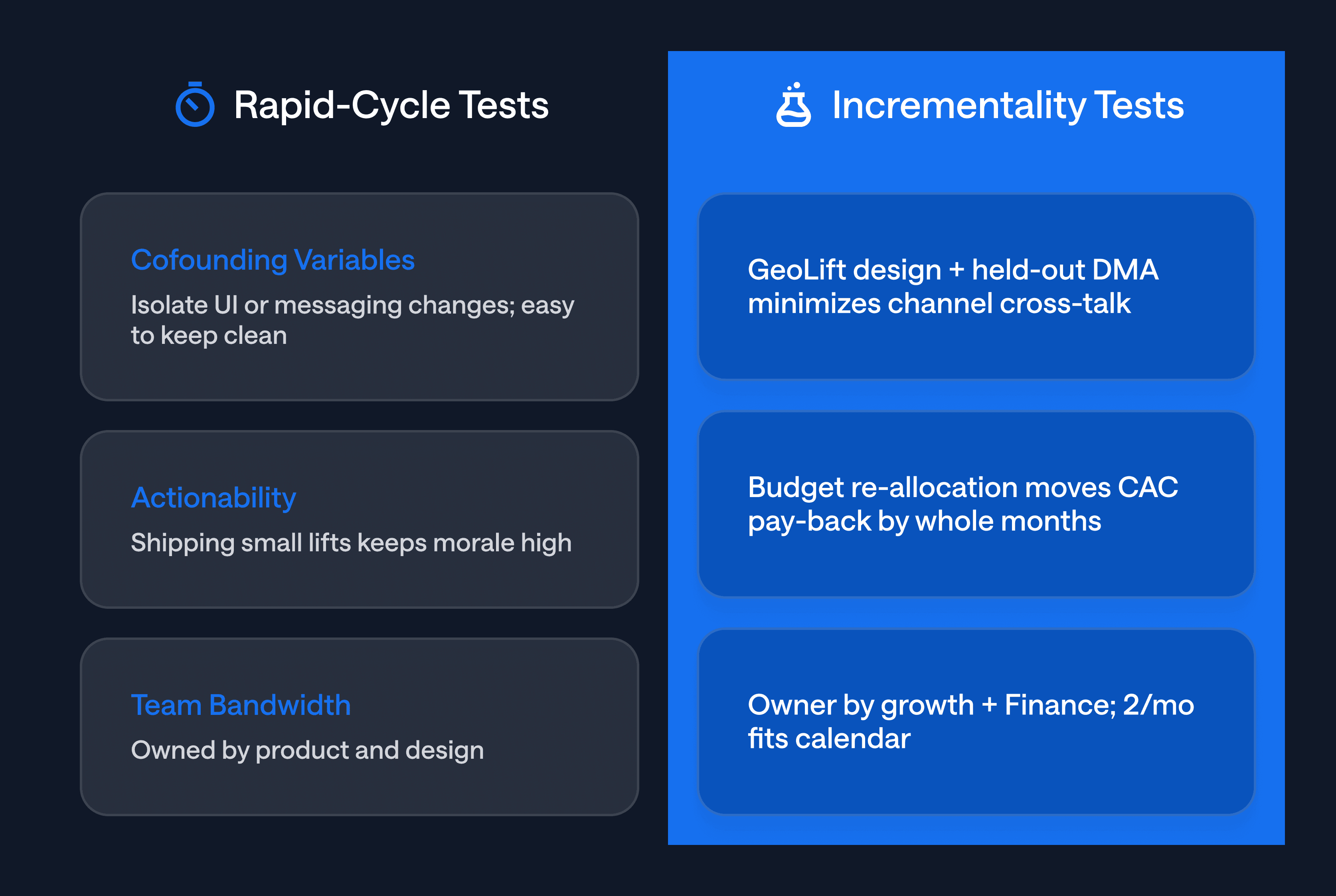
Best practice: Run lots of cheap tests, but treat incrementality tests like capital projects. Two high-confidence GeoLift studies per month drive more margin than twenty guess-and-check budget tweaks.
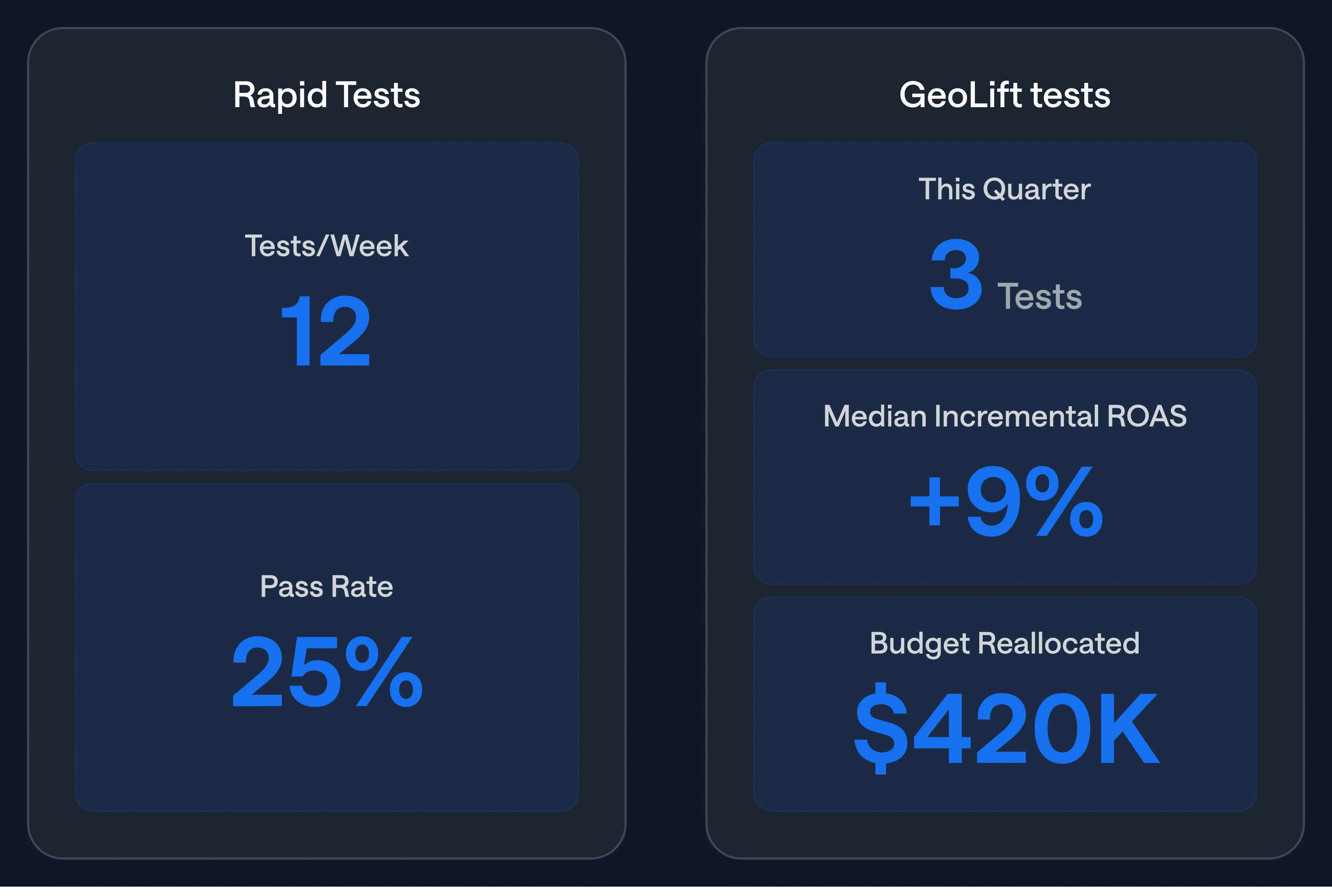
Benchmarks & dashboards - Your dashboard template should show separate panels: Rapid tests on the left, GeoLift tests on the right, so executives see both the volume of learning and the big dollar shifts.
Phase 4: Reallocate Spend to Highest Marginal Lift
Pain point addressed → Attribution & channel cannibalization
Goal → Move dollars to highest marginal lift.
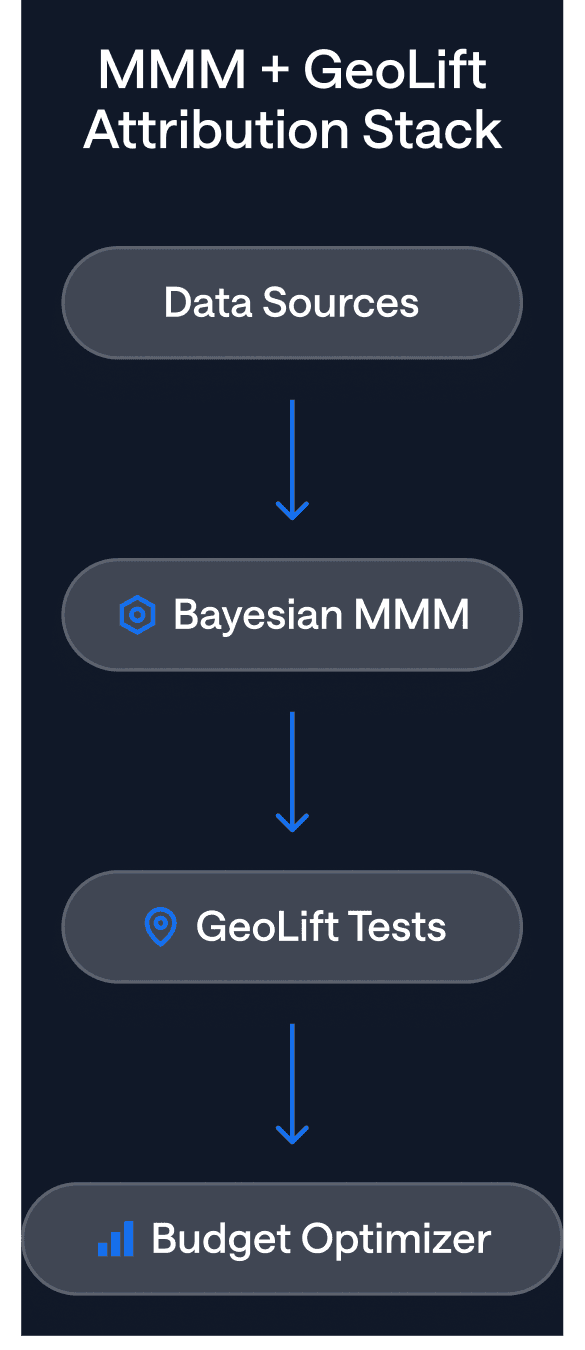
Inputs → Unified channel-cost (or campaign-cost) table, BlueAlpha Bayesian MMM with time-varying betas.
RACI → R Media buyer; A VP Growth / CMO; C Finance lead; I CEO.
Steps
BlueAlpha MMM runs weekly, fitting last 1-2 years of data; coefficients auto-update.
GeoLift test outputs weight recent betas higher than old ones, preventing cannibalization bias.
BlueAlpha recommends budget reallocation when incremental ROAS delta >15%.
Freeze budgets if CAC pay-back rises above 8 months.
Checklist
Attribution error <10% vs. hold-out
Spend shift executed by 9AM each Monday
Outputs → Spend rebalancing log, incrementality dashboard.
KPIs → CAC pay-back, marginal ROAS.
Phase 5: Quarterly Growth Audit and Board Readiness
Pain point addressed → Resource squeeze
Goal → Institutionalize what worked, sunset what did not.
Inputs → All test logs, KPI dashboards, finance actuals.
RACI → R Ops analyst; A VP Growth; C Board observers; I Growth PM.
Steps
Auto-generate Growth Audit from BlueAlpha dashboard: North Star Metric trend, KPI ladder, cash burn.
Map tests to financial impact → cumulative incremental ARR by channel/campaign.
Set next-quarter OKRs; archive orphan road-map items.
Checklist
Audit delivered 5 days before board
Less than 15 slides
Outputs → QBR deck, updated OKRs.
KPIs → Audit completion on time, board satisfaction score.
Dashboard design
Top row → NRR, 90-day retention, CAC pay-back.
Second row → Test velocity, win rate.
Third row → Cash runway, burn multiple.
Troubleshooting: What to Do When Metrics Go Sideways
If this happens | Do this |
|---|---|
Incremental ROAS negative after GeoLift | Pause channel; rerun creative test; cross-check cannibalization in MMM |
CAC pay-back > 10 months in Phase 4 | Re-run channel incrementality test. Cut bottom quartile creatives. Cut spend on channels with <1.5 incremental ROAS |
Test win rate <15% in Phase 3 | Review hypothesis quality; enforce pre-registration; raise minimum detectable effect. |
NRR <100% at Phase 5 review | Trigger expansion nudges tied to power-user milegrays. |
90-Day Retention Benchmarks for Consumer AI SaaS
What good looks like for 90-day retention in consumer AI SaaS
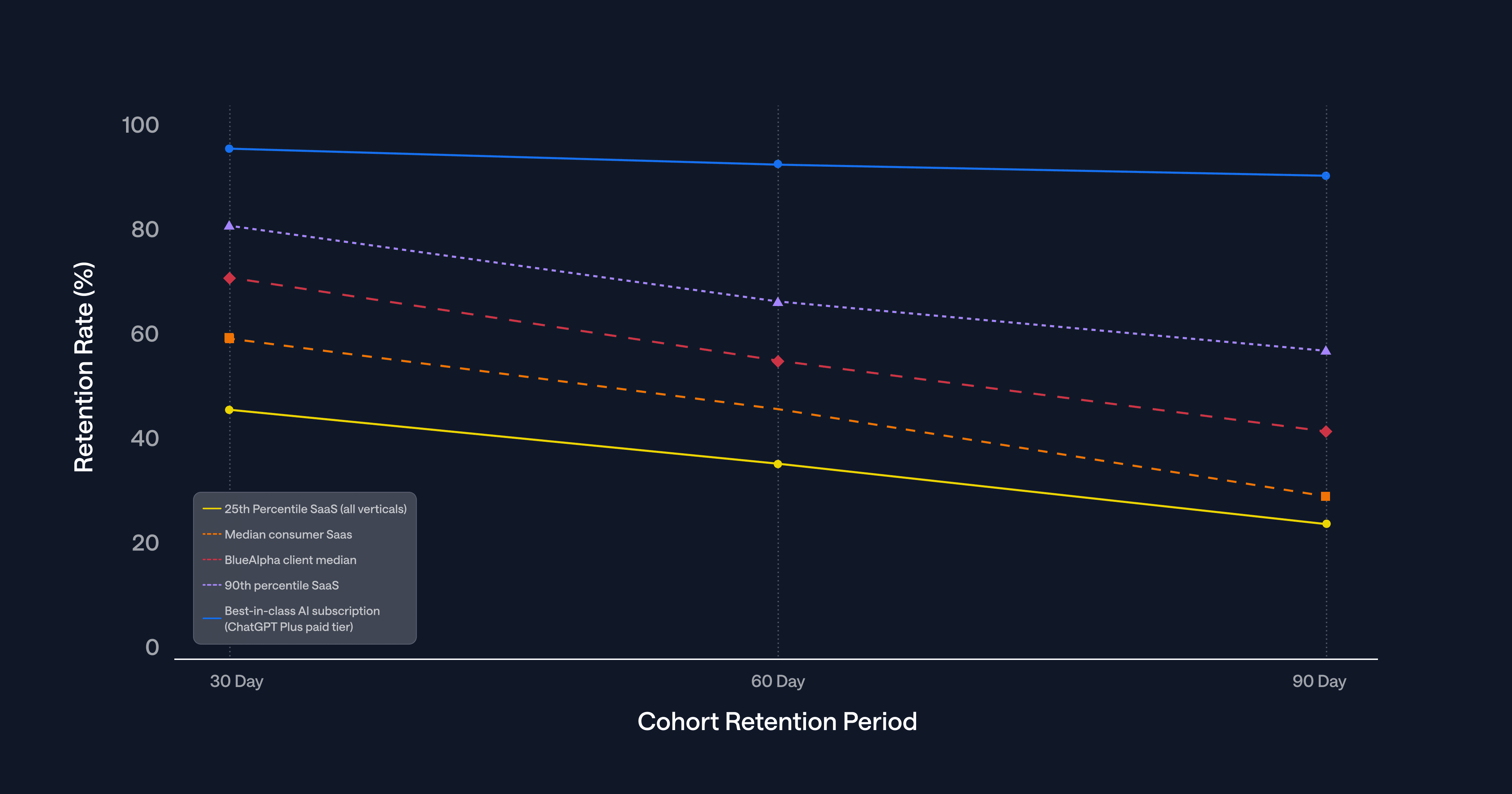
Cohort benchmark | 30-day retention | 60-day retention | 90-day retention | Source |
|---|---|---|---|---|
25th-percentile SaaS (all verticals) | 46% | 36% | 25% | |
Median consumer SaaS | 59% | 46% | 30% | Pendo 2025 panel |
BlueAlpha client median | 70% | 55% | 42% | BlueAlpha anonymized data |
90th-percentile SaaS | 80% | 66% | 57% | Pendo 2025 panel |
Best-in-class AI subscription (ChatGPT Plus paid tier) | 94% | 91% | 89% |
What Worked: Insights from beehiiv's Growth Team
What finally fixed attribution, retention, or both, according to peers who have already cracked the code
“Linking our CDP to acquisition sources let us see which ads drove the people who actually open newsletters and stick. We now run different nurture paths depending on where a user came from. Newsletter cadence tests are our fastest churn lever.” — Tony Varghese, Senior Marketing Manager, Lifecycle and Product @ beehiiv
In the following deep-dive conversation, EJ White (former Head of Growth at beehiiv) shares how they allocate marketing budgets between brand awareness and direct response channels to achieve their 3x+ LTV:CAC target.
Closing
Your team stands at the helm of a market growing 48% year-on-year but already crowded with hundreds of publicly tracked consumer AI apps. Apply this playbook, and you switch from gut-feel campaigns to defensible, data-compounding loops.
Predictable growth demands that every dollar you deploy is incremental, not cannibalized. Armed with reliable incrementality proof and real-time cost visibility, you can scale tests and campaigns without fear of wasting a cent.
That is how you beat rivals, earn the finance chief's respect, and cement your place as the hero of your company's AI story.
BlueAlpha's Causal Measurement Agent runs the weekly Bayesian MMM and GeoLift infrastructure described in Phases 3 and 4 of this playbook. If your consumer AI company is spending $500K+ monthly on paid acquisition and your measurement stack cannot answer "which dollars are incremental," that is the conversation we are built for.
Book a 30-Minute Strategy Call
FAQ
How many incrementality tests should a consumer AI SaaS company run per month?
One to two GeoLift tests per month at two to three weeks runtime each. These are the high-confidence, capital-allocation-grade tests that drive budget shifts. Run them alongside 10+ rapid-cycle A/B tests per week for smaller UX and creative wins. The two testing tracks serve different purposes: rapid tests find small wins fast, incrementality tests answer strategic spend questions.
What is a good CAC payback period for consumer AI SaaS?
Median CAC payback for consumer SaaS is 6 months. Top quartile achieves 3 months. If your payback exceeds 10 months, Phase 4 of this playbook recommends freezing budgets and rerunning channel incrementality tests to identify where spend is leaking into non-incremental channels.
How do I prove marketing ROI to my CFO for an AI product?
Translate channel-level results into finance-ready language: incremental ROAS by channel with confidence intervals, CAC payback in months, and NRR trend. The Growth Audit in Phase 5 produces a 15-slide board deck that maps test results to cumulative incremental ARR by channel. Finance teams respond to "this channel drove $X in incremental ARR at Y% confidence," not "ROAS improved."
What retention rate should I target for a consumer AI subscription?
Median 90-day retention for consumer SaaS is 30%. Top quartile is 45%+. BlueAlpha's client median for consumer AI products is 42%. ChatGPT Plus, the category leader, holds 89% at 90 days. If your 90-day retention is below 30%, fix churn before scaling acquisition spend.
How do I detect channel cannibalization in a multi-channel AI product?
Run a GeoLift test that isolates one channel at a time. Compare the channel's MMM-attributed contribution to its incrementality test result. If the MMM says a channel drives 20% of conversions but the GeoLift shows 5% incremental lift, the gap is cannibalization. Phase 4 of this playbook describes how to use these results to rebalance spend.
Is this playbook relevant if we are pre-Series A?
The measurement framework scales down. Pre-Series A teams with $50K-$100K monthly spend can run the Phase 1 discovery and Phase 2 segmentation without MMM infrastructure. Once spend reaches $500K+ monthly across three or more channels, the GeoLift and MMM components in Phases 3 and 4 become essential. The earlier you establish incrementality discipline, the less budget you waste during scale.

