How Klover Proved Influencer Marketing ROI on iOS
BlueAlpha proved influencer incrementality for Klover: YouTube sponsorships drive ~10% of iOS conversions. Measurability calculator built for evaluating future creator deals.
Incrementality Proven
"The struggle with influencer marketing is you pay $10,000 for someone to post a video, and then you're stuck relying on last-touch attribution or just eyeballing daily installs. That's not real measurement. BlueAlpha integrated our Agentio data into the MMM and proved real contribution - then gave us a measurability calculator so we can vet any creator partnership before committing budget."
"The struggle with influencer marketing is you pay $10,000 for someone to post a video, and then you're stuck relying on last-touch attribution or just eyeballing daily installs. That's not real measurement. BlueAlpha integrated our Agentio data into the MMM and proved real contribution - then gave us a measurability calculator so we can vet any creator partnership before committing budget."

Scott Whittemore Growth Analytics Manager @ Attain/Klover
BlueAlpha integrated YouTube influencer spend and view data from Agentio into Klover's always-on Bayesian MMM and proved that creator sponsorships drive approximately 10% of iOS conversions and 7.5% of Android conversions. The team then built a measurability calculator that evaluates any influencer deal's expected signal-to-noise ratio before budget is committed, turning creator partnerships from speculative bets into calculated portfolio decisions.
Programmatic Was Solved. Influencer Was the Blind Spot
Klover, a fintech cash-advance app with millions of users, had already optimized its programmatic channels with BlueAlpha: Meta iOS spend cut 50% with zero conversion loss, Apple Search Ads scaled 10x while remaining incremental. The measurement system was working for paid media.
Now the team faced a different challenge: influencer marketing. Klover was partnering with YouTube creators through Agentio, an AI-native platform for buying and managing influencer investments. The channel showed promise based on AppsFlyer's last-touch logic, but last-touch is the wrong framework for measuring creator-driven journeys: it misses non-click, cross-device, and delayed conversion behavior that is typical when someone watches a YouTube video and converts hours or days later on a different device.
Influencer Spend Is Lumpy, Delayed, and Invisible to Last-Touch
YouTube influencer marketing breaks the assumptions of standard performance measurement. Programmatic ads generate continuous signals (impressions, clicks, conversions flow steadily), giving models data to learn from in real time. Influencer spend is deployed upfront while impact compounds over time as creator content continues generating views and conversions long after the initial post. As John Stavropoulos, Marketing Lead at Attain/Klover, framed the concern: "Is the model factoring into account that for Agentio specifically, unlike other channels, there is this compounding effect and delayed conversion, more delayed than any other channel?"
The broader measurement gap was even more fundamental. John described it directly: "The struggle that we face is that a lot of people want to experiment with influencers. They want to pay $10,000 and have someone post a video or an Instagram story, but it's just very hard to measure the incrementality beyond just looking at the difference in daily installs. Which is what people are doing nowadays mainly."
The questions stacking up were familiar to any growth team scaling creator partnerships: Is Agentio driving new users, or just capturing people who would have found Klover anyway? Which YouTube channels perform better than others? How do we evaluate a new creator deal before signing, and what's the minimum audience size that would even register in the data?
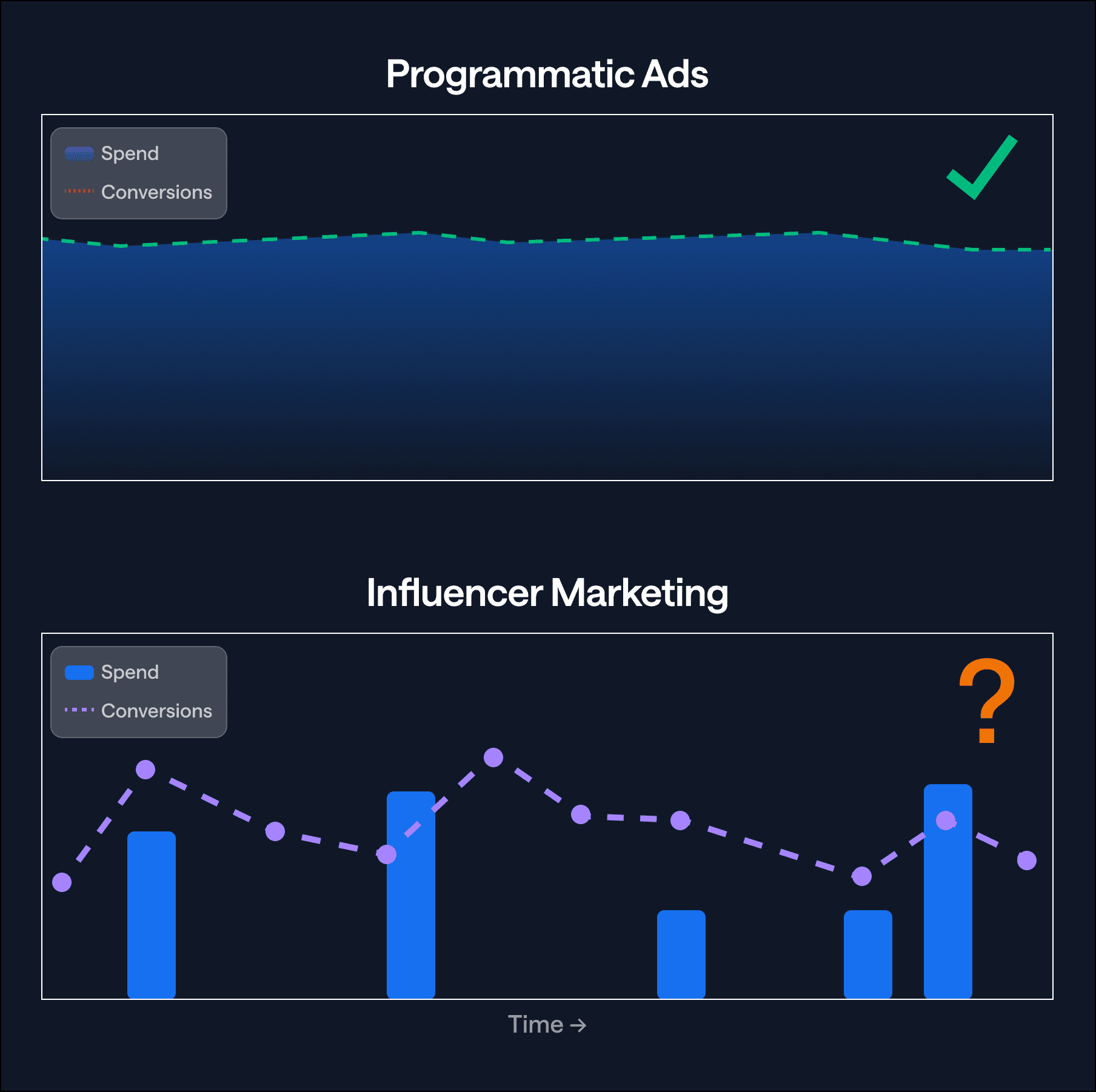
The challenge of influencer marketing measurement: lumpy spend vs. continuous signals.
BlueAlpha's Approach
BlueAlpha deployed a three-phase methodology designed specifically for lumpy, hard-to-measure channels like influencer marketing.
Phase 1: Deep data integration (Weeks 1-2)
Unlike programmatic platforms with standard API connections, Agentio data required custom integration. BlueAlpha built a pipeline capturing weekly spend by campaign, views over time (the daily/weekly trajectory as videos gained traction, not just total views), and YouTube channel granularity via Agentio's reporting to enable channel-level performance analysis. The key modeling decision: rather than treating influencer spend like programmatic spend (point-of-click), BlueAlpha modeled the relationship between accumulated views and downstream conversions, capturing the delayed, distributed impact of creator content.
Phase 2: Contribution measurement (Weeks 3-4)
With data flowing, BlueAlpha's MMM revealed what last-touch metrics could not: the causal contribution of Agentio to conversions on each platform. iOS model: approximately 10% contribution to weekly conversions. Android model: approximately 7.5% contribution. The model also established a baseline metric: Agentio delivered approximately 2 conversions per 1,000 video views, with natural fluctuation between 1 and 3 depending on content and audience.
Phase 3: The measurability system (Weeks 5-6)
Proving Agentio worked was step one. The growth team needed something more operational. John had described exactly what he wanted: "If I use this little tool and I input the average engagement and impressions from an influencer's media kit, then we can piece that together and say: alright, this influencer fits the minimum requirements where we would be able to measure impact."
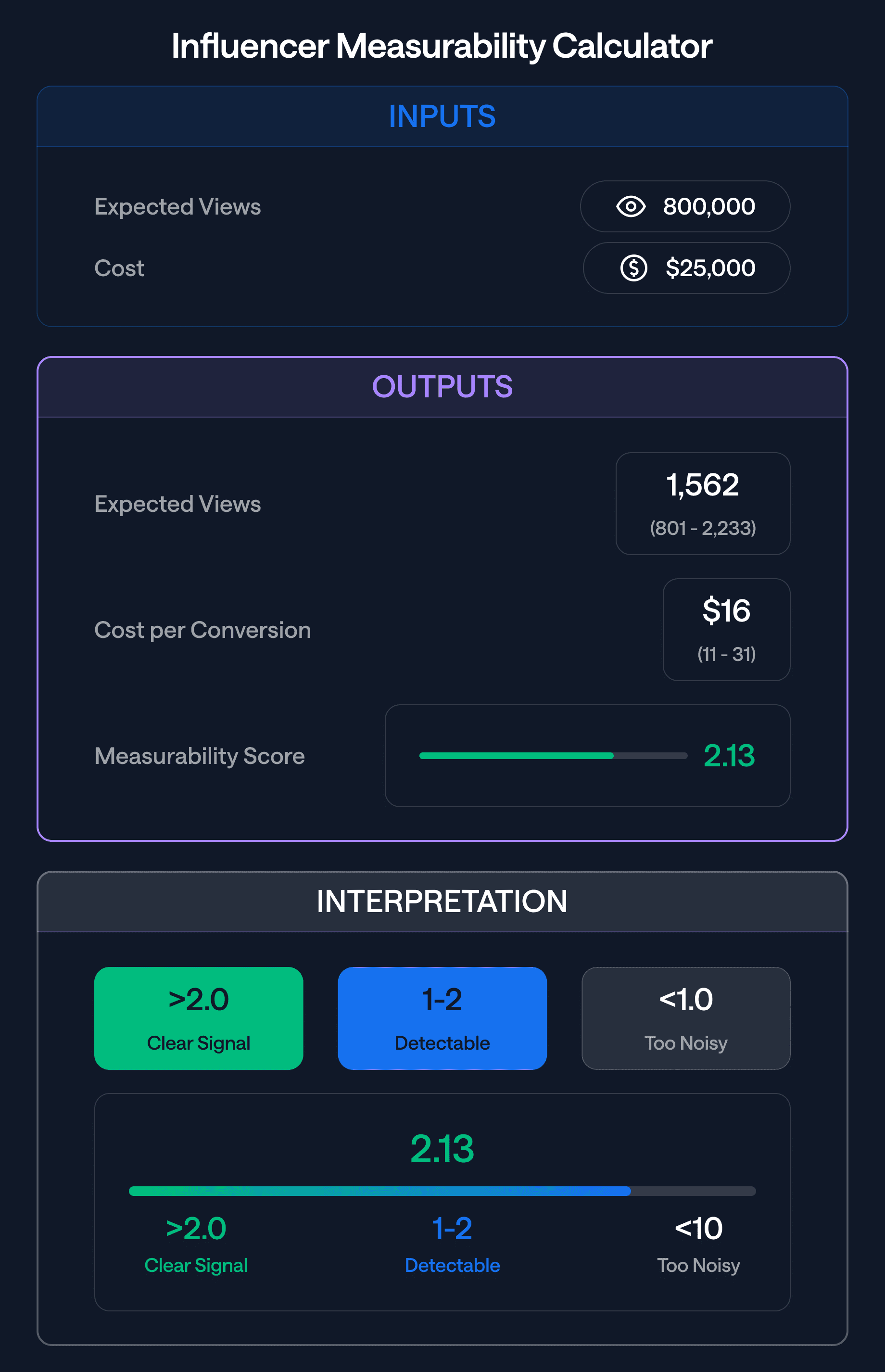
BlueAlpha built a custom measurability calculator that takes two inputs (expected views from the media package, and cost of the deal) and outputs expected conversions based on Agentio's proven conversions-per-view rate, cost per conversion with confidence ranges, and a Measurability Score indicating whether the expected lift would stand out from natural fluctuation.
How to interpret the Influencer Measurability Score:
Above 2 means the effect will clearly stand out from noise.
Between 1 and 2 means the effect is detectable over a few weeks of monitoring.
Below 0.5 means the effect is smaller than normal weekly fluctuation and is effectively unmeasurable.
Klover's weekly conversions fluctuate by roughly 10% naturally, so any creator deal needs to produce enough expected volume to clear that noise floor.
The team's reaction when the calculator was delivered: "This is literally exactly what we were looking for. The measurability score, that's what's so valuable to us."
Last-Touch vs. MMM: ~10% iOS, ~7.5% Android Contribution
Metric | AppsFlyer Last-Touch View | MMM Incremental Read (iOS) | MMM Incremental Read (Android) |
|---|---|---|---|
Channel contribution | Unknown (last-touch cannot isolate influencer contribution from organic) | ~10% of weekly conversions | ~7.5% of weekly conversions |
Cost per conversion | Unreliable (over-credits click-based, under-credits view-through) | Competitive with established programmatic channels | Competitive with established programmatic channels |
Measurement confidence | Low (wrong framework for creator-driven journeys) | High (calibrated MMM with views-over-time integration) | High |
Influencer Validated, Measurability Calculator Deployed
Influencer channel validated. Agentio earned its place in the marketing portfolio with measurable, causal contribution to conversions on both iOS and Android. The incremental cost per conversion was competitive with Klover's established programmatic channels, confirming that creator partnerships are a cost-effective acquisition path when properly measured.
Channel-level intelligence unlocked. With 38 YouTube channels tracked (scaling to 100+), Klover now has visibility into relative performance by creator. John framed the operational value: "How do we distinguish a very high impact, low spending creator versus maybe a creator that spends a lot but actually drives nothing?" The data now answers that question.
A reusable decision framework deployed. The measurability calculator is a permanent addition to the growth team's toolkit: evaluate any new influencer partnership before signing, set minimum audience thresholds for one-off sponsorships, compare expected ROI across creator packages, and make data-driven renewal decisions.
Confidence to scale. Klover now scales influencer spend with conviction. As John summarized: "We've been scaling Facebook and TikTok very aggressively, very quickly, and we've been relying on the curves in the media mix model." The same confidence now extends to the influencer channel, with every dollar tied to expected outcomes and monitored in the MMM.
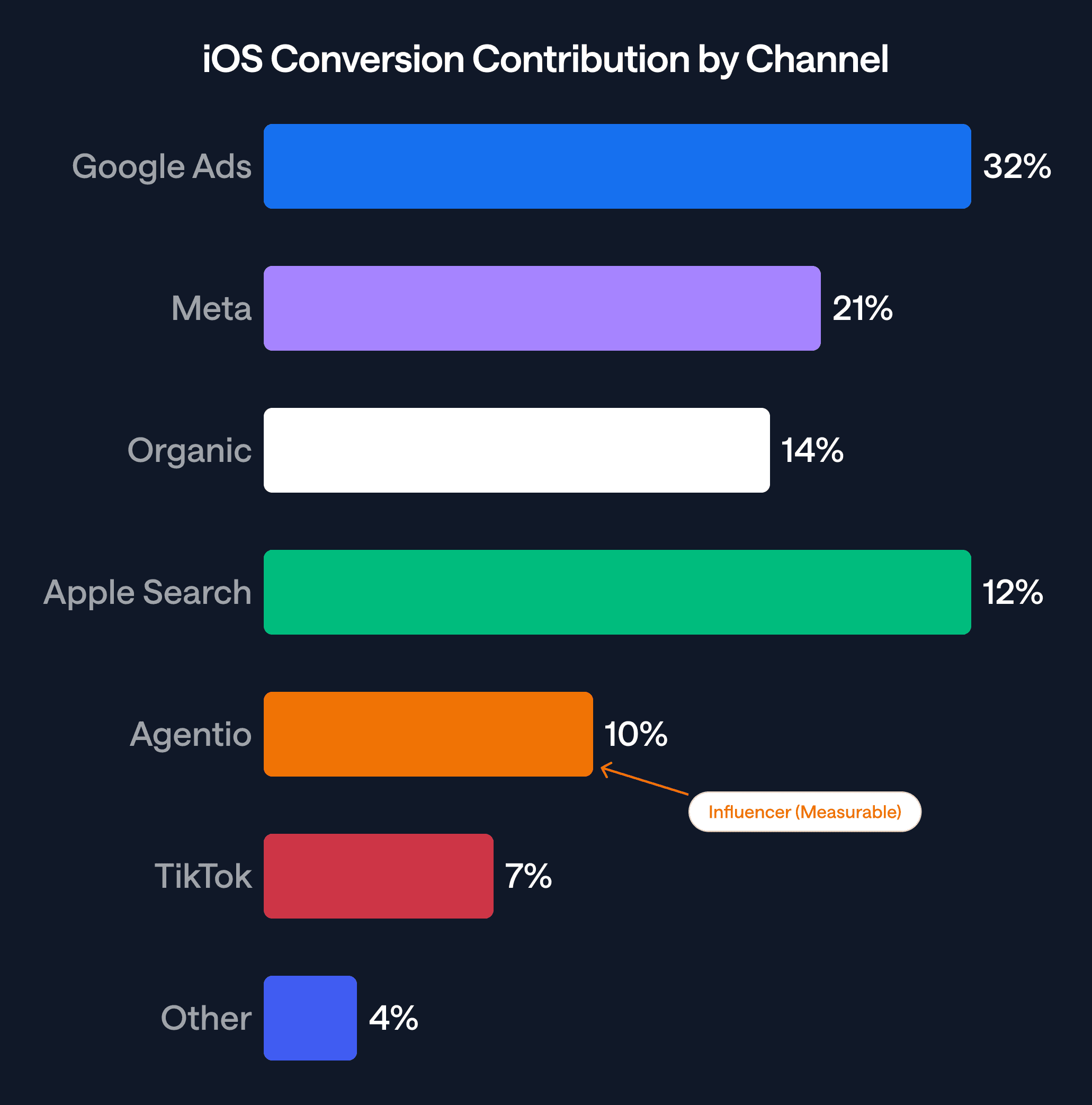
Contribution chart showing Agentio alongside other channels, demonstrating its relative contribution. This positions influencer marketing as a legitimate, measurable channel within the broader mix.
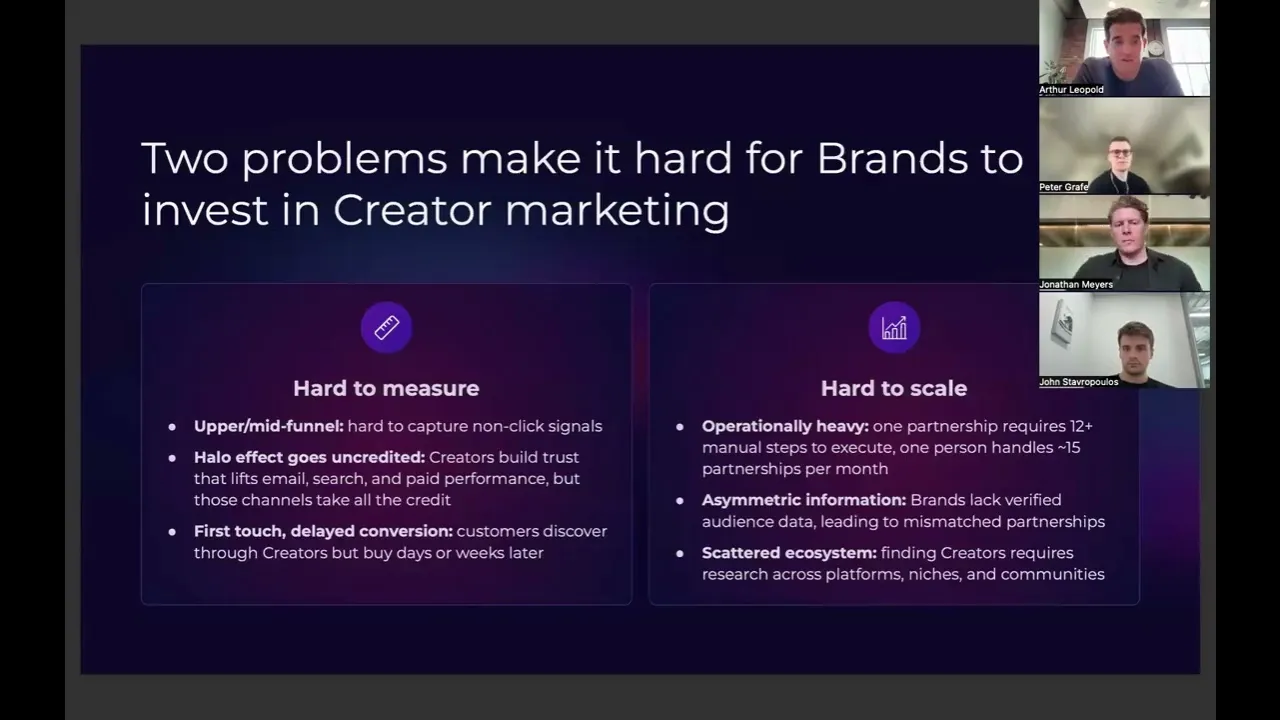
Watch: Proving the Incrementality of YouTube Creator Marketing
The results above are the measurement read. In this session, Klover's growth team gives the operator's account of the same engagement: what it took to get from integration to a decision-grade read, what changed once the contribution was proven, and how creator spend now scales weekly with no added headcount. Agentio joins to explain the delivery data that made the model possible and the creator matching system that made scale practical.
Key moments:
22:00 The test: three weeks to an incrementality read.
23:00 The results, and doubling quarterly creator spend.
30:00 How to know if a creator deal is even measurable.
37:00 Which creators worked for Klover, and why broad won.
41:00 Licensing creator videos as paid social and CTV ads.
Speakers: Arthur Leopold (Co-founder and CEO, Agentio), Jonathan Meyers (Co-founder and CTO, Agentio), Peter Grafe (Co-founder and CEO, BlueAlpha), John Stavropoulos (Growth Lead, Klover).
Creator Partnerships Scaling to 100+ YouTube Channels
Klover's influencer measurement system continues to evolve. The team is expanding creator partnerships through Agentio while monitoring contribution in real time. As data accumulates across 100+ YouTube channels, BlueAlpha provides guidance on which creator relationships deliver strongest relative conversions-per-view rates. The measurability calculator methodology, built on Agentio data, extends to any influencer spend: one-off Instagram posts, podcast sponsorships, TikTok creator deals can all be evaluated using the same signal-to-noise framework.
Spending on influencer marketing without knowing if it's incremental? Book a strategy call to discuss how to integrate creator partnerships into your measurement system and build a deal-evaluation framework before your next commitment.
"The struggle with influencer marketing is you pay $10,000 for someone to post a video, and then you're stuck relying on last-touch attribution or just eyeballing daily installs. That's not real measurement. BlueAlpha integrated our Agentio data into the MMM and proved real contribution - then gave us a measurability calculator so we can vet any creator partnership before committing budget."
Scott Whittemore Growth Analytics Manager @ Attain/Klover
BlueAlpha integrated YouTube influencer spend and view data from Agentio into Klover's always-on Bayesian MMM and proved that creator sponsorships drive approximately 10% of iOS conversions and 7.5% of Android conversions. The team then built a measurability calculator that evaluates any influencer deal's expected signal-to-noise ratio before budget is committed, turning creator partnerships from speculative bets into calculated portfolio decisions.
Programmatic Was Solved. Influencer Was the Blind Spot
Klover, a fintech cash-advance app with millions of users, had already optimized its programmatic channels with BlueAlpha: Meta iOS spend cut 50% with zero conversion loss, Apple Search Ads scaled 10x while remaining incremental. The measurement system was working for paid media.
Now the team faced a different challenge: influencer marketing. Klover was partnering with YouTube creators through Agentio, an AI-native platform for buying and managing influencer investments. The channel showed promise based on AppsFlyer's last-touch logic, but last-touch is the wrong framework for measuring creator-driven journeys: it misses non-click, cross-device, and delayed conversion behavior that is typical when someone watches a YouTube video and converts hours or days later on a different device.
Influencer Spend Is Lumpy, Delayed, and Invisible to Last-Touch
YouTube influencer marketing breaks the assumptions of standard performance measurement. Programmatic ads generate continuous signals (impressions, clicks, conversions flow steadily), giving models data to learn from in real time. Influencer spend is deployed upfront while impact compounds over time as creator content continues generating views and conversions long after the initial post. As John Stavropoulos, Marketing Lead at Attain/Klover, framed the concern: "Is the model factoring into account that for Agentio specifically, unlike other channels, there is this compounding effect and delayed conversion, more delayed than any other channel?"
The broader measurement gap was even more fundamental. John described it directly: "The struggle that we face is that a lot of people want to experiment with influencers. They want to pay $10,000 and have someone post a video or an Instagram story, but it's just very hard to measure the incrementality beyond just looking at the difference in daily installs. Which is what people are doing nowadays mainly."
The questions stacking up were familiar to any growth team scaling creator partnerships: Is Agentio driving new users, or just capturing people who would have found Klover anyway? Which YouTube channels perform better than others? How do we evaluate a new creator deal before signing, and what's the minimum audience size that would even register in the data?
The challenge of influencer marketing measurement: lumpy spend vs. continuous signals.
BlueAlpha's Approach
BlueAlpha deployed a three-phase methodology designed specifically for lumpy, hard-to-measure channels like influencer marketing.
Phase 1: Deep data integration (Weeks 1-2)
Unlike programmatic platforms with standard API connections, Agentio data required custom integration. BlueAlpha built a pipeline capturing weekly spend by campaign, views over time (the daily/weekly trajectory as videos gained traction, not just total views), and YouTube channel granularity via Agentio's reporting to enable channel-level performance analysis. The key modeling decision: rather than treating influencer spend like programmatic spend (point-of-click), BlueAlpha modeled the relationship between accumulated views and downstream conversions, capturing the delayed, distributed impact of creator content.
Phase 2: Contribution measurement (Weeks 3-4)
With data flowing, BlueAlpha's MMM revealed what last-touch metrics could not: the causal contribution of Agentio to conversions on each platform. iOS model: approximately 10% contribution to weekly conversions. Android model: approximately 7.5% contribution. The model also established a baseline metric: Agentio delivered approximately 2 conversions per 1,000 video views, with natural fluctuation between 1 and 3 depending on content and audience.
Phase 3: The measurability system (Weeks 5-6)
Proving Agentio worked was step one. The growth team needed something more operational. John had described exactly what he wanted: "If I use this little tool and I input the average engagement and impressions from an influencer's media kit, then we can piece that together and say: alright, this influencer fits the minimum requirements where we would be able to measure impact."
BlueAlpha built a custom measurability calculator that takes two inputs (expected views from the media package, and cost of the deal) and outputs expected conversions based on Agentio's proven conversions-per-view rate, cost per conversion with confidence ranges, and a Measurability Score indicating whether the expected lift would stand out from natural fluctuation.
How to interpret the Influencer Measurability Score:
Above 2 means the effect will clearly stand out from noise.
Between 1 and 2 means the effect is detectable over a few weeks of monitoring.
Below 0.5 means the effect is smaller than normal weekly fluctuation and is effectively unmeasurable.
Klover's weekly conversions fluctuate by roughly 10% naturally, so any creator deal needs to produce enough expected volume to clear that noise floor.
The team's reaction when the calculator was delivered: "This is literally exactly what we were looking for. The measurability score, that's what's so valuable to us."
Last-Touch vs. MMM: ~10% iOS, ~7.5% Android Contribution
Metric | AppsFlyer Last-Touch View | MMM Incremental Read (iOS) | MMM Incremental Read (Android) |
|---|---|---|---|
Channel contribution | Unknown (last-touch cannot isolate influencer contribution from organic) | ~10% of weekly conversions | ~7.5% of weekly conversions |
Cost per conversion | Unreliable (over-credits click-based, under-credits view-through) | Competitive with established programmatic channels | Competitive with established programmatic channels |
Measurement confidence | Low (wrong framework for creator-driven journeys) | High (calibrated MMM with views-over-time integration) | High |
Influencer Validated, Measurability Calculator Deployed
Influencer channel validated. Agentio earned its place in the marketing portfolio with measurable, causal contribution to conversions on both iOS and Android. The incremental cost per conversion was competitive with Klover's established programmatic channels, confirming that creator partnerships are a cost-effective acquisition path when properly measured.
Channel-level intelligence unlocked. With 38 YouTube channels tracked (scaling to 100+), Klover now has visibility into relative performance by creator. John framed the operational value: "How do we distinguish a very high impact, low spending creator versus maybe a creator that spends a lot but actually drives nothing?" The data now answers that question.
A reusable decision framework deployed. The measurability calculator is a permanent addition to the growth team's toolkit: evaluate any new influencer partnership before signing, set minimum audience thresholds for one-off sponsorships, compare expected ROI across creator packages, and make data-driven renewal decisions.
Confidence to scale. Klover now scales influencer spend with conviction. As John summarized: "We've been scaling Facebook and TikTok very aggressively, very quickly, and we've been relying on the curves in the media mix model." The same confidence now extends to the influencer channel, with every dollar tied to expected outcomes and monitored in the MMM.
Contribution chart showing Agentio alongside other channels, demonstrating its relative contribution. This positions influencer marketing as a legitimate, measurable channel within the broader mix.
Watch: Proving the Incrementality of YouTube Creator Marketing
The results above are the measurement read. In this session, Klover's growth team gives the operator's account of the same engagement: what it took to get from integration to a decision-grade read, what changed once the contribution was proven, and how creator spend now scales weekly with no added headcount. Agentio joins to explain the delivery data that made the model possible and the creator matching system that made scale practical.
Key moments:
22:00 The test: three weeks to an incrementality read.
23:00 The results, and doubling quarterly creator spend.
30:00 How to know if a creator deal is even measurable.
37:00 Which creators worked for Klover, and why broad won.
41:00 Licensing creator videos as paid social and CTV ads.
Speakers: Arthur Leopold (Co-founder and CEO, Agentio), Jonathan Meyers (Co-founder and CTO, Agentio), Peter Grafe (Co-founder and CEO, BlueAlpha), John Stavropoulos (Growth Lead, Klover).
Creator Partnerships Scaling to 100+ YouTube Channels
Klover's influencer measurement system continues to evolve. The team is expanding creator partnerships through Agentio while monitoring contribution in real time. As data accumulates across 100+ YouTube channels, BlueAlpha provides guidance on which creator relationships deliver strongest relative conversions-per-view rates. The measurability calculator methodology, built on Agentio data, extends to any influencer spend: one-off Instagram posts, podcast sponsorships, TikTok creator deals can all be evaluated using the same signal-to-noise framework.
Spending on influencer marketing without knowing if it's incremental? Book a strategy call to discuss how to integrate creator partnerships into your measurement system and build a deal-evaluation framework before your next commitment.