How to Grow When Your Strongest Channel Looks Saturated
Meta description: A four-part diagnostic framework for growth teams: prove whether your dominant channel is truly saturated before committing to a budget reallocation.
Why Most Teams Misdiagnose Channel Saturation
Problem: Your strongest channel, the one driving most of your customer acquisition, has plateaued. Every additional dollar feels like it's earning less. The reflex is to declare it saturated and start scaling a second channel to compensate.
That reflex is wrong roughly half the time, and getting it wrong is expensive. Scaling a "second channel" on top of a misdiagnosed dominant channel is the single most common way performance teams accidentally destroy efficiency.
Solution: Run a structured diagnostic before any reallocation. "Saturated" looks identical to three other failure modes (cannibalization, throttling, and internal misallocation), and each one demands a completely different fix.
Outcome: A diagnostic-first playbook that either (a) recovers material headroom inside the dominant channel before any portfolio move, or (b) confirms structural saturation and unlocks a clean, causal incrementality test for true diversification.
For: Growth leaders, performance marketing teams, and CFOs at companies with $500K+ monthly paid media spend where one channel drives the majority of acquisition.
The Reflex That Costs Money: Scaling Before Diagnosing
When mROI on a dominant channel drops, the conversation almost always jumps to the same place: "We need a second channel." The team carves a budget out of the next-best campaign, runs a new platform for a few weeks, and watches efficiency get worse instead of better.
Here's why. Before scaling a second channel, the dominant channel needs to actually be capped. And "capped" looks identical to three other failure modes that share none of the same fixes:
Failure mode | What's happening | Signature in the data | Fix |
|---|---|---|---|
True saturation | Channel is structurally past its inflection point | mROI < 1, MMM saturation curve flat, no obvious internal concentration | Reallocate budget away or fund a new-channel test |
Cannibalization | Campaigns inside the channel claim credit for organic / brand / other paid | Total customers flat or down, but channel-attributed customers up; baseline shrinking | Pull back the cannibalizer, refit the model |
Throttling | Campaigns hit budget caps before optimal hours; channel-level budget appears uncapped | Spend pacing curve flat after early afternoon; daily cap hits in the morning | Lift the caps, re-measure for two weeks |
Internal misallocation | Spend concentrated on a thin slice of inventory while the rest is starved | Top-3 SKUs / keywords / ad sets capture >50% of spend; remaining inventory under-served | Restructure within the channel before any cross-channel move |
If you reallocate budget away from a channel that's actually throttled or misallocated, you don't reduce concentration risk. You compound the inefficiency. The channel's real ceiling is higher than the model says, and you've just left that headroom on the table.
This playbook gives you the four-part diagnostic to figure out which failure mode you actually have, an audit that surfaces the within-channel headroom most teams miss, and the discipline to validate true saturation with a real causal test before committing portfolio-level moves.
BlueAlpha developed this diagnostic framework from a real client engagement where a $3M/month paid media portfolio was misdiagnosed as saturated. The four-part check (MMM saturation curve, marginal ROI trend, cannibalization analysis, and throttling audit) recovered material efficiency without any cross-channel reallocation.
When to Use This Playbook
Use case | Signals it fits |
|---|---|
Dominant channel is plateauing | mROI on top channel has dropped below average ROI for ≥4 consecutive weeks |
Concentration risk | One channel is >50% of paid spend or paid-attributed customers |
"Second channel" attempts have hurt efficiency | Recent scale-ups in a secondary channel produced no incremental growth |
Baseline shrinking while paid grows | Organic / direct customer counts dropping as a paid channel scales |
Mid-account restructuring | Team has fragmented or split a channel and performance is worse, not better |
If saturation is spread across most or all channels at once, this playbook isn't the right fit. That's a portfolio-level problem and the right starting point is a budget reallocation across the whole mix. This playbook is for the case where one channel looks capped and the rest of the conversation hinges on that read being correct.
Prerequisites
An MMM in place (internal or vendor) with at least 6 months of channel-level data
Channel-level saturation curves and marginal ROI available
Baseline / organic conversion tracking that can be compared to paid-attributed contribution
Ability to run a geo holdout test (≥3 weeks, 15–25% of spend in scope)
Operational discipline to freeze campaign changes for 14 days when needed
Executive willingness to stop scaling a "second channel" if the diagnostic says the first one isn't actually capped
A $3M/Month Paid Media Recovery, Anonymized
Throughout this playbook, we use a real BlueAlpha client engagement , a high-growth direct-to-consumer healthcare brand spending roughly $3M/month across paid media — to illustrate each phase. We'll refer to them as the brand. Names, campaign labels, and product categories are anonymized; the structural patterns and outcomes are real.
When we picked up the engagement, the brand's strongest channel was Google Shopping at roughly 3.1x ROI. PMax was the second-largest channel. Meta and Search rounded out the mix. Acquisition had plateaued, the team believed Shopping was saturated, and their working hypothesis was that scaling PMax would deliver the next leg of growth.
Spoiler: Shopping wasn't saturated. PMax wasn't a second channel. And every assumption in the team's playbook had to be re-examined before the recovery worked.
Phase 1: Validate the Saturation Read (Week 1)
Goal: Run a four-part diagnostic to classify the channel as truly saturated, cannibalized, throttled, or misallocated. Do not move budget until this is complete.
The four checks
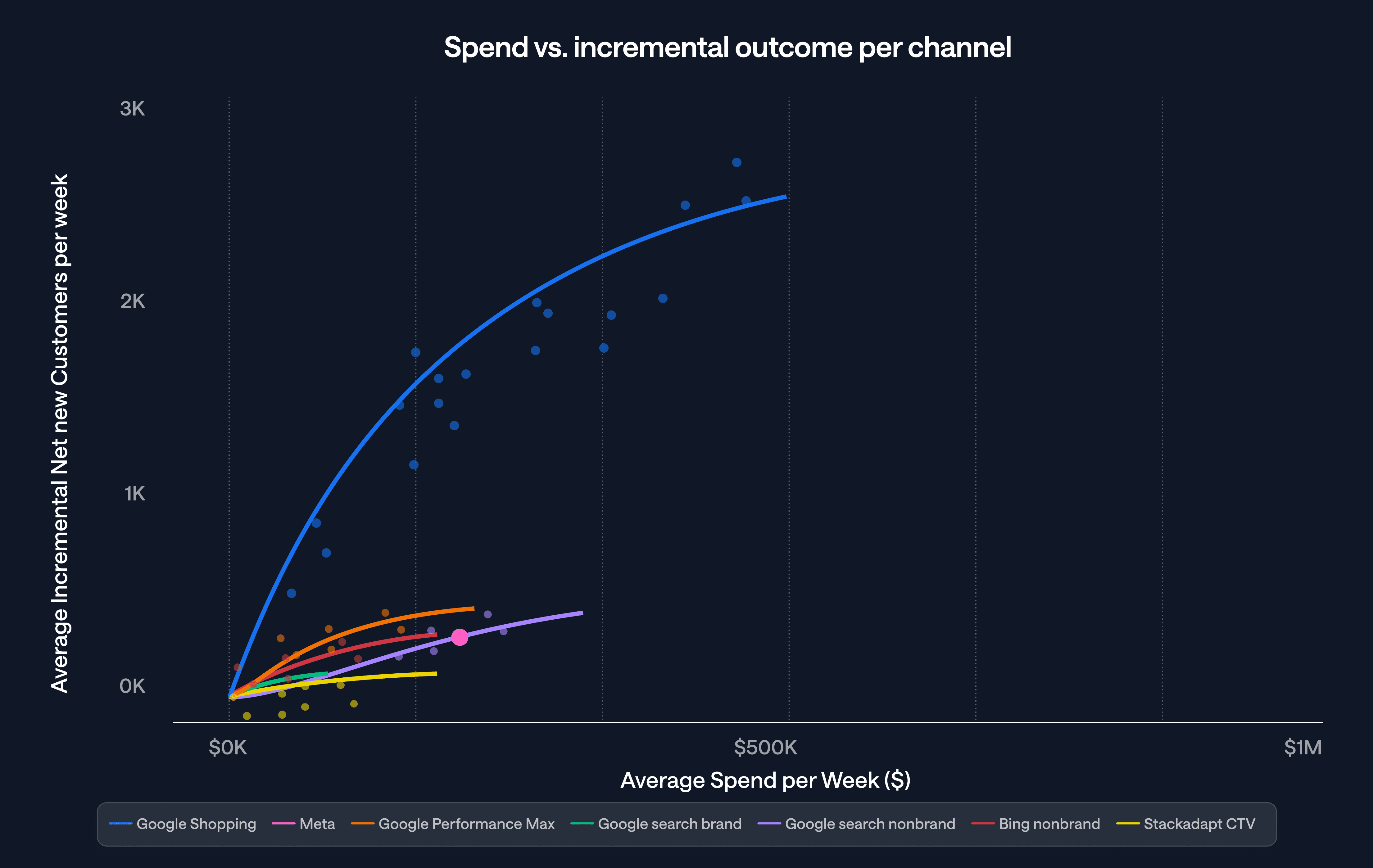
MMM saturation curve. Confirm the channel is past its inflection point on the curve, not just running near it. A channel running 60% along its curve has headroom; a channel at 90%+ does not.
Marginal ROI vs. average ROI. Confirm mROI has dropped meaningfully below average ROI for at least four consecutive weeks. A single-week dip is noise.
Cannibalization analysis. Run cross-channel attribution against organic, brand search, and other paid channels. If the channel's attributed conversions are growing while organic baseline shrinks by a similar amount, you're looking at cannibalization, not saturation. PMax, brand campaigns, and broad-match Search are the usual suspects. BlueAlpha's decision layer automates this cross-channel check weekly by decomposing every channel's contribution against the organic baseline.
Throttling check. Pull spend pacing at the campaign level. Flag any campaigns hitting daily caps before the optimal conversion hour. If the channel-level budget looks uncapped but individual campaigns are exhausted by 2pm, the MMM curve flattens because spend can't actually flow.
Diagnostic outcomes
All four clean → confirmed saturation. Proceed to Phase 4.
Cannibalization flagged → fix cannibalization first, refit the model, re-run the diagnostic.
Throttling flagged → unthrottle and re-measure for two weeks before continuing.
Concentration / misallocation found → proceed to Phase 2 (audit) before any reallocation decision.
How the brand's diagnostic came back
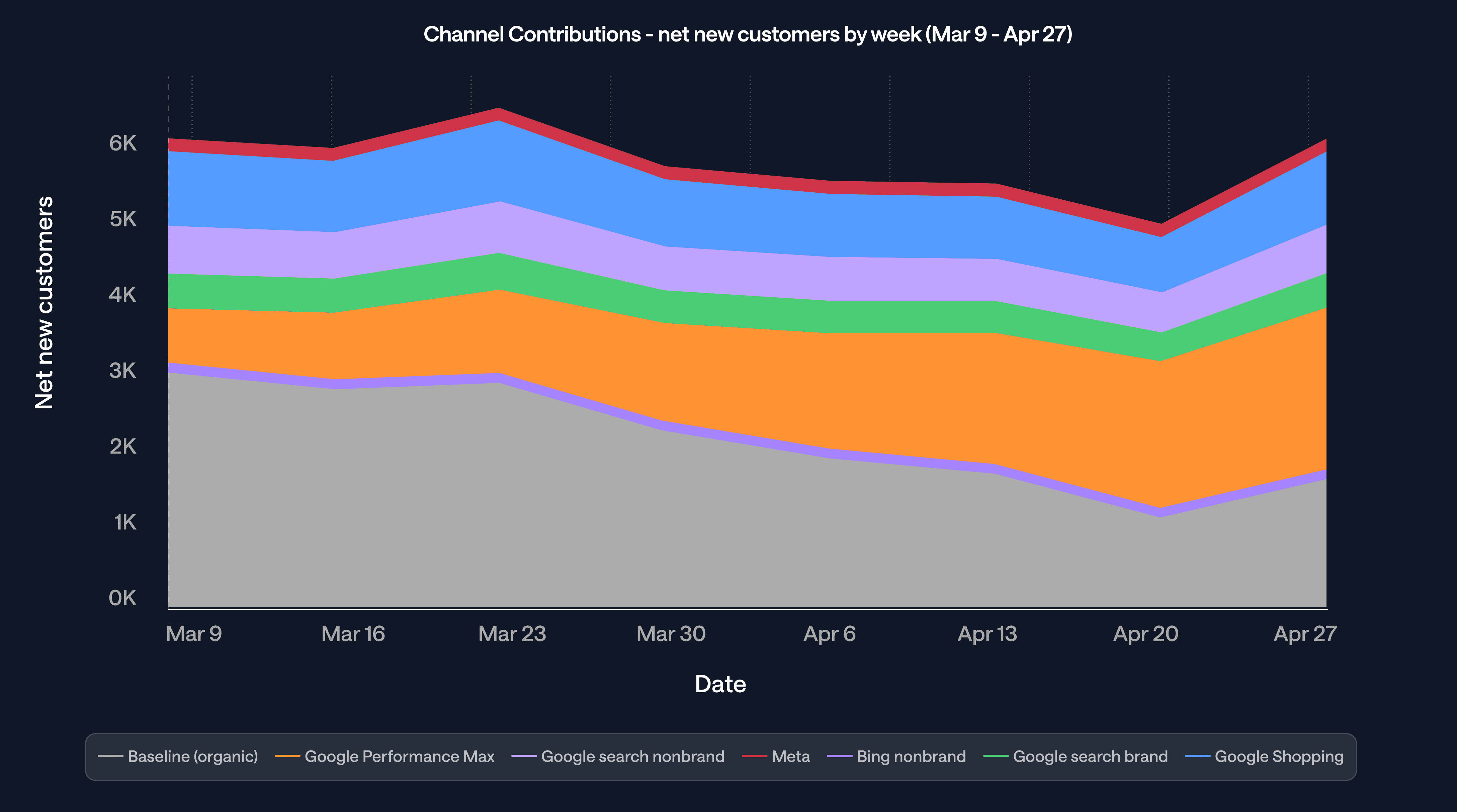
Two of the four checks lit up red:
Cannibalization. PMax spend had been doubled in a single week, from one weekly budget to two, based on what looked like a positive marginal response. Total net-new customers didn't move. The organic baseline dropped from ~2,000/week to ~1,700/week. PMax's MMM-attributed contribution rose by almost exactly the amount the baseline fell. The channel hadn't generated incremental customers; it had reclassified existing demand.
Internal misallocation. Inside Google Shopping, ~3% of SKUs were absorbing roughly 50% of spend, and ~10% of SKUs were absorbing 94%. The remaining inventory was structurally starved. The channel-level saturation curve looked flat because we were saturating one slice of inventory, not the channel.
Both findings invalidated the team's working hypothesis. Shopping wasn't capped; it was misused. PMax wasn't a second channel; it was a cannibalizer. The reflexive fix (more PMax to compensate for plateaued Shopping) was making both problems worse.
Phase 2: Audit Within the Channel (Week 1-2)
Goal: Find the within-channel headroom. The audit is a structured scan for spend concentration and inventory gaps. Every finding becomes a candidate action.
Universal audit dimensions
Run these for any channel:
Spend concentration by campaign (top-3 as % of total)
Spend concentration by audience or segment
Spend concentration by geography
Spend concentration by device
Spend concentration by day-part / hour
Bid strategy mix and budget cap status
Conversion event quality and recency
Negative targeting and exclusion hygiene
Channel-specific dimensions
Google Shopping / PMax. Spend concentration by SKU; standard Shopping vs. PMax vs. feed-only mix; brand vs. non-brand split; product feed health (titles, images, GTINs, custom labels); converting search queries not captured by current campaigns.
Meta. Spend concentration by ad set and creative; audience overlap between ad sets; lookalike vs. interest vs. broad mix; creative format mix; frequency by audience; placement distribution; Conversion API health.
Search. Spend concentration by keyword and ad group; match-type mix; converting queries with no keyword coverage; Quality Score distribution; ad copy variant count per ad group.
CTV / Programmatic. Spend concentration by inventory source; audience segment overlap with other video channels; frequency caps; creative variant count.
Build a ranked action list
For every audit finding above the materiality threshold (default: any concentration ≥70% on top-3 entities, or any inventory gap representing ≥10% of channel spend), generate one row:
Field | What goes here |
|---|---|
Finding | What we observed, with the number |
Recommendation | What to do about it |
Projected impact | Estimated revenue or efficiency lift, with assumption stated |
Effort | S / M / L |
Risk | What could go wrong if we execute |
Test design | Geo holdout, A/B, sequential, or "low risk - ship" |
Owner | Internal / vendor / joint |
Rank by impact × confidence ÷ effort. The top three become the headline actions.
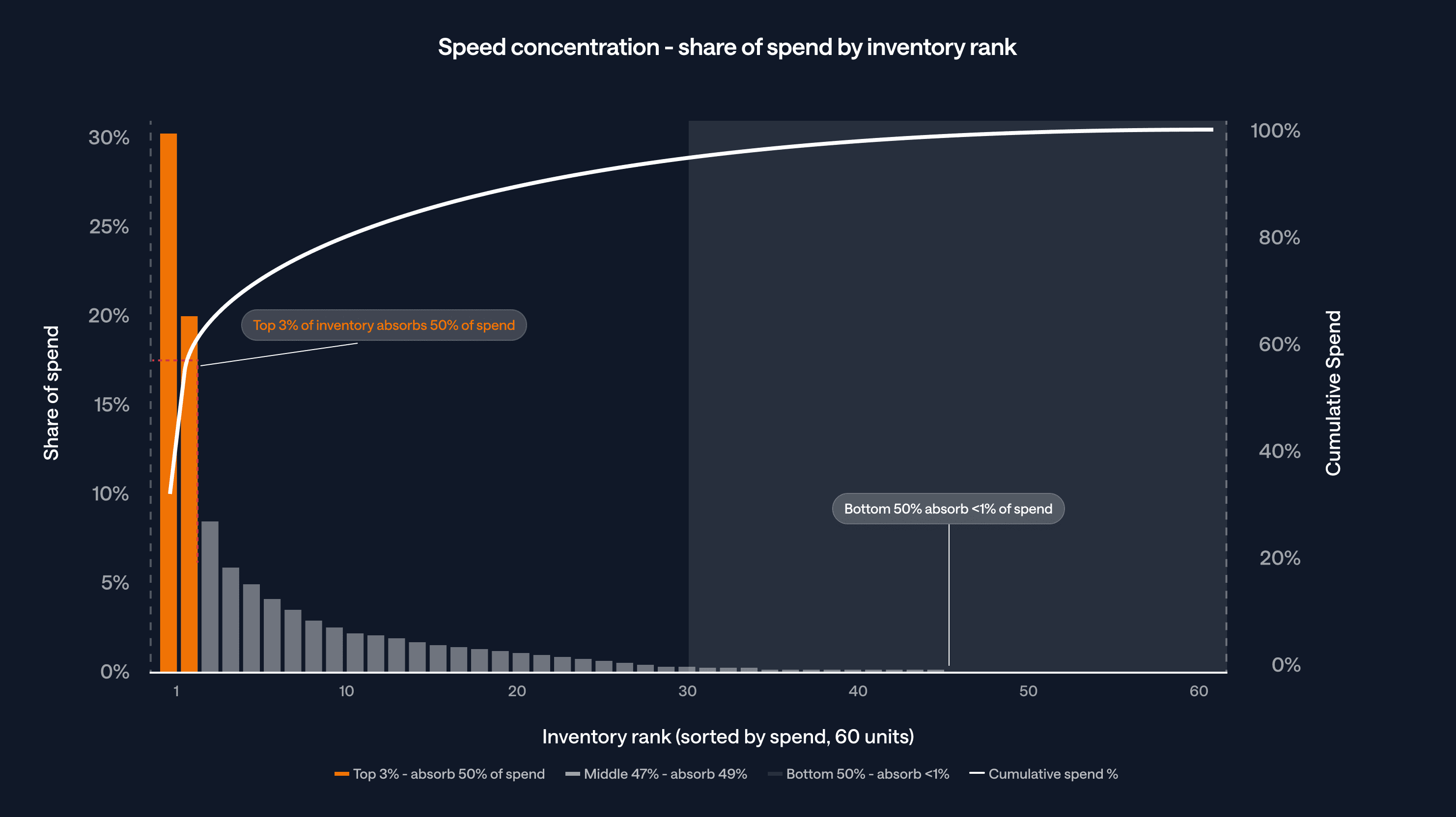
What the audit surfaced for the brand
Shopping was misallocated, not saturated. The team had identified the SKU concentration problem and split four campaigns into 25 to "democratize" SKU visibility. The intent was right; the execution shattered the channel's algorithmic stability. 15 of the 25 campaigns spent under $2,000 each per week, which is below Google's volume threshold for meaningful optimization.
17 campaigns had been disrupted within 7-day windows. A single bid-target change on a campaign is normal optimization. Changing the same campaign again before its algorithm has finished learning (typically 7+ days) is an algorithmic reset. Over 30 days, 17 campaigns had been changed multiple times within 7 days. One campaign's tROAS yo-yoed across nine settings in 30 days. The portfolio was permanently in learning phase.
PMax Feed-Only was the cannibalizer. It was 77% of PMax spend, the only campaign at real scale, and it had been doubled in a single week with no improvement in net-new acquisition.
A productive Shopping campaign had been killed mid-week. A campaign generating 1,400+ conversions/week at ~1.25x ROAS was paused with no ramp time for replacements, removing ~$70K/week of productive spend overnight.
The ranked action list had four headline moves: pull PMax back to its productive range, consolidate Shopping from 25 campaigns to 8–10, freeze all bid changes for 14 days, and stand up governance to prevent the disruption pattern from recurring.
Phase 3: Fix What's Actually Broken (Week 2-4)
Goal: Execute the top-ranked actions from the audit. Most of the work is operational, not strategic, but the operational discipline is what unlocks the headroom.
Three principles
Stabilize before you optimize. A channel mid-restructure can't be measured. Freeze structural changes for at least 14 days after consolidation so algorithms can finish learning.
Consolidation beats fragmentation. If the algorithm needs minimum volume to optimize, splitting your portfolio into smaller campaigns starves every one of them. Eight to ten campaigns optimized cleanly will almost always beat 25 campaigns half-learning.
One change per campaign per week. The single biggest hidden cost in performance accounts is repeat bid-strategy changes inside the algorithm's learning window. Establish this as a hard governance rule.
The brand's recovery sequence
The team executed all three within a single working session and a 14-day freeze:
PMax pulled back from a doubled weekly budget to its prior productive level. The under-performing micro-campaigns were paused. The marginally productive campaigns were held flat with no further bid changes.
Shopping consolidated from 25 campaigns back to 8, merging the over-fragmented "zombie," "containment," and "performer" buckets into stable, volume-sufficient campaigns. The team avoided merging too aggressively (which would have re-triggered learning across the entire portfolio) by keeping the largest stable campaigns standalone.
All bid changes frozen for 14 days. Two simple governance rules went into effect: (a) once a campaign's tROAS or bid strategy is changed, it cannot be changed again for 7 days; (b) structural changes — splits, pauses, new launches, are coordinated in advance.
A second-largest channel was right-sized. Bing had been over-scaled by ~50% above the recommendation; spend was pulled back to the original target.
What recovery looked like
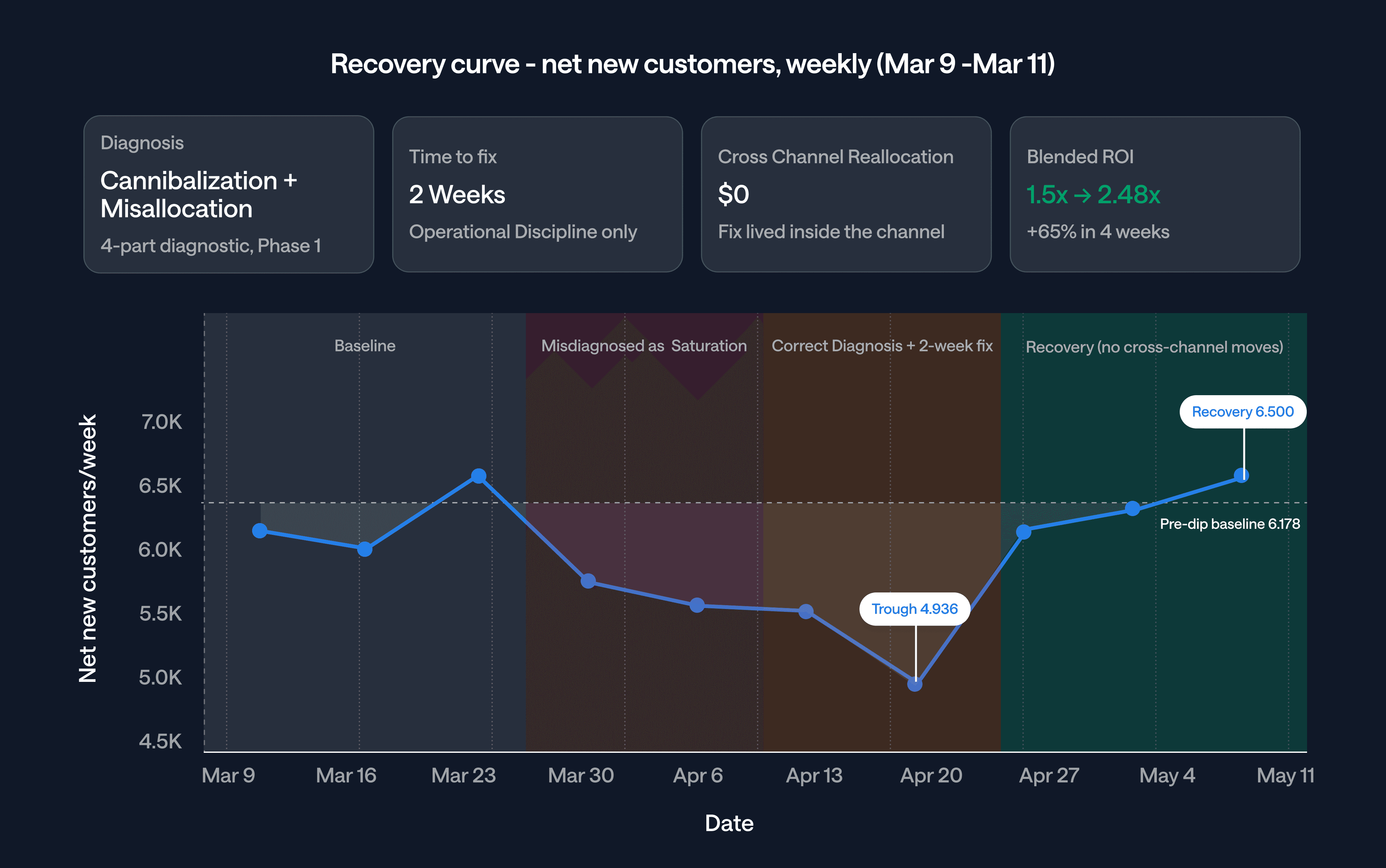
Within two weeks of the freeze:
Total weekly spend down 14%
Net new customers down 9%
Blended CAC down 5%
Blended ROI up 5% (1.50x → 2.48x within four weeks)
Shopping ROI recovered from ~3.1x to ~3.9x
PMax stopped cannibalizing the baseline; organic / direct held in the expected post-seasonal range
The channel that "looked saturated" wasn't. Most of the lost efficiency came back from operational discipline alone, before any new-channel test was even designed.
Phase 4: Only Now, Test for Diversification (Week 4+)
Goal: With the dominant channel stabilized, run a clean causal test on a candidate second channel. Not before.
The mistake most teams make is reversing this order: they reallocate to a "second channel" first, then try to clean up the dominant channel afterward. By the time they're ready to measure, two things have changed simultaneously and the test is uninterpretable.
Test design principles
Geo holdout, not platform-reported lift. Platform-reported conversions almost always overstate incrementality. The only reliable read is a geo-based experiment where treatment and control geographies differ only in the spend uplift.
Pre-defined win / neutral / loss thresholds. Tie the decision to a single metric (incremental CAC) with hard thresholds before the test starts. No reinterpretation post-hoc.
Stop-loss checkpoint at ~one-third of test budget. Build in a directional read partway through where you can kill the test if signal is flat or negative, capping downside.
Statistically significant readout at the end. Directional reads are fine for stop-loss decisions; the final scale-or-kill decision needs a statistically significant lift estimate.
Freeze the surrounding mix. No structural changes to other channels during the test. The dominant channel's freeze period is a feature, not a bug. It stabilizes the noise floor.
If the candidate second channel is offline rather than another platform, the design principles above still hold but the mechanics differ: flight lengths are longer, the cool-off period after the flight matters, and vendor-reported impressions are not a substitute for a causal read. The OOH measurement playbook covers that variant end to end.
What the brand's test looked like
After the dominant channel stabilized, the team designed a six-week geo holdout on a candidate second channel: 17 states received a 75% spend uplift (treatment), 33 states held current levels (control). Total incremental spend: $438K. Stop-loss at $146K (33% of budget) with a directional read after two weeks. Win/neutral/loss thresholds defined upfront against a hard incremental-CAC target.
The first launch of the test was contaminated by an unrelated cookie-consent rollout that degraded measurement signal across every channel. The team paused the test, preserved $370K of the test budget for a retest, defined three gates for restart (signal recovery, baseline re-stabilization, dominant channel freeze completion), and proceeded to a clean retest in mid-May.
The lesson isn't about cookie consent. It's that the diagnostic-first approach kept the team from making three or four bad budget decisions while they waited for a clean test window. If the team had committed to "PMax is the second channel" four weeks earlier, they would have spent into a cannibalizer, declared it a failure, and looked for a third channel, never realizing the dominant channel still had material headroom.
Six Mistakes That Make Channel Saturation Worse
Scaling a "second channel" before validating the first is capped. This is the most expensive mistake. A misdiagnosed dominant channel + an under-tested second channel = compounded inefficiency. Always run the four-part diagnostic first.
Restructuring during a stability problem. Splitting a fragmenting channel into more campaigns rarely fixes the issue and almost always triggers learning phases across the entire portfolio. Consolidate first, then evaluate.
Repeat bid changes inside the learning window. A single tROAS change is normal. The same campaign changed twice in 7 days is an algorithmic reset. Track this explicitly. It is the single biggest hidden cost in most accounts.
Treating platform-reported lift as causal. Platform metrics consistently overstate incrementality, especially for re-targeting and broad-match products. Only geo holdouts give you a clean read.
Killing productive campaigns mid-week. If a campaign is generating real volume above breakeven, pausing it overnight without ramp time will damage portfolio performance regardless of what replaces it. Sunset, don't shut off.
Reading too much into a contaminated test window. Cookie consent rollouts, attribution model changes, and seasonality shifts can all break a test. Build in restart gates rather than declaring a contaminated test a "no."
Weekly and Monthly Metrics for Saturation Monitoring
Weekly:
Channel-level mROI vs. average ROI
Spend concentration (top-3 campaigns / SKUs / ad sets as % of channel total)
Bid-change discipline (count of campaigns changed more than once in 7 days)
Baseline / organic conversion trend (cannibalization detector)
Monthly:
MMM refresh with refreshed saturation curves
Channel concentration as % of paid-attributed customers
Test pipeline status — which channels have been validated causally in the last 6 months
Quarterly:
Strategic channel portfolio review against concentration and incrementality targets
Decision audit: which budget moves were made, what the diagnostic said, what the result was
Replication Checklist: Week-by-Week Execution Plan
Week 1
[ ] Pull saturation curve and mROI for the dominant channel
[ ] Run cannibalization check against organic baseline and brand search
[ ] Pull spend pacing for throttling check
[ ] Compute spend concentration on top-3 campaigns / SKUs / ad sets
Week 2
[ ] Complete channel-specific audit
[ ] Build ranked action list (impact × confidence ÷ effort)
[ ] Lock the top three actions and assign owners
Week 3–4
[ ] Execute consolidation and bid-change freeze
[ ] Establish governance rule: one change per campaign per 7 days
[ ] Refit MMM after freeze; verify mROI recovery in dominant channel
Week 5–6
[ ] Design geo holdout for candidate second channel (if dominant channel is now confirmed capped)
[ ] Define win / neutral / loss thresholds against incremental CAC
[ ] Set stop-loss checkpoint at ~33% of test budget
Week 7+
[ ] Run test through full window
[ ] Read out against pre-defined thresholds; map to portfolio decision
[ ] Update MMM priors with causal test result
Key Takeaways
"Saturated" is the wrong default diagnosis. It's one of four failure modes that look identical, and three of them have nothing to do with reallocating budget away from the channel.
Diagnose before you reallocate. A four-part check (saturation curve, mROI, cannibalization, throttling) takes a week and is the highest-leverage hour of work in the entire process.
Internal misallocation is the most common false-saturation pattern. A channel where 3% of SKUs absorb half the spend isn't capped. It's mis-pointed. Audit, restructure, freeze.
Operational discipline beats portfolio gymnastics. A freeze on bid changes plus a clean consolidation routinely recovers more efficiency than any cross-channel reallocation.
Save the second-channel test for when the dominant channel is genuinely capped. Geo holdouts are precious. Burn them on questions that aren't answerable any other way.
If your strongest channel has plateaued and your team is debating whether to restructure, hold, or fund a second channel, that diagnostic conversation is what BlueAlpha's decision layer was built for. The MMM saturation curves, the mROI reads, and the cannibalization checks in this playbook are exactly what the agent runs weekly for clients spending $500K+ per month across multiple paid channels.
Book a 30-Minute Strategy Call
FAQ
How do I know if my strongest paid channel is truly saturated or just misallocated?
Run the four-part diagnostic from Phase 1: check the MMM saturation curve, compare marginal ROI to average ROI over at least four weeks, run a cannibalization analysis against your organic baseline, and pull campaign-level spend pacing for throttling. If any of the three non-saturation failure modes flag, the channel likely has recoverable headroom before you need to diversify.
What is the most common reason a channel looks saturated when it is not?
Internal misallocation. In the real client example in this playbook, 3% of SKUs were absorbing 50% of Google Shopping spend while the rest of the inventory was starved. The channel-level saturation curve looked flat because only a thin slice of inventory was being saturated, not the channel itself.
Should I scale a second channel before fixing my dominant channel?
No. The diagnostic-first approach in this playbook exists because scaling a second channel on top of a misdiagnosed dominant channel compounds inefficiency. Stabilize, audit, and restructure the dominant channel first. Only test a second channel after the dominant channel is genuinely capped.
How long should I freeze bid changes after consolidating campaigns?
At least 14 days. Algorithms need a minimum learning window after structural changes such as campaign merges, bid strategy shifts, and budget resets. Changing a campaign's tROAS or bid strategy a second time within 7 days triggers an algorithmic reset and the campaign re-enters learning phase.
What kind of test should I use to validate a candidate second channel?
A geo holdout test, not a platform-reported lift study. Platform-reported conversions consistently overstate incrementality. A geo-based experiment where treatment and control geographies differ only in the spend uplift provides a clean causal read. Define win, neutral, and loss thresholds against incremental CAC before the test starts.
How much budget should I allocate to an incrementality test for a new channel?
Enough to generate a statistically significant lift estimate, with a stop-loss checkpoint at roughly one-third of the total test budget. In the example in this playbook, the team allocated $438K with a $146K stop-loss and a directional read after two weeks.

