Find New Google Ads Markets with Claude: BlueAlpha geo-expansion Tutorial
Classify your Google Ads markets into Star, Volume, Opportunity, and Drain tiers, score expansion candidates by keyword volume, and get a 6-week test plan.
TL;DR — geo-expansion-scout pulls your geographic performance data, classifies every market you're running in into Star / Volume / Opportunity / Drain tiers, identifies candidate expansion markets, scores them by keyword volume and competition, and produces a budget allocation plan with a 6-week test framework. It also catches the biggest hidden finding in most multi-geo accounts: you're probably under-indexing on your best market before you should be expanding into new ones. This is the geographic arm of what BlueAlpha calls the Decision Engine — the system that turns every signal in your ad account into a real decision.
Watch the full walkthrough (8 min):
Geographic expansion is usually the highest-leverage growth move available to a mature account — and the most common way to lose money on it is picking markets based on gut feel. Someone says "let's try Canada" because it feels like a natural fit, and six months later you've spent $3K with zero conversions. This skill replaces the intuition with data: keyword volume, competition levels, CPC benchmarks, and performance-based market classification — all in one conversation.
All ten Google Ads skills in the BlueAlpha Marketing Plugin
auto-optimize— Runs a full optimization cycle on a Google Ads account: structural audit, underspend diagnosis, budget reallocation, recommendations review, and creative health check.full-monty— Runs every skill in sequence for a comprehensive top-to-bottom audit plus a strategic deployment plan for the next quarter.audience-intelligence— Analyzes audience performance across Google Ads and recommends bid modifiers, new segments, exclusions, and observation-to-targeting moves.brand-refresh-pipeline— Detects creative fatigue, audits brand voice, and generates fresh responsive search ad copy for any campaign.competitive-conquest— Researches competitors, identifies messaging gaps, and designs conquest campaign specs that target competitor brand terms.competitive-counterpunch— Detects when competitors gain auction share on your brand and plans a proportional defensive response.content-to-campaign— Turns any piece of content (blog, case study, webinar, comparison page) into a paid campaign complete with keywords and ad copy.geo-expansion-scout— Identifies new geographic markets worth entering by analyzing geo performance, keyword volume, and competitive density.incrementality-test-runner— Designs and monitors geo-based incrementality tests in Google Ads with integrity checks and lift analysis.seo-paid-bridge— Finds where organic and paid search overlap or leave gaps, then specs complementary paid campaigns that maximize total search click share.
This article is part of the full series.
Why use Claude to find new Google Ads markets?
Manually evaluating new geographic markets involves pulling geo performance reports, cross-referencing keyword volumes in each candidate market via the Keyword Planner, comparing CPC benchmarks, and building a test plan with budget allocation. For international expansion, add language considerations, timezone proximity, and currency differences. This takes most of a day — and the analysis is usually a spreadsheet that goes stale immediately.
Claude with the BlueAlpha Google Ads Plugin does this in one conversation. It pulls geographic performance data and impression share via GAQL, resolves candidate market geo IDs through google_ads_suggest_geo_targets, runs keyword volume estimates for each candidate via google_ads_generate_keyword_ideas, and produces a visual report with market cards, a scoring chart, budget allocation, and a decision timeline. The same AI that finds the drain markets also tells you where to redirect that budget.
How does Claude connect to your geographic and Google Ads data?
The BlueAlpha Marketing Plugin uses the Model Context Protocol (MCP) — an open standard that lets Claude talk directly to external tools and APIs. For geo-expansion-scout, Claude uses several Google Ads tools: google_ads_execute_query_stream for geographic performance and impression share data via GAQL, google_ads_suggest_geo_targets to resolve market names to criterion IDs, and google_ads_generate_keyword_ideas to estimate search volume and competition in candidate markets. Every tool call goes through your authenticated MCC, scoped to the customer ID you specify.
What the geo-expansion-scout skill does
The skill runs in three phases and produces a complete expansion analysis with budget allocation.
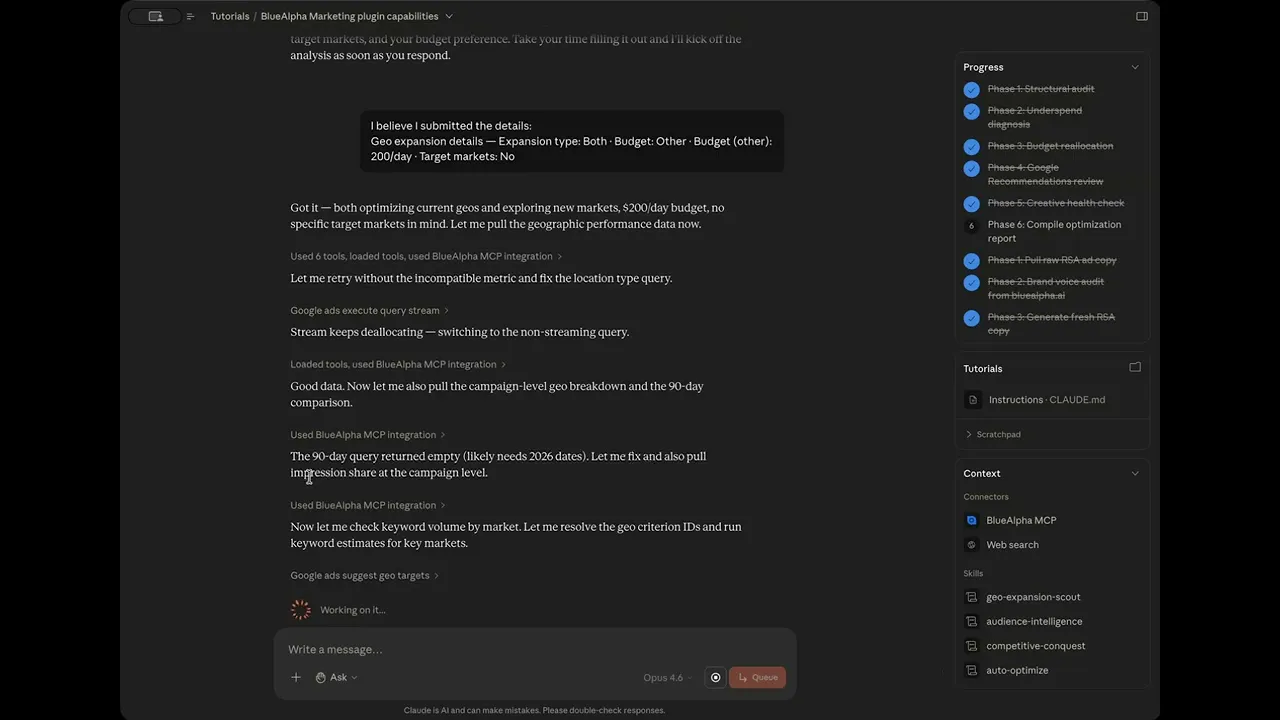
Configure and gather data. An interactive widget asks three questions — expansion type, specific markets to evaluate, and budget. Claude then pulls geographic performance data via GAQL, resolves candidate market geo IDs, and runs keyword volume estimates for each market.
Current market classification + expansion scoring. Classifies every market you're currently running in (Star, Volume, Opportunity, Drain), identifies which markets are bleeding budget with zero conversions, scores candidate expansion markets by keyword volume and CPC competitiveness, and produces a visual report with market cards and a scoring chart.
Budget allocation + decision timeline. Recommends how to split your budget between existing geo optimization and new market tests, with a week-by-week decision framework for scaling winners or cutting losers.
When to use it
When you're running ads in multiple countries and need to know which are performing and which are draining budget. In the demo, three countries were spending money with zero conversions — and nobody had noticed.
When you're considering international expansion. The skill scores candidate markets by keyword volume, competition, and CPC before you spend a dollar.
When
auto-optimizeflags under-indexing on impression share. The demo revealed the account was capturing only 18.5% of available US impressions — meaning the biggest opportunity wasn't expansion, it was capturing more of the existing market.On a quarterly cadence for any multi-geo account. Markets shift, new competitors enter, and what was a Drain last quarter might have new demand.
What you'll need before you start
Google Ads customer ID. Required — the skill needs an account to scan.
Expansion type. Choose from: optimize within current geos, explore new countries, or both. Required.
Specific markets to evaluate. Optional — name specific countries or regions, or let the skill recommend candidates based on your business category.
Budget for geo testing. How much daily budget is available for expansion tests. Can be new budget or reallocated from existing.
Step-by-step: running geo-expansion-scout in Claude
Video walkthrough of this entire flow:
Here's exactly what happens when you invoke the skill, matching the flow shown in the video walkthrough.
1. Invoke the skill
Type the slash command or use natural language:
/geo-expansion-scout
Claude reads the workflow file and opens an interactive widget titled "Geo expansion details" with three configuration questions.
2. Configure the expansion scope
The widget asks:
What kind of expansion are you exploring? — Three options: "Optimize within current geos" (find pockets in US, UK, IE, AU, NZ), "New countries" (expand into new markets), or "Both" (optimize current + explore new).
Any specific markets you want to evaluate? — Free text field. Name specific countries, regions, or metros, or type "No" to let the skill recommend candidates based on your data.
How much budget for geo testing? — Preset options: $50/day, $100/day, Reallocate existing, or Other (type a custom amount).
In the demo, the configuration was: Both · No specific markets · Other: $200/day.
3. Watch the data gathering
Claude pulls data from multiple sources in sequence:
Geographic performance via GAQL — 30-day and 90-day lookback windows showing spend, conversions, CPA, and CVR by country
Campaign-level geo breakdown — how each campaign performs in each market
Impression share at the campaign level — how much demand you're capturing vs. losing
Geo target resolution — maps candidate market names (Canada, Germany, Netherlands, Singapore, UAE) to Google Ads criterion IDs
Keyword volume by market — runs
google_ads_generate_keyword_ideasfor your core terms in each candidate market
In the demo, Claude self-corrected through several GAQL errors (incompatible metrics, stream deallocating) and retried with fixed queries — a good example of the skill handling real-world API edge cases automatically.
4. Review the headline metrics
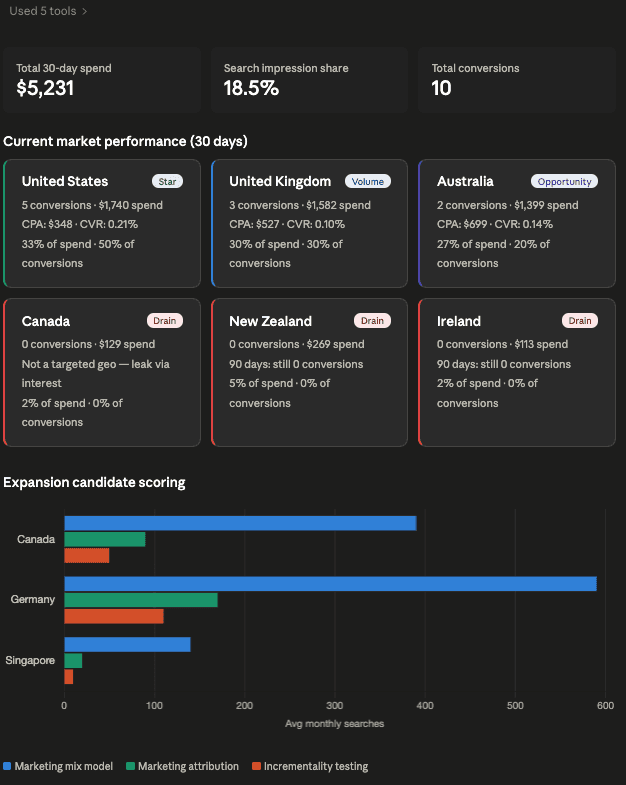
The report opens with three key numbers:
$5,231 — Total 30-day spend across all geos
18.5% — Search impression share (meaning 81.5% of available impressions are being missed)
10 — Total conversions in 30 days
5. Review the current market performance cards
Each market gets a card with a color-coded tier label, performance metrics, and its share of total spend and conversions:
Star markets (green border):
Market | Conv | Spend | CPA | CVR | Share |
|---|---|---|---|---|---|
United States | 5 | $1,740 | $348 | 0.21% | 33% spend · 50% conversions |
Volume markets (blue border):
Market | Conv | Spend | CPA | CVR | Share |
|---|---|---|---|---|---|
United Kingdom | 3 | $1,582 | $527 | 0.10% | 30% spend · 30% conversions |
Opportunity markets (purple border):
Market | Conv | Spend | CPA | CVR | Share |
|---|---|---|---|---|---|
Australia | 2 | $1,399 | $699 | 0.14% | 27% spend · 20% conversions |
Drain markets (red border):
Market | Conv | Spend | CPA | CVR | Share |
|---|---|---|---|---|---|
Canada | 0 | $129 | n/a | 0% | 2% spend · 0% conversions |
New Zealand | 0 | $269 | n/a | 0% | 5% spend · 0% conversions |
Ireland | 0 | $113 | n/a | 0% | 2% spend · 0% conversions |
Key details from the Drain markets: Canada isn't even a targeted geo — it's leaking in via "interest" targeting. New Zealand and Ireland have had zero conversions across both 30- and 90-day windows. Together, the three Drains are bleeding ~$380/month with nothing to show for it.
6. Review the expansion candidate scoring chart
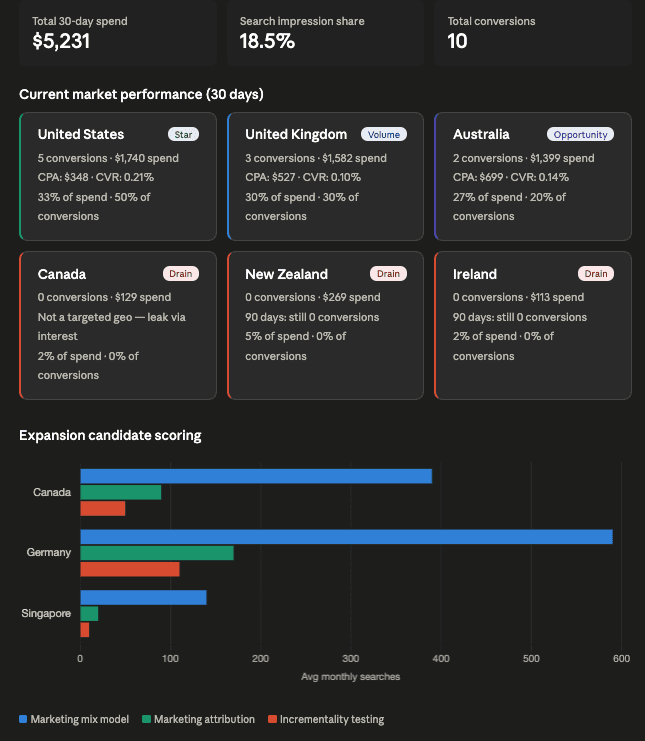
Claude produces a horizontal bar chart comparing keyword volume across candidate markets for three key topic categories: Marketing mix model (blue), Marketing attribution (green), and Incrementality testing (red).
In the demo, three candidates were scored:
Germany — Highest total volume. ~590 avg monthly searches for "marketing mix model" alone, plus strong volume for attribution and incrementality testing terms. Lower competition index. CPCs 40-60% cheaper than Canada ($4-$7 vs $6-$65).
Canada — Second highest. ~390 avg monthly searches for MMM terms. Same language, same timezone proximity. Has some existing (leaked) impression data showing reasonable CTR.
Singapore — Too small. Only ~140 monthly searches for the core term, and category terms at 10-20. Not worth a dedicated campaign.
7. Review the recommended budget allocation
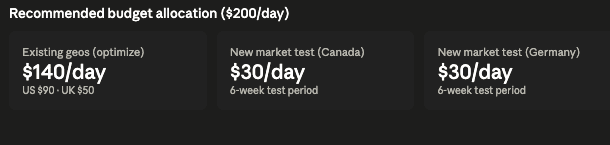
The skill splits the $200/day budget three ways:
Allocation | Amount | Detail |
|---|---|---|
Existing geos (optimize) | $140/day | US $90 · UK $50 |
New market test (Canada) | $30/day | 6-week test period |
New market test (Germany) | $30/day | 6-week test period |
8. Review the current market analysis
Claude provides detailed analysis for each market tier:
US (Star): Highest conversion rate (0.21%), lowest CPA ($348), generates half the conversions on a third of the spend. This is your best market by every metric.
UK (Volume): Gets the most impressions but converts at half the US rate, with a $527 CPA. It's a volume play — lots of eyeballs, mediocre conversion.
Australia (Opportunity): Conversion rate is above average but the CPA ($699) is high. Needs creative or landing page optimization more than more budget.
Ireland, NZ, Canada (Drains): Zero conversions across both 30- and 90-day windows. NZ is the most expensive drain at $269/month. Canada isn't even a targeted geo — it's leaking in via "interest" targeting yet spending $129/month.
9. The biggest finding
You're massively under-indexing on the US. At only 18.5% impression share overall and 52% lost to rank, the single highest-ROI move isn't expanding to new countries — it's capturing more of the US demand you're already losing. The US converts at nearly 2x the rate of any other market, and there's 4-5x more demand available than you're currently capturing.
10. Review the expansion candidates ranked
Germany (#1): Strongest new-market opportunity. 590 avg monthly searches for "marketing mix model" alone (higher than Canada's 390), lower competition index, and CPCs that are 40-60% cheaper ($4-$7 vs $6-$65 in Canada). The caveat is language — you'd need to decide whether to run English-only ads targeting the significant English-speaking B2B audience in DACH, or invest in German-language creative.
Canada (#2): Same language, same timezone proximity, 390 avg monthly searches for MMM terms. Has some existing (leaked) impression data showing reasonable CTR. Lower friction to test.
Singapore (not recommended): Only 140 monthly searches for the core term, category terms at 10-20. Not worth a dedicated campaign.
11. Review the budget allocation detail
Claude breaks down the recommended $200/day allocation:
$140/day to optimize existing geos: $90 to the US (where you're leaving the most money on the table) and $50 to UK. Pull Ireland and NZ out of campaign targeting entirely — they've had 90 days with zero conversions and are bleeding ~$380/month. Australia stays at current spend but gets monitored.
$60/day for two 6-week geo tests: $30/day for Canada and $30/day for Germany (English-language ads only as a first pass). Both as dedicated campaigns with PRESENCE-only targeting, separate from the main non-brand campaign, so you can cleanly measure performance.
12. Review the decision timeline
Weeks 1-2: Learning period. Monitor for delivery issues. Don't judge performance yet.
Weeks 3-4: Compare CPC and CTR to existing markets. New markets should show comparable or better click metrics.
Week 6 decision point: Scale the winner or cut the loser. If a market hits CPA within 20% of US performance, increase budget by 30% and expand keywords. If it's 50%+ worse with no improving trend, pause it.
13. The follow-up Q&A
In the demo, the user asked a key question: "Does this mean that we should put 200/day into the US only perhaps?"
Claude's response validated the instinct and did the math: the US is currently spending ~$58/day and capturing only 18.5% of available impressions, with 52% lost to rank. Adding $200/day to the US (bringing it to ~$258/day) would likely only get to 35-40% impression share — you'd still have headroom, and every incremental dollar is going into a proven market rather than a speculative one.
The counterargument: diminishing returns. As you bid more aggressively to win rank-lost impressions, CPCs will rise and CPA won't stay at $348. But even if US CPA crept up to $450-500, it would still outperform UK ($527) and Australia ($699) by a wide margin.
Claude's recommended middle path: $170/day into the US and carve out $30/day for a single expansion test (Germany, since it has better volume at lower CPCs than Canada). That keeps 85% of the budget in your proven winner while still learning whether a new market has legs. If Germany shows nothing after 6 weeks, fold that $30 back into the US too.
And regardless of the expansion decision: cut Ireland and New Zealand from existing campaign targeting — that frees up ~$13/day ($380/month) that's currently producing zero conversions and redirects it into the US automatically.
Example prompts
Kick-off prompt (slash command):
/geo-expansion-scout
Kick-off prompt (natural language):
"Run geo-expansion-scout on customer 561-240-7843. Both optimize current geos and explore new. Budget is $200/day. No specific target markets — recommend based on data."
Optimize within current geos only:
"Run geo-expansion-scout. Optimize within current geos only. I want to know which countries are draining budget and where to reallocate."
Evaluate specific markets:
"Run geo-expansion-scout. I'm considering Canada, Germany, and the Netherlands. $100/day budget. Score them and tell me which to test first."
After auto-optimize flags under-indexing:
"Auto-optimize showed we're only capturing 18.5% impression share in the US. Run geo-expansion-scout to figure out whether to double down on the US or expand to new markets."
Gotchas and tips
Fill your Star market before expanding. This is the biggest lesson from the demo — the US was at 18.5% impression share with the best CPA, and the initial instinct to put all $200/day into the US was validated by the data. Don't expand until your best market is saturated.
Use PRESENCE-only targeting for geo tests. Presence-or-interest targeting contaminates geo tests because people searching about a region get ads. The skill recommends PRESENCE-only by default.
Run expansion tests as separate campaigns. Don't add new geos to your existing non-brand campaign. Separate campaigns give you clean performance data and independent budget control.
Watch for "interest" leaks. In the demo, Canada was spending $129/month despite not being a targeted geo — it was leaking in via "interest" targeting. Check your existing campaign targeting settings for these leaks.
Language matters for international expansion. Germany had the best keyword volume and cheapest CPCs, but English-language ads targeting a German-speaking market will only capture part of the demand. Start with English-only to test viability, then invest in localization if results are promising.
Cut Drain markets immediately. If a market has zero conversions across 90 days, it's not going to suddenly start converting. Cut it and redirect that budget to your Star market.
Don't test more than 2-3 markets at once with a modest budget. $30/day per market is the minimum for a meaningful test. Spreading thinner than that takes too long to collect statistically significant data.
FAQ
How does the skill classify current markets?
It pulls geographic performance data via GAQL for 30-day and 90-day windows, then classifies each market based on conversion rate and volume relative to the account average. Star = above-average CVR + above-average volume. Volume = below-average CVR + high volume. Opportunity = above-average CVR + below-average volume. Drain = below-average everything (usually zero conversions).
What's the difference between "optimize within current geos" and "new countries"?
"Optimize within current geos" focuses on rebalancing budget across markets you already target — finding drains to cut and stars to invest in. "New countries" evaluates markets you're not targeting yet. "Both" does both, which is what the demo showed.
Does the skill automatically create campaigns or change targeting?
No. It produces recommendations and a budget allocation plan for review. You approve each change before execution.
How does the skill score expansion candidates?
It uses google_ads_generate_keyword_ideas to estimate search volume and CPC for your core terms in each candidate market, combined with competition level data. In the demo, Germany scored highest because it had the most keyword volume (590 avg monthly searches for MMM terms) at the lowest CPCs ($4-$7 vs Canada's $6-$65).
What if my account only targets one country?
The skill still works — it will analyze geo performance within that country (by state, DMA, or metro) and recommend internal rebalancing. The expansion candidate analysis will suggest new countries to test.
How long should a geo test run?
Six weeks minimum. Weeks 1-2 are learning (don't judge performance). Weeks 3-4 you compare CPC and CTR. Week 6 you make the scale/cut decision based on CPA relative to your Star market.
What about the diminishing returns argument?
Claude addressed this in the demo: as you bid more aggressively in the US to win rank-lost impressions, CPCs will rise and CPA will increase from $348. But even at $450-500 CPA, the US still outperforms UK ($527) and Australia ($699). The math still favors doubling down on your Star market until CPA approaches parity with other markets.
Related skills
If the biggest finding is under-indexing on impression share → run
seo-paid-bridgeto capture uncovered keywords in your Star market.If you want to prove geographic incrementality with a holdout test → run
incrementality-test-runner.If Drain markets need creative or landing page fixes before cutting → run
brand-refresh-pipeline.If you want the full account picture before narrowing to geo → run
auto-optimizeorfull-montyfirst.
Your next step
Pick your multi-geo account and run:
/geo-expansion-scout
The interactive widget will walk you through configuration. You'll have a complete market classification, expansion candidate ranking, budget allocation plan, and decision timeline by the end of the session. For the full skill index, see the plugin overview.
Need help getting set up? See the installation guide.
Want a growth partner to run the Decision Engine for you? Book a demo.

