SEO Paid Search Gaps in Claude: BlueAlpha seo-paid-bridge Tutorial
Cross-reference organic rankings against Google Ads keywords, find uncovered search volume, and build bridge campaigns with budget allocation and ad copy.
TL;DR — seo-paid-bridge pulls your organic ranking data alongside your Google Ads keyword performance, finds the gaps where you rank organically but don't bid (or bid but don't rank), and builds a complete bridge campaign to capture that uncovered search volume. It tells you exactly which keywords to add, which underperformers to pause or reduce, and how to allocate your daily budget across new ad groups — with ad copy, match types, and a week-by-week measurement plan. This is the search coverage arm of what BlueAlpha calls the Decision Engine — the system that turns every signal in your ad account into a real decision.
Watch the full walkthrough (10 min):
Most teams run SEO and paid search as separate workstreams with separate reporting. The organic team celebrates ranking #3 for "marketing mix modeling" while the paid team has never bid on it — leaving thousands of monthly searches on the table. Meanwhile, the paid team is spending $532/month on "best ai marketing software" with zero conversions, and nobody on the organic side knows. This skill bridges those two worlds in one conversation.
All ten Google Ads skills in the BlueAlpha Marketing Plugin
auto-optimize— Runs a full optimization cycle on a Google Ads account: structural audit, underspend diagnosis, budget reallocation, recommendations review, and creative health check.full-monty— Runs every skill in sequence for a comprehensive top-to-bottom audit plus a strategic deployment plan for the next quarter.audience-intelligence— Analyzes audience performance across Google Ads and recommends bid modifiers, new segments, exclusions, and observation-to-targeting moves.brand-refresh-pipeline— Detects creative fatigue, audits brand voice, and generates fresh responsive search ad copy for any campaign.competitive-conquest— Researches competitors, identifies messaging gaps, and designs conquest campaign specs that target competitor brand terms.competitive-counterpunch— Detects when competitors gain auction share on your brand and plans a proportional defensive response.content-to-campaign— Turns any piece of content (blog, case study, webinar, comparison page) into a paid campaign complete with keywords and ad copy.geo-expansion-scout— Identifies new geographic markets worth entering by analyzing geo performance, keyword volume, and competitive density.incrementality-test-runner— Designs and monitors geo-based incrementality tests in Google Ads with integrity checks and lift analysis.seo-paid-bridge— Finds where organic and paid search overlap or leave gaps, then specs complementary paid campaigns that maximize total search click share.
This article is part of the full series.
Why use AI to find SEO and paid search gaps?
Manually comparing organic rankings against paid keyword lists is tedious and error-prone. You'd need to export from Google Search Console or a rank tracker, pull a Google Ads keyword report, cross-reference in a spreadsheet, research search volumes for the gaps, and then build new campaigns from scratch. It takes half a day — and by the time you're done, you've probably missed the nuance of which existing paid keywords are spending but not converting.
Claude with the BlueAlpha Marketing Plugin does this in one conversation. It pulls organic rankings via SpyFu/keyword tools, queries your Google Ads account for paid keyword performance, cross-references them to find gaps, audits what's already working vs. wasting budget, and produces a complete bridge campaign blueprint with ad groups, keywords, match types, ad copy, budget allocation, and a measurement plan.
How does Claude connect to your SEO and Google Ads data?
The BlueAlpha Marketing Plugin uses the Model Context Protocol (MCP) — an open standard that lets Claude talk directly to external tools and APIs. For seo-paid-bridge, Claude uses two connectors: the BlueAlpha MCP (Google Ads API for paid keyword data and keyword idea generation) and the BuiltWith MCP or SpyFu/keyword tools (for organic ranking data).
For setup instructions (installing the plugin, authenticating your MCC, and connecting your first account), see The BlueAlpha Google Ads Marketing Plugin for Claude.
What the seo-paid-bridge skill does
The skill runs in four phases and produces a deployment-ready bridge campaign.
Configure and gather data. An interactive widget asks three questions — SEO data source, available budget, and topic priorities. Claude then pulls organic rankings and Google Ads keyword performance in parallel.
Gap analysis and paid audit. Produces a summary dashboard (paid keywords, gap keywords, uncovered monthly searches, available budget) and three lists: converting (keep), spending but not converting (audit), and low-volume (too early to judge).
Bridge campaign blueprint. Breaks gap keywords into themed ad groups with daily budget allocation, match types, keyword lists, campaign settings, and full ad copy.
Quick wins + measurement plan. Identifies underperformers to pause/reduce (freeing budget), then sets Week 2/3/4 checkpoints.
When to use it
When
brand-refresh-pipelineorauto-optimizeflags landing page relevance issues. The cross-skill flag "Run SEO-Paid Bridge" is the most common entry point.After launching new content pages. Run this to see if there are paid keywords that should point to your new content.
On a quarterly cadence for any account where SEO and paid coexist.
When you have incremental budget to deploy. The bridge campaign blueprint is designed for deploying new budget into uncovered search territory.
What you'll need before you start
Google Ads customer ID. Required.
Domain. Required — used to pull organic rankings.
SEO data source choice. Let Claude pull rankings, or provide your own data from Ahrefs, SEMrush, or GSC.
Available daily budget. New budget or "reallocate existing."
Topic priorities. Optional but recommended.
Step-by-step: running seo-paid-bridge in Claude
Video walkthrough of this entire flow:
1. Invoke the skill
Type the slash command or use natural language:
/seo-paid-bridge let's run
Claude opens an interactive widget titled "SEO-paid bridge details" with three configuration questions.
2. Configure the analysis
The widget asks:
Do you have SEO data to provide, or should I pull organic rankings? — Choose "Pull rankings" or "I have data" (Ahrefs, SEMrush, or GSC export).
How much incremental daily budget is available for bridge campaigns? — No new budget, $25-50/day, $50-100/day, or Other.
Any keyword categories or topics to prioritize? — Choose from suggested topics or "All relevant terms."
In the demo: Pull rankings · Other: $200/day · MMM/media mix modeling, Incrementality testing, Budget optimization.
3. Review the gap analysis dashboard
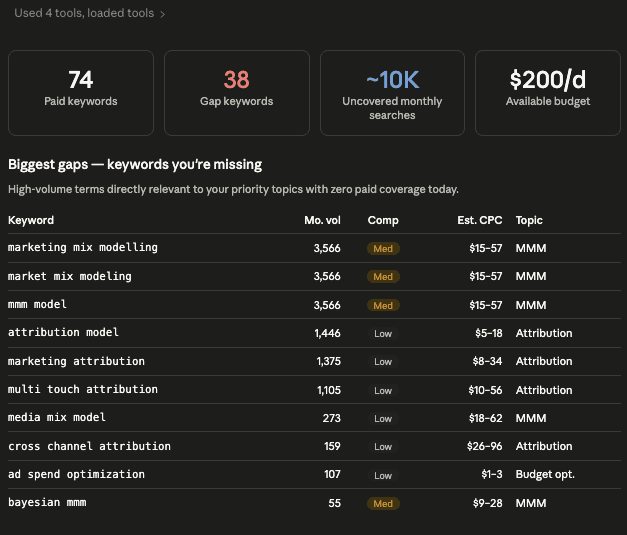
Claude produces a summary dashboard with four headline metrics:
74 Paid keywords — currently active in Google Ads
38 Gap keywords — terms with zero paid coverage
~10K Uncovered monthly searches — total volume you're leaving on the table
$200/d Available budget
Below the dashboard: the "Biggest gaps" table showing each gap keyword with monthly volume, competition level, estimated CPC, and topic category.
4. Review the current paid audit
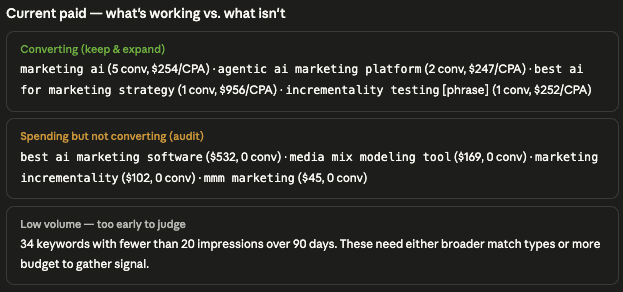
Existing paid keywords are broken into three buckets:
Converting (keep & expand) — Keywords with conversions and reasonable CPA
Spending but not converting (audit) — Real spend, zero conversions. Candidates for pausing.
Low volume — too early to judge — Fewer than 20 impressions over 90 days
5. Review the bridge campaign blueprint
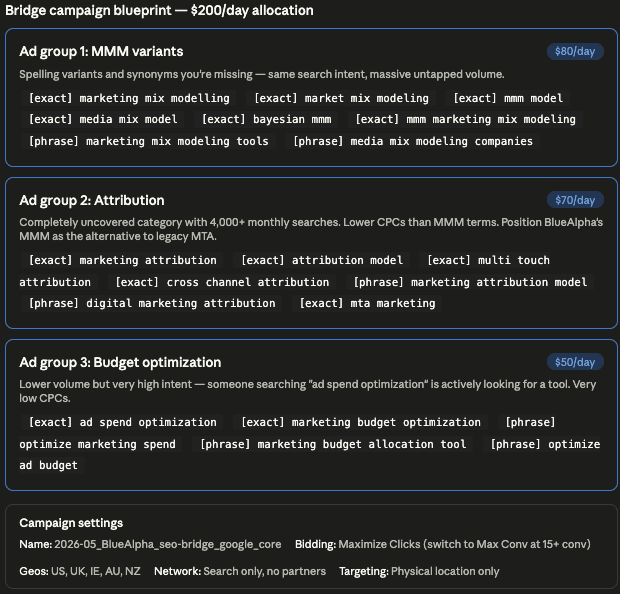
A complete campaign spec with themed ad groups. In the demo, three ad groups were created:
Ad group 1: MMM variants ($80/day) — Spelling variants and synonyms with massive untapped volume
Ad group 2: Attribution ($70/day) — Completely uncovered category with 4,000+ monthly searches
Ad group 3: Budget optimization ($50/day) — Lower volume but very high intent
Campaign settings: naming convention, bidding (Maximize Clicks → Max Conv at 15+ conv), geo targeting (US, UK, IE, AU, NZ), Search only, physical location.
6. Review ad copy for gap ad groups
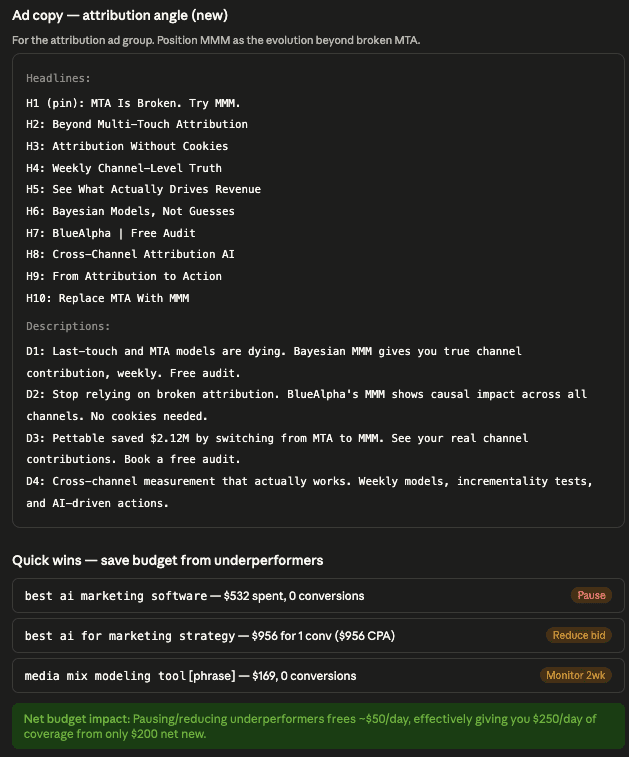
For new ad groups, the skill generates full ad copy with 10 headlines and 4 descriptions. In the demo, the attribution ad group got copy positioning MMM as the evolution beyond broken MTA.
7. Review quick wins and measurement plan
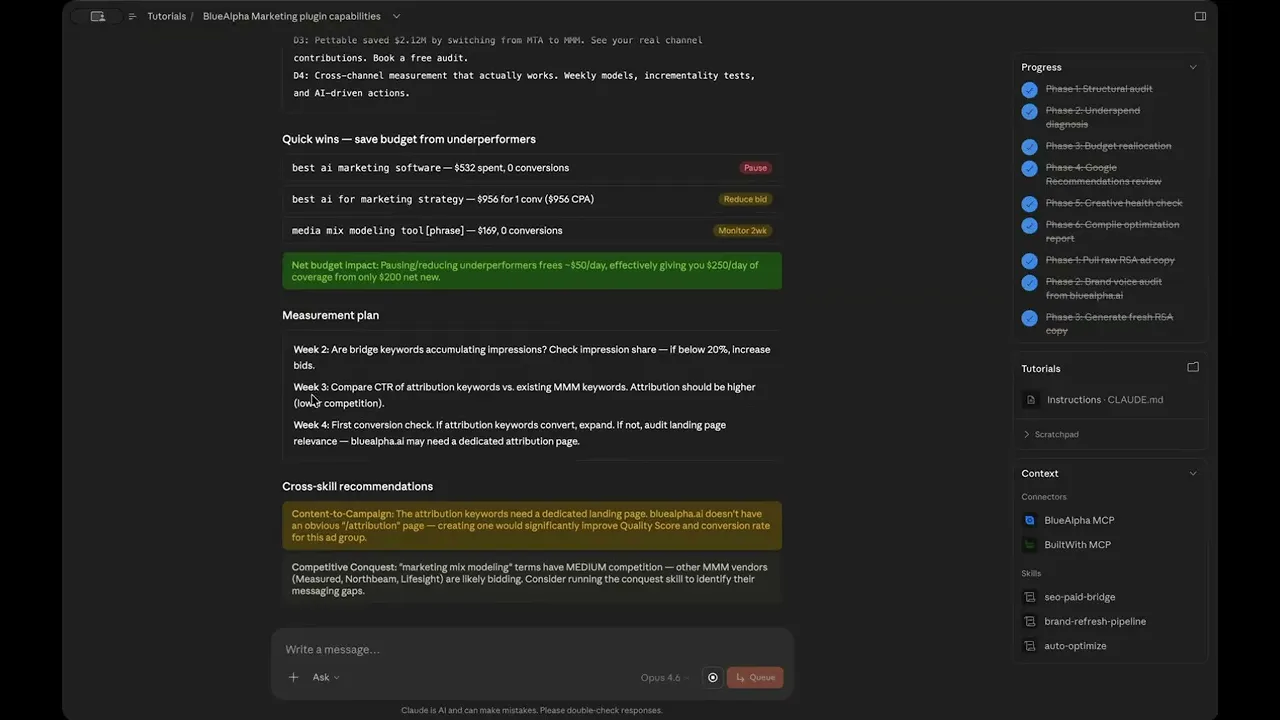
Quick wins identify underperformers to pause or reduce. Net budget impact is calculated — in the demo, freeing ~$50/day gave $250/day of coverage from only $200 net new.
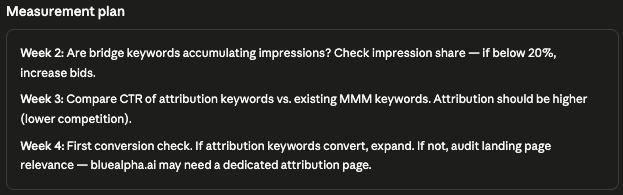
Measurement plan:
Week 2: Impression share check. If below 20%, increase bids.
Week 3: CTR comparison — new categories should outperform given lower competition.
Week 4: First conversion check. If converting, expand. If not, audit landing page relevance.
8. Cross-skill recommendations and landing page mapping
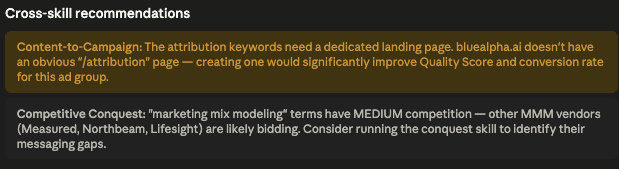
The skill flags:
Content-to-Campaign: Gap keywords need a dedicated landing page? Spec one out.
Competitive Conquest: Medium competition from known vendors? Run conquest to find messaging gaps.
A landing page mapping table shows which existing page each ad group should point to, and flags CTA mismatches.
Example prompts
Kick-off prompt (slash command):
/seo-paid-bridge let's run
Natural language:
"Run seo-paid-bridge on customer 561-240-7843 for bluealpha.ai. Pull organic rankings. I have $200/day available. Focus on MMM and attribution keywords."
After brand-refresh-pipeline flags LP issues:
"Brand refresh flagged 53% lost to rank on LP relevance. Run seo-paid-bridge to diagnose whether bluealpha.ai is the right LP for all nonbrand keywords."
With your own SEO data:
"Run seo-paid-bridge. I have an Ahrefs export — uploading now. Budget is $50/day. Prioritize all relevant terms."
Gotchas and tips
Landing page relevance is everything. Quality Score is heavily influenced by keyword-to-landing-page alignment. Follow the landing page mapping.
Start with Maximize Clicks, switch to Max Conv. You need 15+ conversions before Smart Bidding has enough signal.
Don't ignore "spending but not converting." Pausing zero-conversion keywords frees budget for untried keywords.
CTA alignment matters. If ad copy promises "free audit" but the landing page says "Book a Demo," conversion rates will suffer.
Run this after content launches. Every new page is a potential landing page for gap keywords.
FAQ
Where does the organic ranking data come from?
If you choose "Pull rankings," Claude uses SpyFu/keyword tools. If you choose "I have data," upload from Ahrefs, SEMrush, or GSC.
Does the skill create the campaign in Google Ads?
No. It produces a complete specification. You build it in Google Ads Editor.
What if I don't have incremental budget?
Choose "No new budget." The skill still finds gaps and quick wins — pausing underperformers frees budget.
How often should I run this?
Quarterly, or whenever you launch new content pages or another skill flags LP relevance issues.
What's the difference between this and content-to-campaign?
seo-paid-bridge starts from your existing rankings and paid keywords to find gaps. content-to-campaign starts from a specific content piece. They're complementary.
Related skills
If
brand-refresh-pipelineflags landing page relevance issues → this is the follow-up skill.If gap keywords need a dedicated landing page → run
content-to-campaignto spec one out.If gap terms face competition from known vendors → run
competitive-conquest.For the full account picture →
auto-optimizeorfull-montyfirst.
Your next step
Pick a domain where you run both SEO and paid search and run:
/seo-paid-bridge let's run
The interactive widget will walk you through configuration. You'll have a gap analysis, a bridge campaign blueprint, and a measurement plan ready to deploy by the end of the session.
Need help getting set up? See the installation guide.
Want a growth partner to run the Decision Engine for you? Book a demo.

