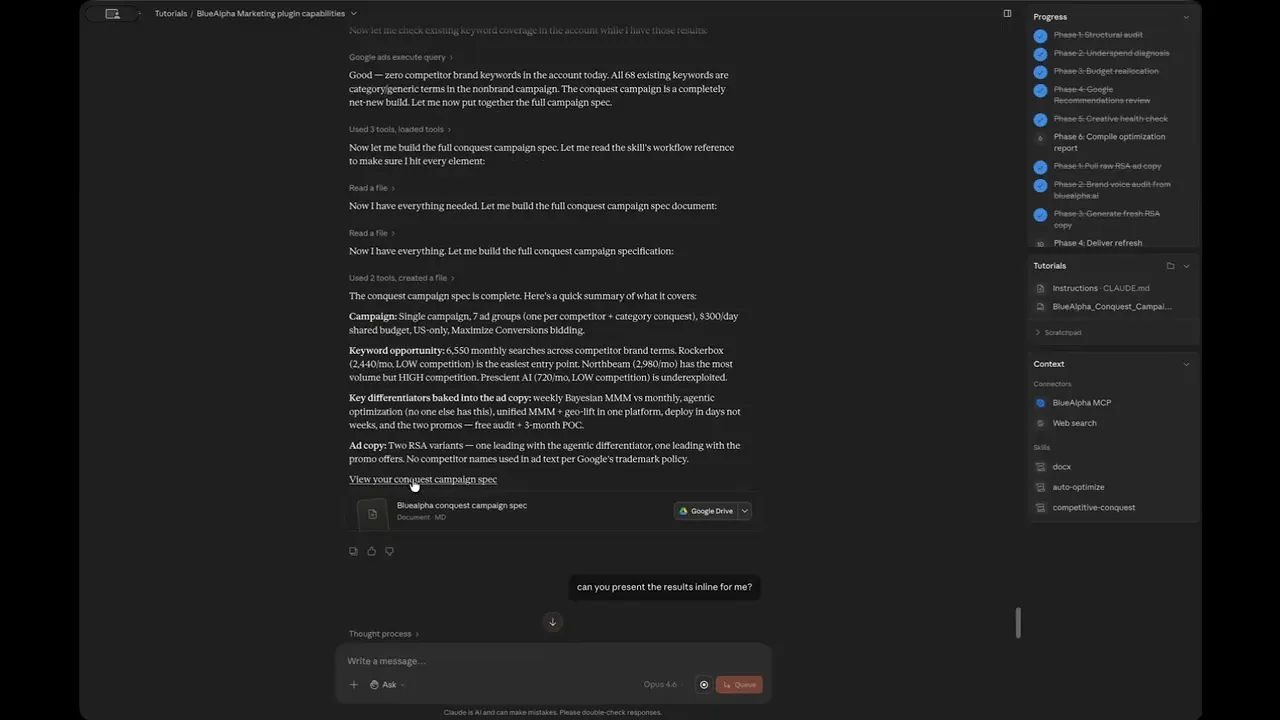
Google Ads Conquest Campaigns in Claude: BlueAlpha competitive-conquest Tutorial
Research up to seven competitors in parallel, size their branded search volume, and build a concentrated conquest campaign with ad copy and budget allocation.
TL;DR — competitive-conquest researches up to 7+ competitors in parallel, extracts their positioning and messaging weaknesses, sizes their branded search volume via Google Keyword Planner, and builds a single conquest campaign with one ad group per competitor plus category-level coverage — complete with two RSA variants (differentiator-led and promo-led), Smart Bidding budget allocation, and a 3-month optimization timeline. The key insight: it identifies where branded volume and competition levels create the best entry points, bakes your promotional offers directly into the ad copy, and produces a deployment-ready spec you can build in Google Ads Editor the same day. This is the offensive arm of what BlueAlpha calls the Decision Engine — the system that turns every signal in your ad account into a real decision.
Watch the full walkthrough (7 min):
Most conquest campaigns fail for one of two reasons: they spread budget across too many competitors without understanding which ones are easy to break into vs. which will be expensive fights, or they bid on competitor terms without any differentiation in the ad copy. This skill solves both — it sizes volume and competition levels for each competitor, identifies the easiest entry points, and writes conquest angles that exploit real positioning gaps while featuring your promotional offers.
All ten Google Ads skills in the BlueAlpha Marketing Plugin
auto-optimize— Runs a full optimization cycle on a Google Ads account: structural audit, underspend diagnosis, budget reallocation, recommendations review, and creative health check.full-monty— Runs every skill in sequence for a comprehensive top-to-bottom audit plus a strategic deployment plan for the next quarter.audience-intelligence— Analyzes audience performance across Google Ads and recommends bid modifiers, new segments, exclusions, and observation-to-targeting moves.brand-refresh-pipeline— Detects creative fatigue, audits brand voice, and generates fresh responsive search ad copy for any campaign.competitive-conquest— Researches competitors, identifies messaging gaps, and designs conquest campaign specs that target competitor brand terms.competitive-counterpunch— Detects when competitors gain auction share on your brand and plans a proportional defensive response.content-to-campaign— Turns any piece of content (blog, case study, webinar, comparison page) into a paid campaign complete with keywords and ad copy.geo-expansion-scout— Identifies new geographic markets worth entering by analyzing geo performance, keyword volume, and competitive density.incrementality-test-runner— Designs and monitors geo-based incrementality tests in Google Ads with integrity checks and lift analysis.seo-paid-bridge— Finds where organic and paid search overlap or leave gaps, then specs complementary paid campaigns that maximize total search click share.
This article is part of the full series.
Why use AI to build Google Ads conquest campaigns?
Building a conquest campaign manually means researching each competitor's positioning one at a time, guessing at their branded search volume, writing ad copy that stays within Google's trademark policies, and hoping you sized the budget right. For one competitor, that takes half a day. For seven, it's a week — and you still don't know which competitors are worth targeting until after you've spent the money.
Claude with the BlueAlpha Marketing Plugin compresses this into a single conversation. It researches all competitors in parallel via web search, pulls branded keyword volumes from Google Keyword Planner via the Google Ads MCP, cross-references against your existing campaigns to avoid conflicts, and produces a complete campaign spec with ad copy, match types, budget allocation, and a measurement plan.
How does Claude connect to your competitor and Google Ads data?
The BlueAlpha Marketing Plugin uses the Model Context Protocol (MCP) — an open standard that lets Claude talk directly to external tools and APIs. For competitive-conquest, Claude uses two connectors: the BlueAlpha MCP (Google Ads API for keyword idea generation, existing keyword data, and campaign structure) and Web search (for competitive intelligence gathering).
For setup instructions (installing the plugin, authenticating your MCC, and connecting your first account), see The BlueAlpha Google Ads Marketing Plugin for Claude.
What the skill does
The skill runs in four phases and produces a deployment-ready conquest campaign.
Configure and gather competitive intelligence. An interactive widget asks four questions — which competitors to target, available budget, whether to use MMM for post-launch validation, and what promotional offers to feature in ad copy. Claude then researches all competitors in parallel via web search, extracting their positioning, pricing, methodology, and weaknesses.
Keyword research and volume sizing. Uses
generate_keyword_ideasvia Google Ads Keyword Planner to size branded search volume for each competitor, then checks what keywords you're already bidding on to avoid conflicts. Produces a competitor opportunity map showing volume and competition level per brand.Campaign architecture and ad copy. Builds a single campaign with one ad group per competitor plus category-level coverage, with keywords, match types, Smart Bidding budget allocation, negative keywords, and two RSA ad copy variants (differentiator-led and promo-led) — all policy-compliant.
Targeting, negatives, and optimization timeline. Specifies geo, language, network, and bidding settings, produces a comprehensive negative keyword list, and lays out a 3-month optimization timeline with learning, tCPA-setting, ROI review, and full review phases.
Step-by-step walkthrough
1. Invoke the skill
Type /competitive-conquest. Claude opens the "Conquest campaign details" widget with four configuration questions.
2. Configure the conquest targets
The widget asks:
Which competitors do you want to target? — Pre-populated options based on your space (in the demo: Measured, Northbeam, Rockerbox, Recast, Haus, Paramark, PrescientAI, Other). Select as many as you want and type additional competitors in the Other field.
Daily budget for conquest campaigns? — Preset options: $50/day, $100/day, $150/day, or Other (type a custom amount).
Include MMM incrementality measurement? — Yes or No.
Any promotional offers to feature in ads? — Free text field (e.g., "Free audit, 30-day trial, etc."). These offers get baked into one of the two RSA variants the skill produces.
Demo config: Measured, Northbeam, Rockerbox, Recast, Haus, PrescientAI (6 selected, Paramark unselected) · Other: $300/day · MMM: No · Promos: free audit and 3 month POC.

3. Review the competitive intelligence
Claude researches all 6 competitors in parallel via web search — scraping their websites, pricing pages, G2 reviews, and product documentation. It then generates keyword ideas seeded by competitor brand names via the Google Ads MCP, and checks what keywords BlueAlpha is already bidding on.
In the demo, the Google Ads keyword tool disconnected mid-flow — Claude surfaced the competitive intelligence it had already gathered while waiting for re-authentication, then resumed keyword data pulling once reconnected. A good example of the skill handling real-world API interruptions gracefully.
4. Review the competitive landscape summary
While keyword data loads, Claude surfaces a competitive landscape summary for all 6 targets:
Measured — Enterprise-focused, starts ~$50K/year. Combines incrementality testing with test-calibrated MMM. Strength: 70+ integrations, 24-hour deployment. Weakness: high price point, enterprise-only.
Northbeam — MTA + MMM+, strong with DTC/Shopify brands. Just launched automated incrementality testing (April 2026). Strength: deterministic view-through attribution. Weakness: DTC-centric, less enterprise.
Rockerbox — MTA + MMM + Testing, 500+ brands. Strength: 100+ integrations, SOC2-certified. Weakness: 6-8 week implementation timeline.
Recast — Bayesian MMM updated weekly, plus GeoLift testing. Strength: 94%+ revenue forecasting accuracy. Weakness: best for $500K-$10M annual spend, narrower scope.
Haus — Pure incrementality platform, PhD-backed. Strength: deep causal measurement expertise. Weakness: single methodology, no full MMM offering.
PrescientAI — AI-powered MMM with halo effects measurement. Raised $10M Series A. Strength: pixel-free, predictive modeling. Weakness: newer platform, DTC-focused.
5. Review the headline metrics and competitor opportunity map
The report opens with four key numbers:
$300 — Daily budget ($9,000/month)
6 — Competitors targeted + category conquest
6,550 — Monthly searches (brand terms only)
0 — Current coverage (net-new campaign — all 68 existing keywords are category/generic terms in the nonbrand campaign)
Below the headline metrics, Claude produces a "Competitor opportunity map" — a set of cards showing each competitor's branded search volume, competition level, CPC range, and conquest angles:
Northbeam — 2,980/mo · HIGH competition · $9–$39 CPC. Angles: MTA-first, MMM bolted on → BA is MMM-native. DTC/Shopify only → BA handles offline + OOH. New incrementality (Apr '26) → BA geo-lift is mature.
Rockerbox — 2,440/mo · LOW competition · $13–$46 CPC. Angles: 6-8 week setup → BA deploys in days. 500+ brands, thin support → BA is white-glove. MTA+MMM+Testing complexity → BA unified platform.
Prescient AI — 720/mo · LOW competition · $11–$52 CPC. Angles: Pixel-free but digital-only → BA measures offline. $10M Series A startup → BA enterprise-grade. No incrementality testing → BA has built-in geo-lift.
Measured — 240/mo · LOW competition · $11–$127 CPC. Angles: ~$50K/yr enterprise pricing → BA free audit + POC. Long test periods → BA weekly Bayesian MMM.
Haus — 140/mo · LOW competition · $2–$39 CPC. Angles: Pure incrementality, no full MMM → BA is both. Experimental-only → BA has always-on measurement.
Recast — 30/mo · Medium competition · $10–$39 CPC. Angles: $500K-$10M sweet spot → BA scales beyond. No incrementality → BA has native geo-lift.

6. Review the budget allocation
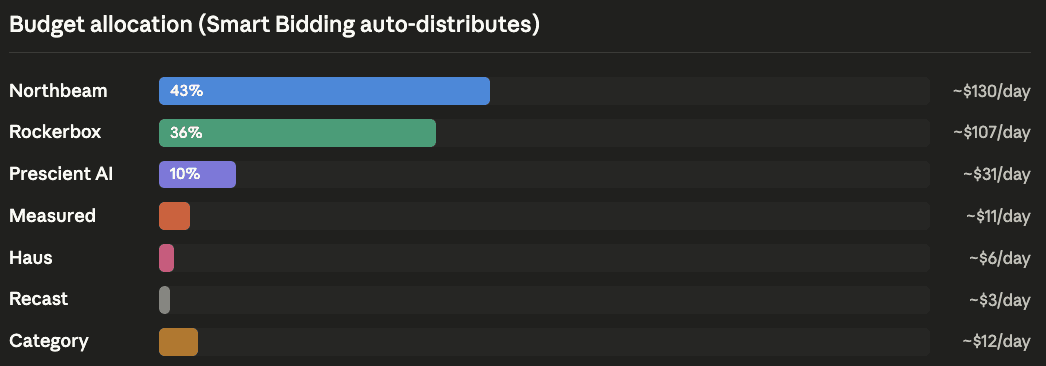
The skill produces a budget allocation chart showing how Smart Bidding auto-distributes the $300/day across ad groups, weighted by search volume and competition:
Ad group | Share | Est. daily budget |
|---|---|---|
Northbeam | 43% | ~$130/day |
Rockerbox | 36% | ~$107/day |
Prescient AI | 10% | ~$31/day |
Measured | — | ~$11/day |
Haus | — | ~$6/day |
Recast | — | ~$3/day |
Category | — | ~$12/day |
Campaign name: 20260511_BlueAlpha_conquest_google_competitors_mixed
Campaign structure: Single campaign, 7 ad groups (one per competitor + category conquest), $300/day shared budget, US-only, Maximize Conversions bidding.
Bidding strategy: Maximize Conversions with no tCPA cap for the first 2 weeks to accumulate conversion data. Then set tCPA at 2x the nonbrand CPA.
7. Review the RSA ad copy
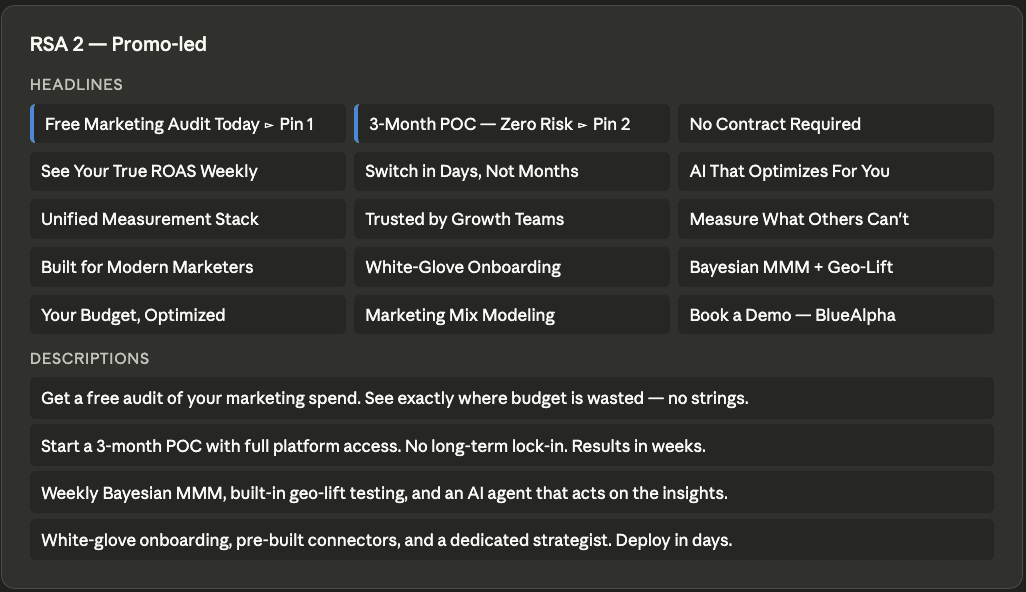
The skill generates two RSA variants per ad group — a differentiator-led version and a promo-led version — each with 15 headlines and 4 descriptions. All ad copy points to bluealpha.ai/demo.
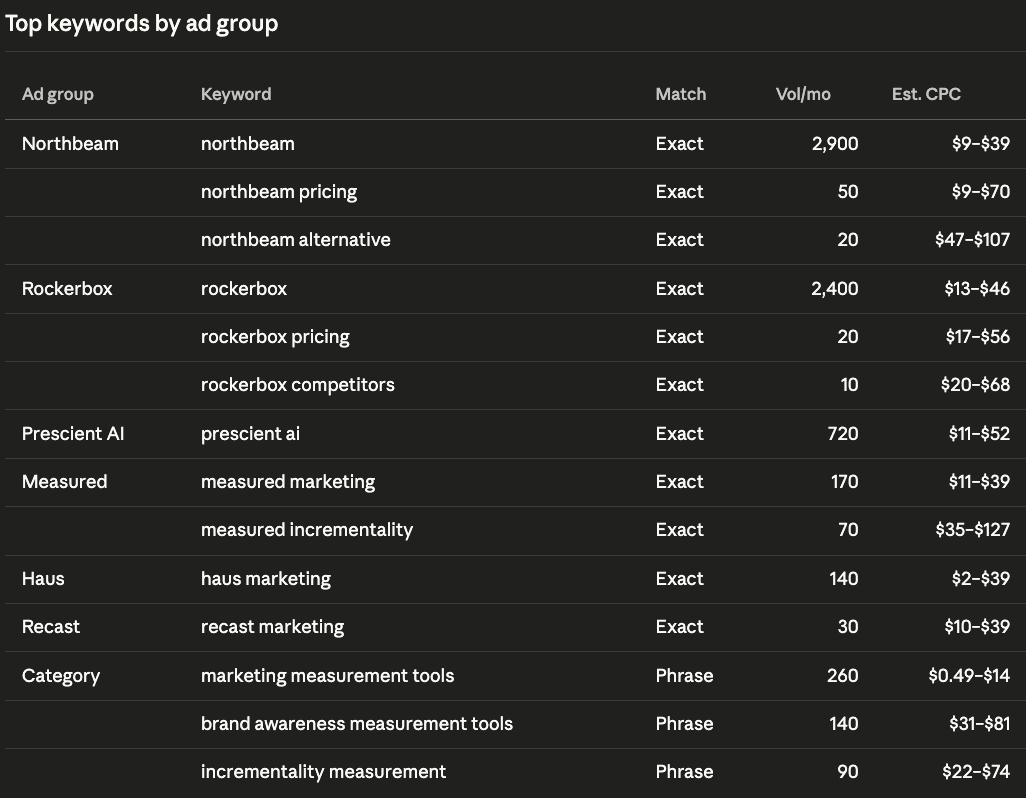
RSA 1 — Differentiator-led:
Pin 1: "MMM That Acts on Insights"
Pin 2: "Free Marketing Audit"
Remaining headlines cover the product wedge: weekly model refresh, AI-native execution layer, Bayesian MMM + incrementality in one platform, detection agents that flag issues automatically.
Descriptions position BlueAlpha as the measurement platform that doesn't just report — it acts.
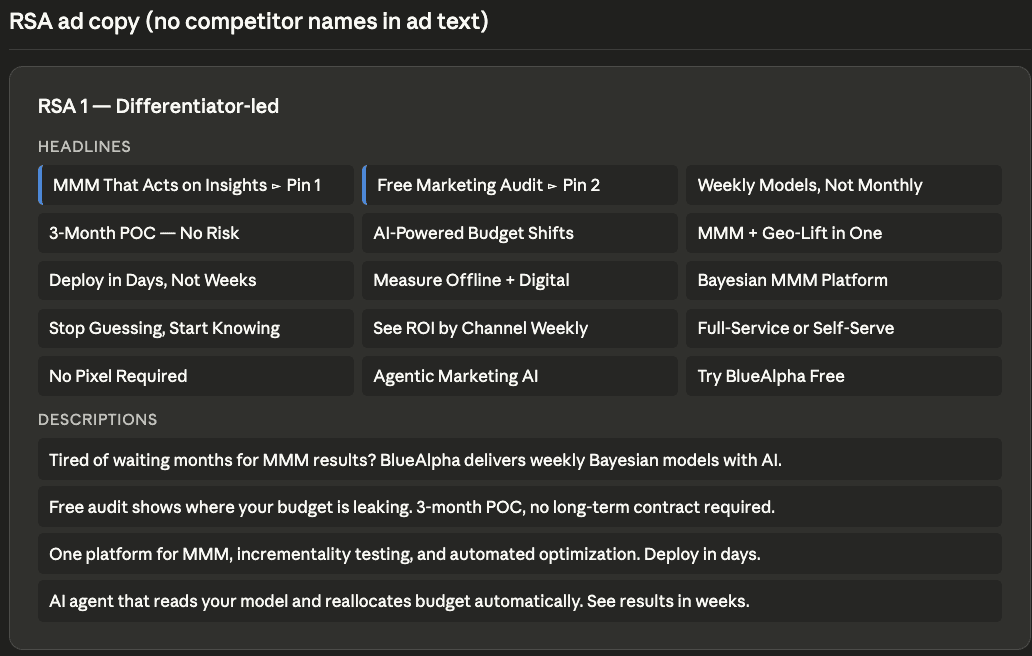
RSA 2 — Promo-led:
Pin 1: "Free Marketing Audit Today"
Pin 2: "3-Month POC — Zero Risk"
Remaining headlines lead with the offer: no enterprise contract, prove ROI before committing, free audit + 3-month proof of concept.
Descriptions emphasize the risk-free trial and fast time to value.
Both variants are generated for every ad group. All copy follows Google Ads trademark policy — no competitor names appear in any headline or description. Keywords bid on competitor brand terms, but ads differentiate with category messaging and promotional offers only.
8. Review targeting and negatives
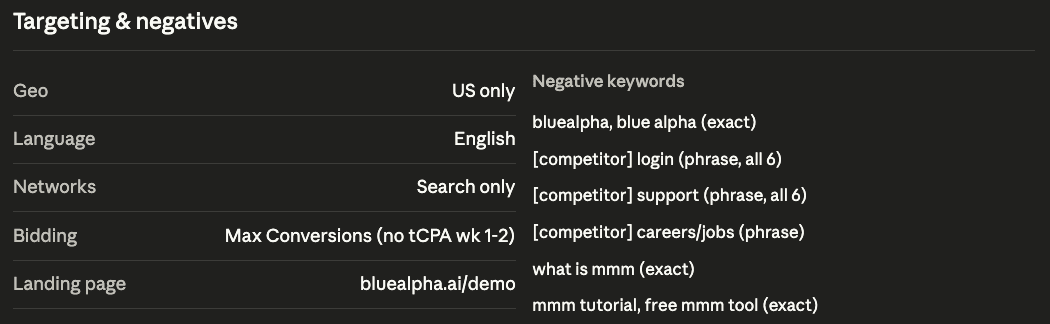
The skill outputs campaign-level targeting settings and a negative keyword list:
Targeting settings:
Geo: US only
Language: English
Networks: Search only (no Display, no Search Partners)
Bidding: Maximize Conversions with no tCPA cap for weeks 1–2
Landing page:
bluealpha.ai/demo
Negative keywords:
[bluealpha],[blue alpha]— exact match, protect your own brand"[competitor] login","[competitor] support","[competitor] careers"— phrase match, exclude navigational/job queries[what is mmm]— exact match, exclude top-of-funnel educational intent[mmm tutorial],[free mmm tool]— exact match, exclude research-stage queries with no buying intent
9. Review the optimization timeline
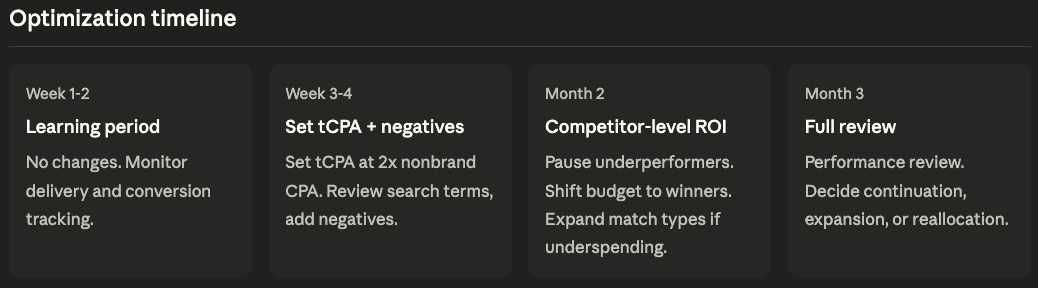
The skill produces a 3-month phased optimization plan:
Week 1–2 — Learning: Let Maximize Conversions accumulate data. No tCPA cap. Monitor for keyword cannibalization against your non-brand campaign. Pause any ad groups with zero impressions.
Week 3–4 — Set tCPA + negatives: Set tCPA at 2x your nonbrand CPA. Add search-term negatives from the first two weeks. Evaluate which RSA variant (differentiator-led vs. promo-led) wins per ad group.
Month 2 — Competitor-level ROI: Break out performance by competitor ad group. Pause any competitor where CPA exceeds 3x nonbrand with no pipeline signal. Shift budget to the top-performing ad groups.
Month 3 — Full review: Re-run the skill to refresh competitor intelligence and keyword volumes. Decide whether to expand budget or consolidate to the 2–3 highest-ROI competitors.
10. Review the big takeaway
The skill finishes with a summary of the highest-value opportunities:
Rockerbox is the easiest win — 2,440 monthly searches at LOW competition and a $6.37 average CPC. This is the ad group most likely to deliver volume at a reasonable CPA.
Northbeam has the most branded search volume (2,980/mo) but HIGH competition and a $31.53 CPC. Expect higher CPAs here — worth running, but watch closely.
Prescient AI is underexploited — 720 monthly searches at LOW competition and only $4.67 CPC. A sleeper opportunity most competitors are ignoring.
Example prompts
Slash command:
/competitive-conquest
Natural language:
"Run competitive-conquest on customer 561-240-7843. Target Northbeam, Rockerbox, Prescient AI, Measured, Haus, and Recast. Budget: $300/day. No MMM validation. Promos: free audit and 3-month POC."
After seo-paid-bridge flags competitors:
"SEO-paid bridge flagged competitors bidding on MMM and attribution terms where I'm not present. Run competitive-conquest."
Focused on a single competitor:
"Run competitive-conquest targeting only Rockerbox. Budget: $100/day. We differentiate on AI-native execution, weekly model refresh, and no enterprise contract. Use MMM for validation."
With MMM validation enabled:
"Run competitive-conquest targeting Northbeam and Prescient AI. Budget: $200/day. Use Meridian model for post-launch incrementality validation. Promos: free audit and 3-month POC."
Gotchas and tips
Competition level matters more than raw volume. In the demo, Rockerbox (2,440/mo, LOW competition) is a better starting point than Northbeam (2,980/mo, HIGH competition) despite lower volume. The skill surfaces competition level for exactly this reason.
Never use trademarked competitor names in ad copy text. Bid on them as keywords — don't put them in headlines or descriptions.
Expect a 2–3x CPA premium. Conquest traffic converts at lower rates. That's normal.
Cross-negative religiously. Prevent the conquest campaign from cannibalizing your non-brand campaign.
Keyword Planner data is directional, not gospel. KP rounds aggressively at low volumes. Run actual campaigns on broad match for real data.
Smart Bidding needs 2 weeks before you set a tCPA. The optimization timeline starts with no cap intentionally. Adding a tCPA too early starves the algorithm of the conversion data it needs to optimize.
Two RSA variants gives you a built-in test. The differentiator-led and promo-led variants let you see whether product positioning or promotional offers drive more conversions per competitor — without designing the experiment yourself.
FAQ
How does the skill determine branded search volume for competitors?
It runs generate_keyword_ideas via Google Keyword Planner, seeded with competitor brand terms. KP returns avg_monthly_searches for each keyword. The skill also pulls competition level (LOW/MEDIUM/HIGH) and average CPC to size the opportunity.
What do the volume numbers mean in the competitor opportunity map?
In the demo, the 6 competitors ranged from 2,980/mo (Northbeam) down to 30/mo (Recast). These are summed across all branded variants per competitor. The skill uses volume + competition level + CPC to rank the opportunities — Rockerbox (2,440/mo, LOW, $6.37 CPC) ranked as an easier win than Northbeam (2,980/mo, HIGH, $31.53 CPC) despite lower volume.
Does the skill create the campaign in Google Ads?
No. It produces a complete campaign specification — ad groups, keywords with match types, two RSA variants per ad group, bidding strategy, budget allocation, negative keywords, targeting settings, and an optimization timeline. You build it in Google Ads Editor or ask Claude to help with the next step.
Does competitive-conquest put competitor names in the ad copy?
No. The skill bids on competitor brand terms as keywords but never includes trademarked competitor names in headlines or descriptions. All RSA copy is policy-compliant.
How many competitors can I target in one run?
The widget offers pre-populated options plus an "Other" field for custom entries. In the demo, 6 competitors were selected (Paramark was deselected). There's no hard limit — the skill creates one ad group per competitor plus a category conquest ad group.
What if most of my competitors don't have branded search volume?
The skill handles this automatically by building category-level ad groups that capture the higher-volume "shopping around" queries where all competitors compete organically. You don't need branded volume to run conquest — you need category volume with competitive intent.
What bidding strategy does the skill recommend?
Maximize Conversions with no tCPA cap for the first 2 weeks, then set tCPA at 2x your nonbrand CPA. The optimization timeline walks you through each phase.
What if I don't have an MMM for validation?
Choose "No" for MMM validation. The skill will still produce an optimization timeline based on Google Ads metrics — but you lose the incrementality check. Without MMM, watch for declines in your non-brand campaign as a cannibalization signal.
How often should I refresh the conquest campaign?
Re-run the skill quarterly or whenever a competitor changes their positioning, pricing, or product. The Month 3 full review in the optimization timeline is a natural trigger to refresh.
Related skills
If
seo-paid-bridgeflagged competitors on your gap terms → this is the natural follow-up.If a competitor is bidding on your brand → run
competitive-counterpunch(defense, not offense).If the conquest campaign needs comparison content → run
content-to-campaignto build a landing page.If RSAs need refreshing after 6–8 weeks → hand off to
brand-refresh-pipeline.If you want to validate incrementality → run
incrementality-test-runnerfor a geo-based lift test.For the full account picture → run
auto-optimizeto check account health first.
Your next step
Pick up to 7 competitors and run:
/competitive-conquest
The interactive widget will walk you through configuration. You'll have a competitive intelligence report, a competitor opportunity map, two RSA variants per ad group, and a 3-month optimization timeline ready to deploy by the end of the session.
Need help getting set up? See the installation guide.
Want a growth partner to run the Decision Engine for you? Book a demo. Or start with a free Competitive Benchmark Report to see how you stack up before building your first conquest campaign.

