Fintech's Google Ads Strategy Has Quietly Split in Two. Most Marketers Haven't Noticed.
We benchmarked 35 fintech brands on Google Ads format mix, creative velocity, and evergreen dependency. Two camps emerged. The most efficient quadrant is nearly empty.
TLDR: We pulled the full Google Ads catalogs for top brands across consumer fintech, brokerage, and payments: including Chime, SoFi, Fidelity, Schwab, Stripe, PayPal, Dave, Current, and Coinbase, expecting a variety of strategies. We found a category that pulls toward two opposing creative philosophies: a search-led camp running 70%+ text ads with locked-in evergreen winners, and a surface-led camp running 50%+ video with near-zero evergreen reliance. A smaller image-led middle sits between them, mostly the payments processors. Brand size doesn't predict which camp a company lands in. And almost none match the "Stable Core" archetype, the playbook that pairs aggressive testing with proven long-running winners. That's the strategic gap, and it's wide open.
We expected a spectrum. Some brands testing more, some less. Some leaning into video, some sticking with search. A distribution of strategy, maybe aligned with size or company age.
That's not what's happening.
When we pulled the full Google Ads catalogs for 35 brands across fintech and payments, running each through BlueAlpha's competitive benchmarking, the picture that came back clustered hard at two poles. Two dominant camps, a thinner image-led middle, and the divide doesn't track with company size, sub-vertical, or maturity. Brands have picked a lane on what Google is for.
How fintech Google Ads strategy has split into two camps
Two camps dominate.
Camp A - Search-led: Fidelity, Schwab, SoFi, Stripe, Coinbase, Klarna, Plaid, Stash, N26, Current, Fastspring, Moomoo, Wealthfront. All running 70%+ text: several at or near 100% (N26 at 100%, Stash at 98%, Stripe near 99%). These brands are treating Google like it’s 2015: text ads against high-intent search queries, optimized for direct response. Basically a keyword optimizer, all bottom-of-funnel.
Camp B - Surface-led: Chime, Dave, Cash App, Acorns, Nubank. All running 50%+ video on Google. Dave is 100% video; Cash App is 72%; Acorns 62%; Chime 59%; Nubank 52%. These brands are treating Google as a multi-surface system: using YouTube, Discovery, and Performance Max to reach users before they're searching, not just when they are. Maximizing top of funnel exposure.
The middle is thinner, and it has a signature. It's mostly the payments processors and a handful of challengers running image-led or balanced mixes: PayPal (50% image), Square (64% image), and Adyen (32% image), alongside Brex (53% text / 25% video / 22% image), Affirm, Betterment, Kraken, and eToro. They balance top-of-funnel exposure with bottom-of-funnel conversions instead of committing to one.
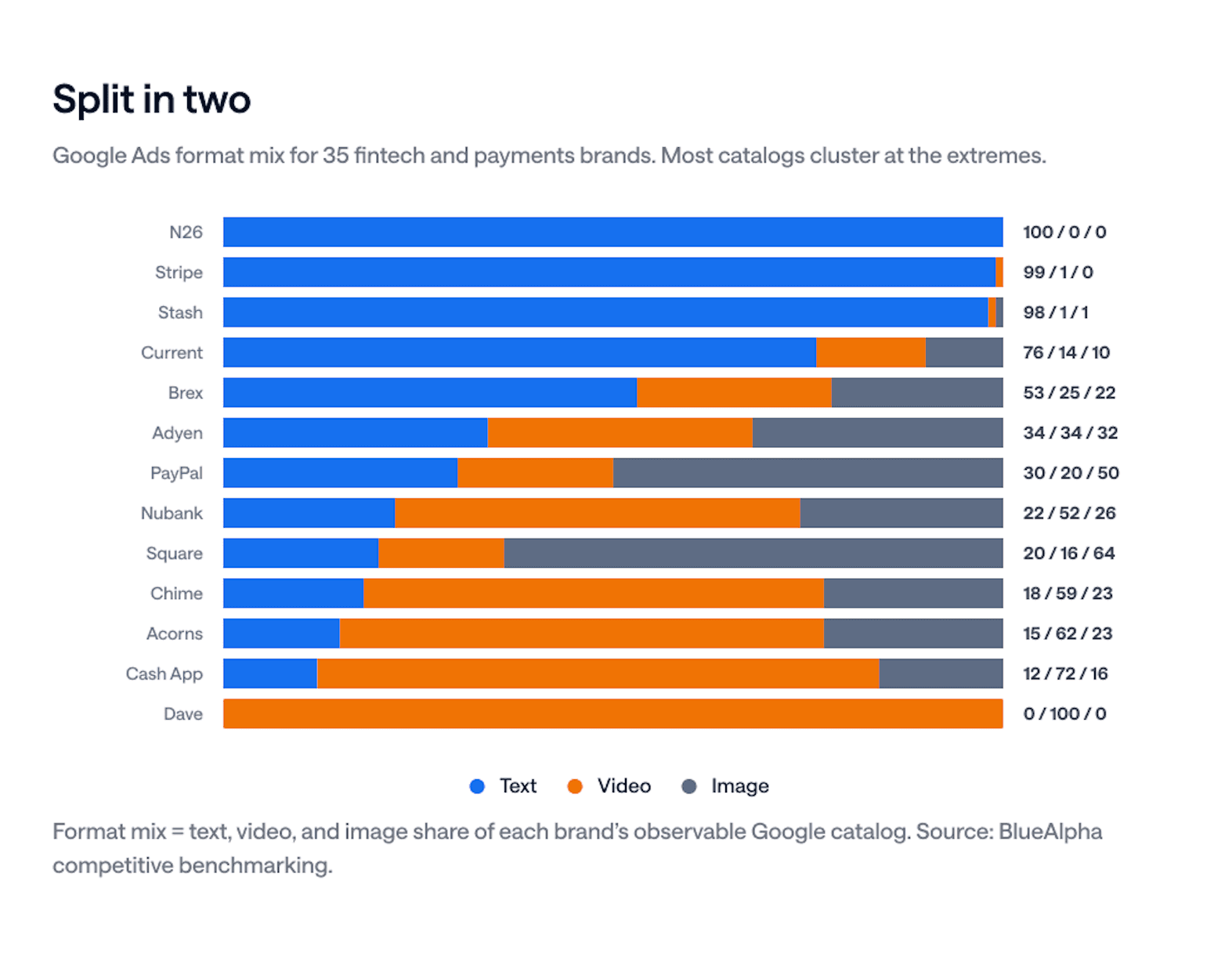
This matters because Google Ads stopped being one channel a long time ago. It's six surfaces under one auction: Search, YouTube, Display, Discovery, Gmail, Maps. A 100% text catalog is a deliberate choice to ignore five of them. A 100% video catalog is the inverse choice. Both are defensible. Both are surprisingly common. And both leave half the platform unused.
Does company size predict Google Ads creative strategy?
You'd assume incumbents would have the richer creative footprint - bigger budgets, more sophisticated agencies, more surface coverage. And you'd assume challengers would run lean, text-only programs because they can't afford video production at scale.
The data says the opposite.
Fidelity, a brokerage giant in the dataset (4,000 Google ads), runs almost entirely text. Current, a small neobank challenger (700 ads), runs ~76% text. Same camp.
Chime, a ~$25B-valuation neobank (3,000 ads), runs 59% video. Dave, a much smaller neobank (300 ads), runs 100% video. Also same camp.
This isn't a budget story. It's a strategy story. Brands have made an explicit call about what Google is for, and that call is decoupled from how much they're spending. Fidelity could afford to run video at scale. They've chosen not to. Dave can barely afford to produce a few hundred ads total. They've chosen video anyway.
The implication: when a fintech CMO asks "what should our Google strategy look like?", looking at peers won't help. Peers have split into incompatible playbooks, and the playbooks don't sort by company stage.
How often fintech brands launch new Google Ads
The second sharp split: freshness, or how often brands actually launch new ads.
The 30-day launch rate, what percentage of a brand's currently-observable Google catalog was launched in the last month, varies wildly across the dataset:
Brand | 30-day launch rate |
|---|---|
Dave | 50% |
eToro | 32% |
Chime | 24% |
Moomoo | 13% |
Interactive Brokers | 10% |
Fidelity | 7% |
Schwab | 4% |
Dave has rebuilt half its observable Google footprint in the last 30 days; eToro a third; Chime a quarter. Schwab and Fidelity, sitting on libraries of 5,000 and 4,000 ads, have refreshed 4% and 7%. All are established brands. The gap is so wide it can't be explained by market difference alone. It's philosophical.
High-velocity programs are betting that creative half-life on Google's algorithmic surfaces is now measured in weeks. The auction punishes stale creative; the algorithm rewards fresh inputs. So you keep launching.
Set-and-forget programs are betting that compounding wins matter more than recency. A high-converting search ad against a high-intent keyword can run for years. Why disturb it?
Both bets are defensible in isolation. The problem is most marketers haven't actually picked one, they've defaulted into whichever posture their agency or in-house team finds easier to operate.
How much of a fintech brand's Google catalog is evergreen?
If launch velocity tells you whether a brand is testing, evergreen dependency tells you whether they believe in winners.
Share of currently-observable Google ads that have been running 180+ days:
Brand | Evergreen dependency |
|---|---|
Current | 76% |
Mercury | 69% |
Klarna | 68% |
Brex | 60% |
Interactive Brokers | 55% |
SoFi | 50% |
Monzo | 50% |
Adyen | 49% |
Plaid | 49% |
Fidelity | 47% |
Schwab | 47% |
Kraken | 47% |
Moomoo | 43% |
Square | 42% |
Betterment | 38% |
Acorns | 21% |
This is what makes the bifurcation feel real. It's not just what format a brand runs. It's whether they keep anything around long enough to compound.
Current's program is roughly three-quarters long-runners (76%); Acorns' is barely a fifth (21%). The text-led camp tends to lock in evergreens it trusts (Current, the brokerages, SoFi). The video-heavy camp rotates fast and keeps far less around long enough to call it evergreen. Chime, Dave, and Acorns all sit in the Actively Managed corner with thin evergreen cores. Same auction, opposite postures on what "winning" looks like.
The Mercury anomaly is worth flagging: a young startup bank running a 69% evergreen base, incumbent-grade evergreen discipline at a fraction of the scale. Not wrong, but unusual for a brand that age.
The Stable Core quadrant: the Google Ads archetype nobody runs
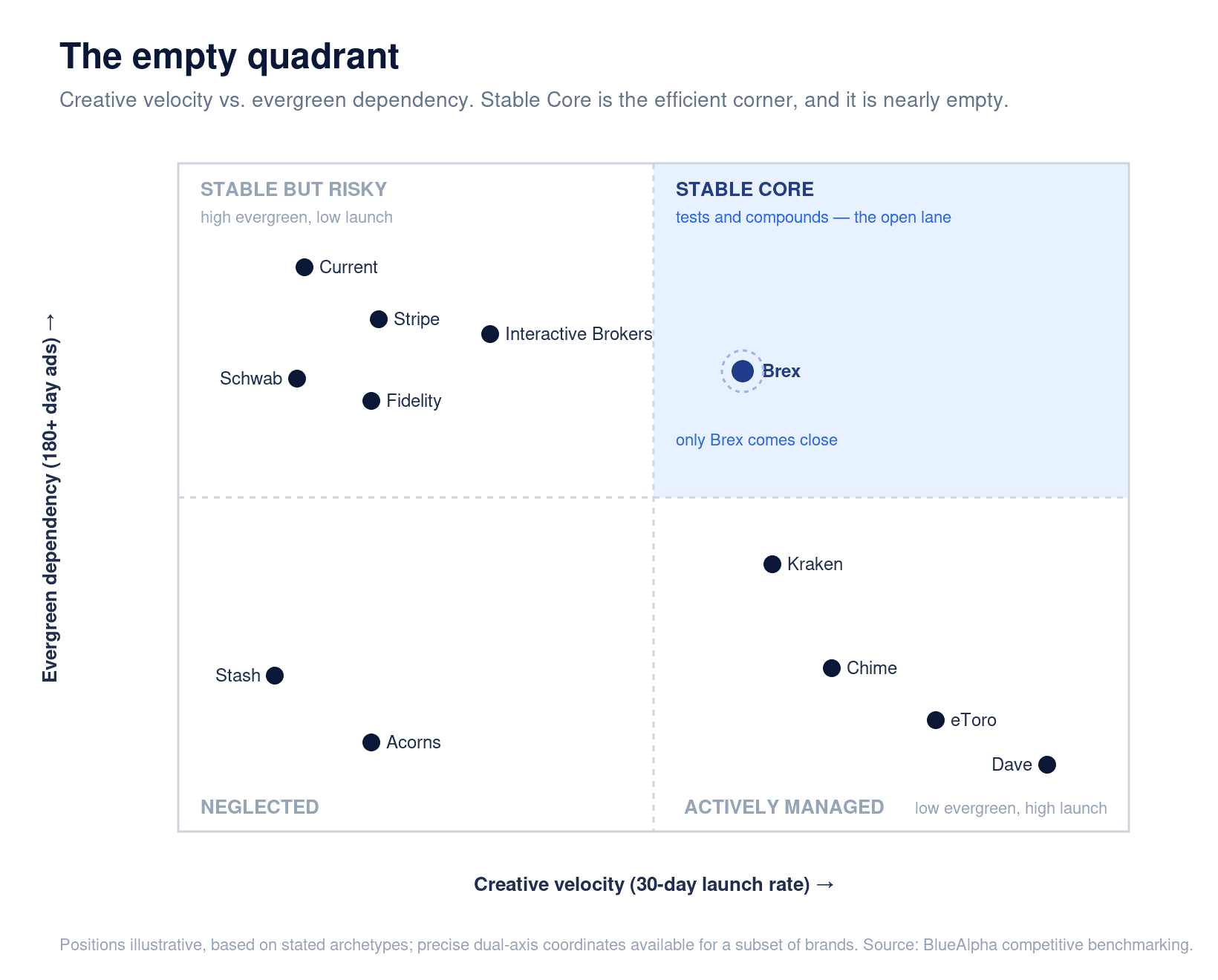
Cross freshness × evergreen reliance and you get four archetypes:
Stable but Risky: high evergreen, low recent launches. Locked into aging winners. (Fidelity, Schwab, Interactive Brokers, Current, Stripe)
Actively Managed: low evergreen, high recent launches. Constant rotation. (Chime, Dave, eToro, Kraken)
Neglected: low everything. Programs running themselves. (Acorns, and small-catalog players like Stash)
Stable Core: high recent launches and strong evergreen base. Tests aggressively, compounds winners.
The fourth quadrant is nearly empty. Across 35 brands in fintech and payments, only one comes close: Brex pairs the dataset's most aggressive Google replacement cadence (a 15.33 replacement ratio) with a 60% evergreen core; the one profile that looks like Stable Core. Everyone else is firmly in one of the other three. The brands testing the most (Chime, Dave) keep almost nothing around. The brands with the strongest evergreen base (Current, the brokerages) are barely launching anything new.
Stable Core is the most efficient quadrant in theory: you keep your top performers running while continuously feeding fresh tests into the system, and the winners that emerge get promoted into the evergreen layer. It's the textbook answer for how to run a mature paid program. And almost nobody in this sample is doing it.
How to pick your Google Ads strategy: demand type and measurement
Two takeaways for fintech marketers.
One: "Look at peers" stopped being useful advice for Google strategy. Peers have already split into incompatible playbooks, and which camp a competitor is in tells you almost nothing about what you should do. Pick a thesis on what Google is for in your funnel - search-led, surface-led, or both, and let that drive format mix and testing cadence. Don't drift into a posture by default.
Two: The empty Stable Core quadrant is the most interesting strategic position in the category right now. The first fintech to reliably pair Chime's testing velocity with Fidelity's evergreen discipline owns the most efficient Google program in the category by a wide margin. It's not a budget question. It's an operational question - whether your team can run two motions in parallel without one cannibalizing the other.
The brands in this dataset have almost all picked one. Few have figured out how to do both.
BlueAlpha's take: demand type and measurement decide your Google Ads strategy
So how do you pick?
Ask one question: is my buyer already searching for what I sell, or do I have to teach them they have a problem?
If the demand already exists, rollover IRAs, business checking, "best brokerage", search-led harvests intent that's already on the table. That's Camp A, and it's why the brokerages live there. If your product creates a need people don't yet know to search for, a cash advance, a new spending primitive, a category that didn't exist three years ago, there's no intent to harvest. You have to manufacture it on the surfaces. That's Camp B. High-consideration, high-LTV products reward bottom-funnel precision. Low-friction, impulse signups reward broad reach. Your demand type picks your camp. Not your budget. Not your competitors.
The team question is really a measurement question.
What kills brands running both motions isn't budget cannibalization. It's attribution cannibalization. Run video and Performance Max alongside search, and the top-funnel surfaces inflate your search numbers. Last-click reporting hands the credit to the bottom of the funnel. So the team "discovers" search is the best channel, and defunds the exact top-funnel work that was feeding it. You can run both motions if, and only if, you can measure both causally. The moment you can't, you cannibalize yourself by accident.
This is also why Stable Core is empty. It's not a discipline problem. Without incremental measurement, you can't tell which fresh tests actually earned promotion to evergreen, so winners never compound and the quadrant stays out of reach. The wall between a fintech and the most efficient Google program in the category isn't spend. It isn't talent. It's whether you can separate real incremental lift from attribution noise.
Methodology
This analysis was generated by BlueAlpha's competitive benchmarking system, which pulls public Google Ads Transparency Center data and quantifies creative posture across the dimensions above. We run these benchmarks for customers to surface exactly this kind of category-wide pattern.
Want to see where your brand sits on this map? Request your free competitive benchmark, or book a 20-minute walkthrough to talk through the findings.
See how we helped fintech brand Klover measure what was actually driving growth.
Google data sampled from up to 500 ads per brand via Google Ads Transparency Center; format mix, launch rate, and evergreen dependency computed against currently-observable catalogs. Brands analyzed: Chime, SoFi, Current, Varo, Dave, Squareup, PayPal, Robinhood, Adyen, Fastspring, eToro, Schwab, Moomoo, Interactive Brokers, Fidelity, Brex, Affirm, Klarna, Ramp, Plaid, Wealthfront, Betterment, Kraken, Stash, Acorns, Nubank, Monzo, Mercury, Cash App, N26, Wise, Stripe, Coinbase, Revolut, Authorize.net.
FAQ
What are the two Google Ads strategy camps in fintech?
Camp A (search-led) runs 70%+ text ads against high-intent search queries, treating Google as a direct-response keyword engine. Camp B (surface-led) runs 50%+ video across YouTube, Discovery, and Performance Max, treating Google as a multi-surface reach system. Between them sits a thinner, image-led middle, mostly payments processors: PayPal, Square, and Adyen.
Does company size predict which Google Ads strategy a fintech brand uses?
No. Fidelity (a brokerage giant, 4,000 Google ads) runs almost entirely text. Dave (a much smaller neobank, 300 ads) runs 100% video. The split is strategic, not budgetary. Brands have made an explicit call about what Google is for, and that call is decoupled from spend levels.
What is the 30-day launch rate in Google Ads?
The percentage of a brand's currently-observable Google Ads catalog that was launched in the last 30 days. It measures creative velocity. Dave has rebuilt 50% of its footprint in 30 days and Chime 24%, while Schwab and Fidelity have refreshed only 4% and 7% of much larger libraries. High-velocity programs bet that algorithmic surfaces punish stale creative; set-and-forget programs bet that compounding winners matter more than recency.
What is evergreen dependency in Google Ads?
The share of currently-observable Google Ads that have been running for 180+ days. Current's program is roughly three-quarters long-runners (76%); Acorns' is barely a fifth (21%). Text-led brands tend to lock in evergreen winners they trust; video-heavy brands rotate too fast for much to compound.
What is the Stable Core archetype and why is it nearly empty?
Stable Core is the quadrant where a brand both tests aggressively (high launch/replacement cadence) and compounds proven winners (strong evergreen base). Across 35 fintech and payments brands, only Brex comes close, pairing a 15.33 replacement ratio with a 60% evergreen core. Almost everyone else either tests fast and keeps nothing, or holds evergreens and barely launches.
What are the four Google Ads creative strategy archetypes?
Stable but Risky (high evergreen, low launches): locked into aging winners. Actively Managed (low evergreen, high launches): constant rotation. Neglected (low everything): programs running themselves. Stable Core (high launches and strong evergreen): the most efficient quadrant in theory, but nearly empty across fintech.
How should fintech marketers choose their Google Ads strategy?
Stop looking at peers for guidance: they've already split into incompatible playbooks that don't sort by company stage. Pick a thesis on what Google is for in your funnel (search-led, surface-led, or both) and let that drive format mix and testing cadence. The most interesting strategic position is the nearly empty Stable Core quadrant: pairing high testing velocity with evergreen discipline.

