How to Measure Whether ChatGPT Ads Actually Drive Revenue
Geo-targeting made ChatGPT ads testable in May 2026. The geo holdout test design that separates real revenue lift from platform-reported claims.
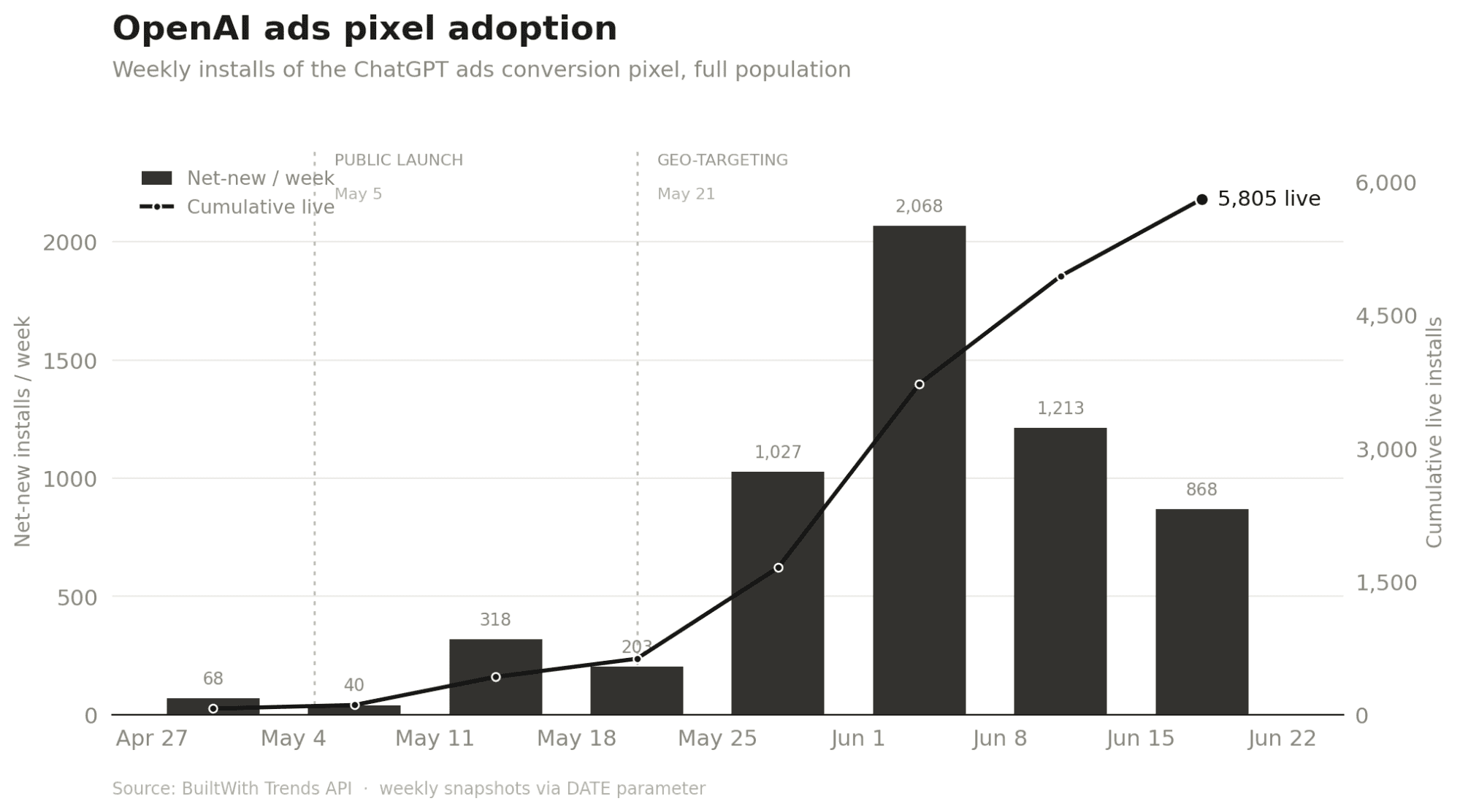
Roughly 5,805 advertisers have installed the ChatGPT ads conversion pixel, and not one of them can prove whether it drives revenue that would not have happened anyway. BuiltWith data as of mid-June 2026 shows net-new sign-ups peaked at over 2,000 in a single week, but adoption does not equal measurement. Every one of those installs reports conversions the same way: through a platform-owned pixel with no third-party verification layer, no independent measurement partner integration, and no way to isolate incremental impact. Every advertiser running ChatGPT ads faces the same question: can the platform drive revenue you would not otherwise have captured?
Incrementality testing is the only method that answers that question with causal evidence. This article explains why platform-reported metrics from ChatGPT ads are structurally unreliable, how the May 2026 launch of geo-targeting makes rigorous measurement possible for the first time, and how to design a geo holdout test that separates real lift from attribution overlap.
Why ChatGPT Ad Metrics Cannot Be Trusted at Face Value
Every ad platform reports its own version of the truth. Meta, Google, TikTok, and now OpenAI all use conversion pixels that fire when a user clicks an ad and later completes an action on the advertiser's site. The pixel closes the loop and attributes the conversion to the ad. Many of those conversions would have happened without the ad. The user was already in the funnel, already searching, already comparing. The platform claims the conversion; the ad did not cause it.
This is not a theoretical concern. It is a measured, quantified gap that consistently shows up across channels.
When BlueAlpha ran a geo holdout test for beehiiv, the results showed Meta's true CPA was 345% higher than what the platform reported.
For Cann, AppLovin's own dashboard swung between 2x and 16x ROAS and the third-party tool Triple Whale showed 4.77x. The measured incremental lift was zero, saving the company $480K per year.
For MUBI, Meta platform reporting claimed 66 subscriber acquisitions. Causal measurement showed 835, meaning paid media was driving 13x more growth than reported (in this case, the platform understated its own contribution).
The direction of the error varies. The pattern does not: platform-reported numbers and actual incremental impact are almost never the same.
ChatGPT ads are in an earlier and more exposed position than any of these channels were at the time of testing. Here is what the measurement infrastructure looks like as of June 2026:
No third-party measurement partners.
Meta has third-party lift study integrations. Google offers Conversion Lift and has open-sourced GeoX for geo-based incrementality. ChatGPT ads have neither. The only conversion data available comes from OpenAI's own pixel and Conversions API. The industry shorthand for this is "marking your own homework."
No search terms report or conversation placement report.
Advertisers set "context hints" (the ChatGPT equivalent of keywords) but cannot see which conversations their ads appeared in. Without a placement report, advertisers cannot audit whether impressions matched purchase intent or adjacent conversation context.
CPM billing charges for exposure, not action.
ChatGPT ads can be purchased on a CPM basis ($25-$60 depending on category) or CPC ($3-$5 bid floors). Under CPM, you pay for impressions regardless of whether those impressions influenced any outcome. The gap between reported and actual impact is wider by default than in CPC-only channels.
The pixel is weeks old.
The conversion tracking infrastructure shipped alongside the May 2026 Ads Manager launch. Any conversion data it generates has no historical baseline, no cross-channel calibration, and no lookback window longer than the pixel's own age.
None of this means ChatGPT ads do not work. It means the existing measurement infrastructure cannot tell you whether they work. The only way to answer the question is to build the measurement yourself.
What made incrementality testing possible: May 22 geo-targeting
Before May 22, 2026, ChatGPT ads could only target at the country level. That made any form of controlled geographic experiment impossible. You could not run ads in some markets and hold out in others because the platform had no mechanism for geographic segmentation.
On May 22, OpenAI shipped geo-targeting down to state, DMA, and ZIP code level. This single change makes a geo holdout incrementality test feasible on ChatGPT ads for the first time.
A geo holdout test works by splitting your target geography into treatment markets (where the ad runs) and control markets (where it does not). You then compare the primary business outcome, such as revenue, subscriptions, or purchases, between the two groups over a fixed period. The difference is your incremental lift: the revenue directly caused by the ad that would not have occurred without it.
The test requires geographic targeting precision. Without it, there is no way to hold out specific markets cleanly. The May 22 release is what moved ChatGPT ads from "interesting but unmeasurable" to "testable."
How geo holdout incrementality testing works
A geo holdout test has five components: market selection, pre-period calibration, treatment design, measurement period, and statistical analysis. Each one matters. Skipping any of them produces a number that looks like a measurement but is not.
Market selection
Select two groups of geographic markets that are comparable in size, demographics, and historical conversion behavior. The goal is to create a control group that would have performed identically to the treatment group in the absence of the ad. If the groups are not well-matched, any lift you measure could be driven by market differences rather than ad exposure.
For US-based campaigns, state-level splits are the most common starting point. Choose treatment states representing roughly 50-60% of your current spend share, with the remaining states as controls. Weight control markets by historical revenue share so you can normalize the comparison.
Pre-period calibration
Before launching the test, collect a pre-period baseline: typically 8-15 weeks of historical data on your primary KPI in both treatment and control markets. This baseline is what the statistical model uses to estimate what would have happened in treatment markets without the ad.
The pre-period matters because markets have natural variance. A treatment group might outperform its control for reasons that have nothing to do with the ad: seasonal differences, local promotions, competitive shifts. The pre-period calibrates the model to account for this variance.
Treatment design
Run ChatGPT ads only in treatment markets. Hold out entirely in control markets. Do not run overlapping promotions, creative changes, or spend shifts on other channels during the test window. Every additional variable you introduce weakens the causal claim.
For ChatGPT specifically, set up a campaign targeting only the treatment states via OpenAI's geo-targeting controls. Keep the existing campaigns on other channels (Meta, Google, etc.) unchanged in both treatment and control markets to isolate the ChatGPT effect.
Measurement period
Run the test for a minimum of four weeks. Shorter windows produce statistically underpowered results, especially for a channel like ChatGPT where the conversion path is longer than direct-response search. Users encounter an ad inside a conversation, may not click immediately, and may convert days later through a different channel. A four-week window gives the signal time to materialize.
Statistical analysis: why "compare the averages" is not enough
The naive approach to a geo holdout is to compare average revenue in treatment markets vs. control markets and call the difference "lift." This ignores natural variance, trend differences, and the fact that individual markets behave differently for reasons unrelated to the test.
The standard statistical framework for this type of analysis is Bayesian Structural Time Series (BSTS). A BSTS model builds a synthetic control: a modeled prediction of what treatment markets would have done without the ad, based on their pre-period behavior and the actual performance of control markets during the test. The estimated causal lift is the difference between the synthetic control and actual treatment performance.
BSTS produces a probability distribution, not a single number. The output is typically expressed as an estimated lift with a credible interval (e.g., "12% lift, 95% credible interval [4%, 19%]"). This is fundamentally different from a single ROAS number. It tells you how confident you should be in the result and where the uncertainty lies.
This matters for budget decisions. A test that shows 15% lift with a wide credible interval crossing zero is telling you something different from a test that shows 8% lift with a tight interval entirely above zero. The second result is more actionable even though the point estimate is lower.
What the test tells you (and what it does not)
A well-designed geo holdout test answers one question: did ChatGPT ads cause incremental revenue in treatment markets beyond what would have happened without them?
If the answer is yes, with a statistically significant lift and a tight credible interval, you have causal evidence that the channel works. You can then calculate an incremental CPA and an incremental ROAS, compare those against your acquisition targets, and make a scaling decision grounded in actual economics.
If the answer is no, or if the credible interval is too wide to draw a conclusion, the test has still produced value. It has prevented you from scaling spend on a channel that cannot demonstrate causal impact. Given that ChatGPT CPMs range from $25-$60 and CPC bids start at $3-$5, the cost of scaling a non-incremental channel is significant.
What the test does not tell you:
It does not tell you whether ChatGPT influenced brand awareness. A geo holdout measures downstream conversion behavior, not upstream awareness. ChatGPT may be generating impressions that lead to branded search lift, social engagement, or word-of-mouth effects that do not show up in conversion data. To measure this, you would need a complementary brand lift study or branded search volume analysis in treatment vs. control markets.
It does not tell you whether creative or targeting changes would improve performance. A test that shows low or zero lift might be testing the wrong message, the wrong context hints, or the wrong audience. Before concluding that ChatGPT ads do not work for your brand, consider whether the test was designed to give the channel a fair chance. If your context hints were too broad, your creative was not tailored to the conversational format, or your landing page did not match the intent a ChatGPT user arrives with, the test is measuring execution quality as much as channel quality.
It does not tell you what happens at scale. A geo holdout in 15 states does not predict performance when you scale nationally. Saturation effects, audience overlap with other channels, and competition for impression share all change at higher spend levels. Plan to retest at each significant budget increment.
Why ChatGPT ads are different from every other new channel launch
The measurement gap on ChatGPT ads is not unusual. Every new ad channel launches with immature attribution, limited reporting, and optimistic platform-reported metrics. What makes ChatGPT structurally different is where the ad sits in the user's decision process.
On Google Search, ads appear alongside results for a query the user explicitly typed. The intent signal is in the query itself. On Meta, ads appear in a feed and interrupt a passive browsing experience. The intent signal is modeled from behavioral data.
On ChatGPT, the ad appears at the bottom of a response to a question the user asked in natural language. The user is not browsing. They are actively describing a problem, comparing options, or evaluating a purchase inside a conversation. The ad shows up at the moment of deliberation, not at the moment of search or the moment of scroll.
This means two things for measurement:
First, the cannibalization risk is high. A user asking ChatGPT "best running shoes for flat feet under $150" is likely the same user already in your paid search funnel, already on your Meta retargeting list, and potentially already on your email nurture sequence. Without incrementality testing, you cannot distinguish between ChatGPT creating new demand and ChatGPT intercepting existing demand from channels you are already paying for.
Second, the influence window is ambiguous. A ChatGPT conversation might span 10 exchanges over 15 minutes. The ad appears once, at the bottom of one response. The user may see it, process it, and convert three days later through branded search. Traditional attribution models distribute credit across touchpoints, but they cannot tell you whether the ChatGPT impression changed the user's path or simply decorated it.
Geo holdout testing sidesteps both of these problems. By measuring aggregate business outcomes at the market level, you avoid the attribution assignment problem entirely. Either treatment markets generate more revenue than the synthetic control predicts, or they do not. The mechanism does not matter. The causal impact does.
Who is already running ChatGPT ads
Adoption is concentrated in consumer-facing brands with strong direct-response funnels. Based on BuiltWith pixel detection data, enterprise advertisers that have gone live on the platform include:
Rocket Money (consumer fintech, detected April 27), HelloFresh (food & beverage, April 27), AllTrails (consumer tech, May 12), Uber Eats (food delivery, May 15), ElevenLabs (AI, June 1), SoFi (consumer fintech, June 8), and Mailchimp (martech, June 12), among others.
The pattern is consistent: subscription-oriented businesses with high lifetime value, multi-channel paid acquisition stacks, and the budget scale to absorb a test. These are also the businesses most exposed to attribution overlap with existing channels. Incrementality testing is the only way to know whether ChatGPT is expanding the funnel or claiming credit within it.
The measurement gap pattern: what we see across every new channel
The gap between platform-reported conversions and actual incremental impact is not unique to ChatGPT. It is a structural feature of how ad platforms report performance. Every platform has an incentive to claim conversions generously, and every pixel-based attribution system counts conversions that would have happened without the ad.
The consistency of this pattern across channels is the strongest argument for running an incrementality test before scaling ChatGPT ads:
Channel | Platform claim | Measured incremental result | Gap |
|---|---|---|---|
Meta (beehiiv) | Reported CPA | True CPA 345% higher | Platform overstated efficiency by 3.5x |
AppLovin (Cann) | Own dashboard 2-16x ROAS; Triple Whale 4.77x | Zero incremental lift | 100% of claimed conversions were non-incremental, and the third-party tool landed further from the truth than the platform's own dashboard |
Meta iOS (Klover) | Full conversion attribution | Half of attributed spend was waste | |
Google Search (Pettable) | Full attribution on branded search | Branded search was capturing organic demand | |
Meta (MUBI) | 66 subscriber acquisitions | 835 measured | Platform understated true contribution by 13x |
The direction of the error is unpredictable. Sometimes the platform overstates. Sometimes it understates. The magnitude of the error is almost always larger than advertisers expect. A six-week-old pixel on a brand-new ad platform with no third-party verification is the most exposed point on this spectrum.
How to run your first ChatGPT ads incrementality test
Step 1: Confirm geo-targeting is active on your account
Log into the OpenAI Ads Manager and verify you can target campaigns at the state, DMA, or ZIP level. Geo-targeting shipped May 22, 2026, but feature rollout may vary by account tier.
Step 2: Define your primary KPI
Choose the business outcome the test will measure. Revenue, subscriptions, purchases, or another conversion event that is downstream enough to reflect actual business impact. Avoid proxy metrics like clicks or site visits for the primary analysis, because those can move without revenue moving with them. These can be tracked as secondary signals but are not what the test is designed to prove.
Step 3: Select treatment and control markets
Split your target geography into two matched groups. A common approach: rank your markets (states or DMAs) by historical conversion volume, then assign the top ~50-60% by volume to treatment and the remainder to control. Weight control markets by their historical share so you can normalize comparisons.
Step 4: Collect a pre-period baseline
Run 8-15 weeks of pre-period data collection on your primary KPI in both market groups with no ChatGPT ads active. This baseline calibrates the statistical model.
Step 5: Launch treatment campaigns
Create ChatGPT ad campaigns targeting only treatment markets. Keep all other channels (Meta, Google, etc.) unchanged across both groups. Run for a minimum of four weeks.
Step 6: Analyze with causal inference
Apply a BSTS model (or equivalent causal inference framework) to compare actual treatment performance against the synthetic control. Report the estimated lift as a probability distribution with credible intervals, not as a single number. For a detailed walkthrough, see the full incrementality testing implementation guide.
Step 7: Make the scaling decision
If the test shows statistically significant positive lift with a credible interval entirely above zero, calculate your incremental CPA and incremental ROAS. Compare against your target acquisition economics. If the numbers work, scale with confidence. If they do not, you have saved yourself from pouring budget into a channel that cannot demonstrate causal impact.
FAQ
Can you measure incrementality on ChatGPT ads today?
Yes, as of May 22, 2026. OpenAI shipped geo-targeting at the state, DMA, and ZIP code level on that date. Geographic targeting is the prerequisite for a geo holdout incrementality test because you need the ability to run ads in some markets and hold out in others. Before that date, ChatGPT ads only supported country-level targeting, which made controlled experiments impossible.
What is the difference between ChatGPT's pixel data and an incrementality test?
The ChatGPT conversion pixel tells you how many users clicked an ad and later completed an action on your site. It cannot tell you whether those users would have completed the same action without the ad. An incrementality test compares business outcomes in markets where the ad ran against markets where it did not, measuring the causal lift the ad produced. The pixel measures correlation. The test measures causation.
How long should a ChatGPT ads incrementality test run?
A minimum of four weeks for the treatment period, with 8-15 weeks of pre-period baseline data collected before the test begins. Shorter treatment windows produce underpowered results, especially on a channel where the conversion path is longer than direct-response search. The pre-period is necessary to calibrate the statistical model that estimates what treatment markets would have done without the ad.
What statistical method is used for geo holdout analysis?
The standard framework is Bayesian Structural Time Series (BSTS). BSTS builds a synthetic control prediction of what treatment markets would have done without the ad, based on their pre-period behavior and the actual performance of control markets during the test. The output is a probability distribution with credible intervals, not a single ROAS number. This tells you both the estimated lift and how confident you should be in the result.
Does ChatGPT have third-party measurement partner integrations?
No, as of June 2026. Meta offers third-party lift study integrations. Google provides Conversion Lift and the open-source GeoX tool. ChatGPT ads have neither. The only conversion data available comes from OpenAI's own pixel and Conversions API. Until third-party verification arrives, advertisers need to build their own measurement through geo holdout tests or media mix modeling.
How much budget do you need to run an incrementality test on ChatGPT ads?
The test budget depends on the number of treatment markets and the CPM or CPC rates in your category. ChatGPT CPMs currently range from $25 to $60, and CPC bids start at $3 to $5. A test across 10-15 treatment states at moderate daily budgets for four weeks typically requires a commitment in the low five figures. The cost of the test is usually a fraction of the cost of scaling a non-incremental channel.
The Bottom Line on Measuring ChatGPT Ads
ChatGPT ads are a new surface sitting at the point where purchase intent now lives. The potential is real. The adoption curve is steep: from a few hundred installs to nearly 6,000 in seven weeks. And the combination of conversational context with geographic targeting makes the channel testable in a way it was not before May 22.
But "testable" is not the same as "tested." Every advertiser currently running ChatGPT ads is trusting a weeks-old pixel on a platform with no third-party verification to tell them whether their spend is driving real revenue. The history of new channel launches is clear: platform-reported metrics and actual incremental impact are almost never aligned, and the gap is almost always larger than expected.
The advertisers who will win on this channel are not the ones who adopt first. They are the ones who measure first.
Prove what every marketing dollar drives and manage it like a portfolio position, inside the stack your team already runs on. Causal MMM, geo holdout incrementality tests, and execution agents that act on the results. If you are running or considering ChatGPT ads and want to know what the spend actually delivers before you scale it, book a 20-minute walkthrough.

